
A category-level buying guide for gift retailers and stationery importers: how bamboo pen stands (brush rests) differ functionally from pen holders, which style tiers exist, what to inspect in bamboo, and how to structure MOQs when the two SKUs sit in the same collection. Includes a comparison table, checklists and FAQs.
Wholesale buying guide · Bamboo desk accessories
Gift retailers and cultural-creative stationery shops in Southeast Asia, Japan and Korea often stock both a bamboo pen stand and a bamboo pen holder in the same collection — and just as often blur the two when they order. The confusion is understandable: both are bamboo desk accessories, both sit near a writing set, and both appear in gift-box photography. But they are different SKUs with different functions, different style ranges and different quality risks. This guide separates them, outlines the common style tiers for pen stands, sets out what to inspect in bamboo, and explains how to structure MOQs when both items ship together.
- Pen stand vs pen holder: the functional split
- Style tiers for bamboo pen stands
- Sizes: what to confirm per order
- Bamboo quality and workmanship checklist
- MOQ structure when the two SKUs share a collection
- Pairing pen stands into gift-ready desk sets
- FAQ
Pen stand vs pen holder: the functional split
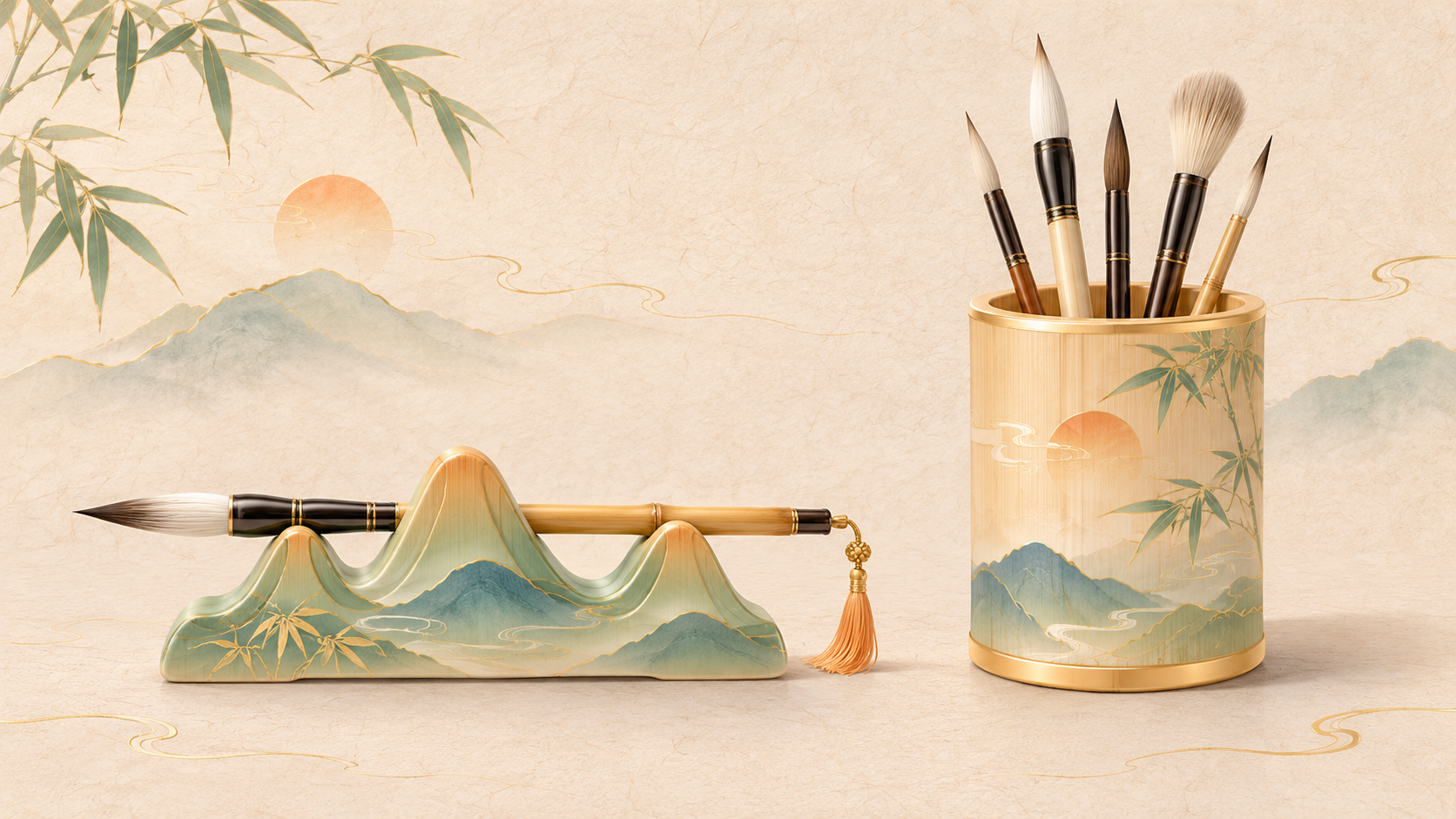
A pen stand — often called a brush rest, and usually shaped like a mountain ridge or a small bridge — is a resting surface. Its job is to hold a wet brush horizontally so the tip does not touch the desk, smudge a page or drip ink. The brush is placed on the stand between strokes and lifted off again; the stand is not storage.
A pen holder is upright storage. Pens, brushes or tools are dropped into it and stay there for the day or the session. The pen holder is the subject of our companion article, What Should Buyers Check in Bamboo Pen Holders?, which covers the storage SKU in detail. This article covers the other SKU.
That difference drives everything a buyer needs to consider: form, footprint, finish wear, packaging and the use case you are stocking for.
| Dimension | Pen stand (brush rest) | Pen holder |
|---|---|---|
| Primary function | Rests a wet brush without the tip touching the desk | Stores pens upright between uses |
| Typical form | Low, horizontal; mountain-, bridge- or scroll-shaped with a cradle; often 1–3 peaks | Vertical cylinder, square or polygonal cup; open top |
| Placement | Beside the paper or inkstone, within reach of the brush hand | At the edge of the desk or in a pen cup position |
| Buyer use case | Calligraphy gift sets, cultural-creative displays, tea-room and study-set pairings | General desk retail, office gifting, student and stationery assortments |
| Key risk to check | Stability under a brush; cradle width vs brush size | Joint strength; interior finish; base weight |
For a gift retailer, the practical consequence is that a pen stand makes sense after the brush set is on the table; a pen holder makes sense as a standalone desk accessory, independent of calligraphy. If your assortment is built around calligraphy and cultural themes, the pen stand is the more natural anchor. If it is built around general gifting, the pen holder carries the volume.
Style tiers for bamboo pen stands
Pen stands vary enormously in decoration, and the tier you choose should follow the retail price band and the gift context rather than the other way round. A simple way to tier is by the amount of shaping and decoration, not by a fixed price.
Tier 1 — Plain carved rest
A single low arc or mountain profile, clean edges, no added components. Best for entry price bands, bulk gift sets and cultural-creative shops that want a restrained desk piece. The visual focus is the bamboo grain and the form.
Tier 2 — Multi-peak or bridge form
Two or three peaks, a deliberate cradle for the brush, and better shaping of the ends. This is the tier most gift retailers settle on for calligraphy sets: it reads clearly as a brush rest in photography and feels substantial in the hand.
Tier 3 — Decorated or paired form
Pen stands with engraved motifs, a small carved element, or a matched base that can be sold with a pen holder. These are suited to premium gift boxes and to buyers who want a coordinated desk set rather than a single accessory. Expect more inspection time on joins and edges at this tier.
In practice, the tiers separate by process as much as by look. A Tier 1 piece may be carved from a single block, which removes joint inspection from your checklist and leaves sanding and edge rounding as the main checks; confirm with the supplier whether the design is single-block or joined. Tier 2 introduces more shaping — and in some designs, joins — so end symmetry, cradle depth and joint lines enter the inspection list. Tier 3 adds an engraving or assembly step, which is where edge burrs and base alignment most often go wrong. Ask the supplier which processes each tier involves, then weight your incoming inspection accordingly: the higher the tier, the more the retail price band and the gift-box context justify the extra checks.
Across all tiers, ask the supplier for the actual form dimensions and cradle width before committing, because the brush you intend to pair will define whether the rest works. A pen stand that is beautiful but too narrow for the brush in your set is a mismatch at the point of sale.
Sizes: what to confirm per order
Pen stand dimensions vary by design, so treat size as an order-specific confirmation rather than a catalog constant. Before placing an order, ask for:
- Length, width and height of the stand as supplied.
- Cradle width and depth at the resting point — this is the dimension that matters for the brush.
- Base footprint, so you can check it against the presentation box or retail shelf plan.
- Unit weight, relevant for shipping cost and for how the piece feels in the hand.
While the exact figures are order-specific, the relative size trends across styles are stable enough to guide first-round planning. Treat the points below as directional references to confirm per order — not as specifications:
- Single-peak rests are the most compact form. A short, low horizontal piece with the smallest base footprint, they are the easiest to fit into a slim gift box and the lightest to ship in volume.
- Multi-peak and bridge forms run longer end to end. The cradle sits between the peaks, so the same brush capacity needs a longer piece and a wider base footprint — plan for a deeper presentation box and more shelf space.
- Paired or decorated forms are usually the bulkiest. A matched base or carved element adds height and width on top of the rest itself, which matters most for box tooling and freight volumetrics.
- Across all forms, cradle width — not overall length — decides the fit. A long stand with a narrow cradle still fails the brush it was bought for.
Use these trends to shortlist styles and estimate packaging; confirm the actual dimensions with the supplier for each order before locking artwork or box tooling.
If the stand is destined for a gift box with a brush and inkstone, ask for a sample set assembled together. Fit at the box level is easier to judge physically than from a dimension list. Buyers should confirm available dimensions with the supplier for each order.
Bamboo quality and workmanship checklist
Bamboo is a natural material, so no two units are identical, but the checks below are the ones that separate a reliable shipment from a complaint-heavy one. Phrase each as a question to the supplier and ask for photos or samples where it matters.
Surface finish
- Is the surface sanded smooth across the whole piece, including the cradle and the underside?
- Are there visible splinters, raised grain or fill spots, and how are they treated?
- What finish is applied — oil, wax or lacquer — and is it food-safe rated or not? (Relevant because the brush tip and fingers contact the stand.)
Joints and shaping
- For multi-piece stands, how are the parts joined — glue, dowel or a single carved block?
- Are joints tight and flush, with no visible gaps or excess adhesive?
- Are the peaks and edges rounded consistently, so the piece does not feel sharp?
Stability
- Does the base sit flat without rocking on a level surface?
- Does the stand stay in place when a brush is placed on it, or does it tip?
- Is the base wide enough for the brush length you intend to pair?
Scent and coating
- Does the finished piece have a strong smell, and if so from the bamboo or the finish?
- Is the coating fully cured before packing?
- Is there any residue or tackiness on the surface?
These are inspection questions, not pass/fail thresholds. The answers tell you whether the supplier's process is under control and whether the finish is appropriate for a gift item that may sit on a desk near paper and hands.
MOQ structure when the two SKUs share a collection
MOQ is set per order and per supplier, but the structural principles are fairly consistent:
- Separate the two SKUs in the quotation. Ask for the pen stand and the pen holder to be priced and MOQ'd individually, even if you intend to buy both. This preserves flexibility if one item sells faster.
- Ask whether MOQ can be met across a mixed style tier. Some suppliers will accept a combined quantity across two or three pen stand forms; others will not. Clarify before you build a plan around it.
- Check whether a gift-box version carries its own MOQ. If the pen stand is packed into a set with a brush and inkstone, the set may have a separate minimum from the loose piece.
- Ask how samples are handled. A pre-production sample is the only reliable way to check cradle width, finish and stability before a bulk order.
Pairing pen stands into gift-ready desk sets
The pen stand's natural home is inside a themed gift set. It sits beside the inkstone and brush and completes the calligraphy narrative. If you are building such a set, a program such as the Complete Scholar Desk Set — ink stick, inkstone, brush and Xuan paper in a custom presentation box — shows the type of gift-ready desk program a pen stand can complement. The custom presentation box is the point: it gives you a place to fix the stand's footprint and to present the two items as one idea.
For the storage side of the same collection, pair the pen stand with a bamboo pen holder and let the two share a finish and grain direction. Buyers building a broader assortment can review the product catalog for matched bamboo desk pieces.
FAQ
Can a bamboo pen stand be used as a pen holder?
Not practically. A pen stand is a horizontal rest with a shallow cradle; it has no upright cavity to store pens. Using it as a holder risks the pens rolling off and defeats its purpose of keeping a wet brush off the desk.
What brush size suits a mountain-shaped pen stand?
It depends on the cradle width and depth of the specific stand. There is no universal match — confirm the cradle dimensions with the supplier and test with the brush you plan to pair.
Do I need both SKUs in my assortment?
Only if your customers buy calligraphy or cultural gift sets and general desk accessories. A pen stand supports the calligraphy story; a pen holder supports everyday desk retail. Many gift retailers stock both, but the quantities should follow the two separate demand patterns.
How should I check bamboo quality on arrival?
Inspect for rocking on a flat surface, run a hand over the cradle and edges for splinters, check joints for gaps, and confirm there is no strong finish smell. Compare against the approved sample.