
A practical sourcing guide for buyers of oversized Chinese calligraphy brushes, covering size/spec structure, handle and hair construction, export packing, and supplier evaluation—with reference to Gu Mo Craft Technology's Large Format Calligraphy Brush.
When you need a large Chinese calligraphy brush for a stage performance, an exhibition piece, or temple writing, the sourcing criteria are different from standard brushes. You're not just buying a tool—you're buying a tool that must perform consistently at scale, survive shipping, and meet the expectations of artists, curators, or religious communities.
This guide walks through what to specify, how to evaluate construction quality, and what to check before placing a bulk order for oversized brushes.
In this guide
Size and specification: what “oversized” actually means
In calligraphy supply catalogs, terms like “giant,” “big,” and “extra large” are marketing labels, not standardized sizes. For B2B sourcing, you need dimensions that can be verified and compared across suppliers.
Key measurements to request for any oversized brush:
- Total length (including handle and ferrule)
- Handle length and diameter
- Tip width at the base (the widest point of the hair bundle)
- Hair length (from ferrule to tip)
- Weight—a very large brush can be surprisingly heavy; verify it's suitable for the user
For reference, one configuration used for large-format work is the Large Format Calligraphy Brush from Gu Mo Craft Technology. It has a 35 cm lacquered wood handle and a tip width of 3–5 cm at the base. This is a practical size for floor-standing performance writing or large scroll pieces. If you need something bigger, you'll need to discuss custom dimensions with the supplier.
Handle and hair construction: what to inspect
An oversized brush is only as good as its two main components: the handle and the hair bundle. Both must be built for the stress of large, sweeping strokes.
Handle
For a large brush, the handle must be straight, stable, and comfortable to grip for extended periods. Look for:
- Wood quality: dense, straight-grained wood resists warping.
- Lacquer finish: a reinforced lacquer protects the wood from moisture and provides a smooth grip.
- Balance: the weight distribution should feel natural, not handle-heavy or tip-heavy.
Gu Mo's Large Format brush uses a reinforced lacquered wood handle. The lacquer is not just cosmetic—it seals the wood and makes the handle easier to clean after ink exposure.
Hair bundle
The hair is what holds the ink and shapes the stroke. For oversized brushes, the hair bundle must be dense and evenly packed to hold its shape when wet.
- Blend: a goat and horse hair blend is common for large brushes. Goat hair is soft and absorbent; horse hair adds stiffness and spring. The ratio affects how the brush behaves.
- Dense packing: the hair should be packed tightly at the base so the brush doesn't splay or lose its point during use.
- Consistency: for a batch, hair length and texture should be consistent. Uneven hair leads to unpredictable strokes.
Gu Mo's Large Format brush is made with a goat and horse hair blend, dense-packed for stability. They also test stroke width consistency and provide handle stress test documentation—useful evidence for buyers who need assurance that the brush can handle repeated large strokes without the handle snapping or the hair loosening.
Performance and display: matching the brush to the use
The same oversized brush may serve three different buyers, and each has different priorities:
Performance calligraphy
For stage performances or demonstrations, the brush must be reliable. The artist needs:
- Good ink flow and release
- Consistent stroke width across multiple characters
- A handle that doesn't slip when wet
Ask the supplier if they test stroke width consistency. If they do, request the test method and results. This is more useful than a generic “quality” claim.
Display and exhibition
For display, the visual impact matters most. The brush should look impressive—long, substantial, and well-crafted. But it also needs to be structurally sound if it will be handled or moved. Check:
- Overall aesthetics: the lacquer finish, the hair color, the ferrule (if any)
- Stability when standing upright (if displayed that way)
- Packaging for transport to the exhibition site
Temple and religious writing
Temple writing often involves large characters on paper or fabric, sometimes for banners or ceremonial pieces. The brush must be able to hold a large amount of ink and release it evenly. Dense packing and a good hair blend are critical. Also consider the handle length: a longer handle may be needed for writing on the floor or on a high surface.
Export packing: getting oversized brushes to you intact
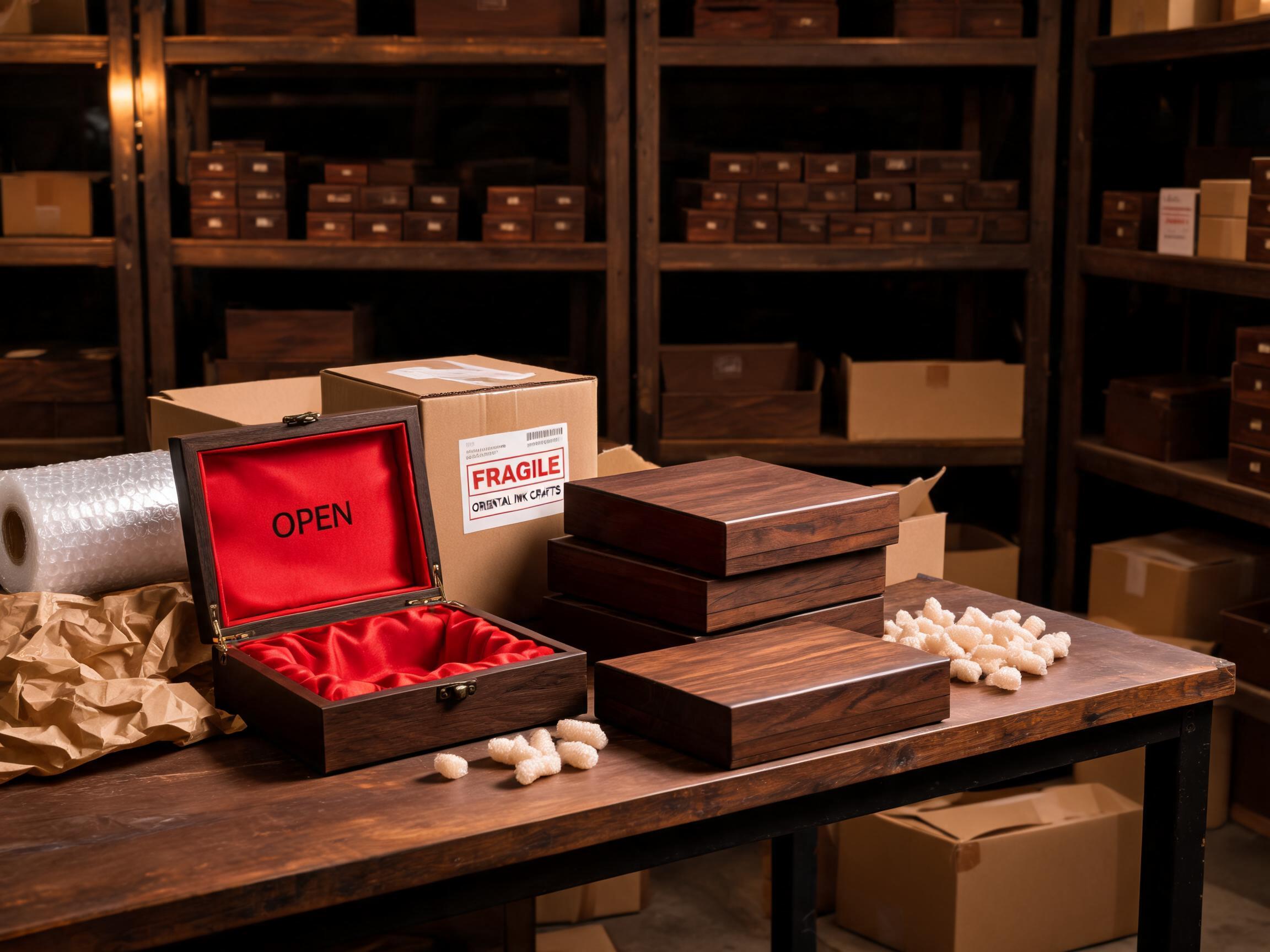
Oversized brushes are fragile items. A 35 cm handle can snap if the carton is dropped or crushed. The hair bundle can be deformed if it's compressed. Proper export packing is not an afterthought—it's part of the product.
What to ask your supplier about packing:
- Carton strength: what weight and stacking load can the carton handle?
- Internal protection: are brushes individually wrapped or separated by dividers?
- Moisture protection: is a desiccant or moisture barrier included? (Wood and hair can be affected by humidity during sea freight.)
- Labeling: are cartons marked “FRAGILE” and with handling icons?
Gu Mo Craft Technology offers an export packing and carton plan service. They can design a packing solution for your specific order and provide a buyer approval document set, so you know exactly what's being shipped and how. This is especially valuable for large orders where damage in transit would be costly.
Supplier evaluation checklist
Before placing a bulk order for oversized brushes, verify these points with the supplier:
| Checkpoint | What to confirm |
|---|---|
| Specifications | Exact dimensions (handle length, tip width, hair length, total length) and weight |
| Materials | Hair blend ratio, wood type, lacquer type |
| Quality control | Are there tests for stroke width consistency or handle stress? Can they provide documentation? |
| MOQ | What is the minimum order quantity? (Gu Mo's Large Format brush has an MOQ of 50 pcs.) |
| Customization | Can they make a custom handle size or hair blend? Is there a design approval process? |
| Export packing | Do they offer a packing plan? Can they provide a buyer approval document? |
FAQ
What is the difference between a “large” and a “giant” calligraphy brush?
There is no industry standard. Always request specific dimensions. A brush with a 35 cm handle and 3–5 cm tip width is considered large-format; anything bigger would be custom.
Can I get a custom handle length?
Many suppliers, including Gu Mo, offer OEM custom handle size. If you need a longer handle for a specific performance or display, ask about custom options.
How do I know the brush will perform consistently?
Ask the supplier if they test stroke width consistency. If they do, request the test method and results. Also ask about the hair blend and packing density—these affect performance.
What is the MOQ for oversized brushes?
MOQs vary by supplier. Gu Mo's Large Format brush has an MOQ of 50 pcs. For custom sizes, the MOQ may be different.
How should oversized brushes be packed for export?
Each brush should be protected individually, with adequate cushioning in a sturdy carton. Look for suppliers who offer a carton plan and can provide a buyer approval document.
For more information on brush options, see our premium wolf hair brush or bulk calligraphy liquid ink.