
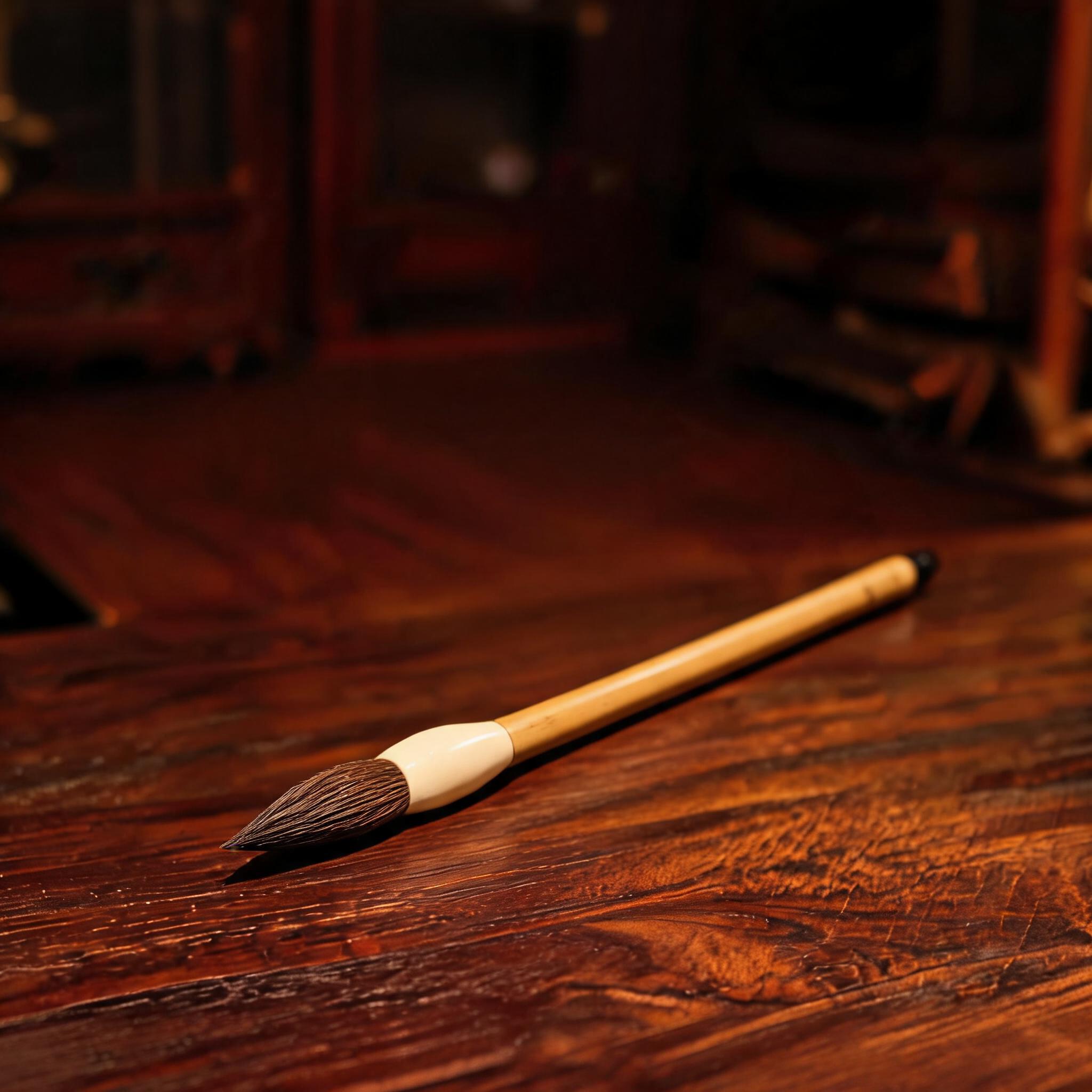
A buying guide for importers supplying Japan and Korea calligraphy channels. It maps hair type and stiffness to script styles, explains mixed-hair brushes and build-quality signals, and gives a ready-to-order assortment recipe by channel tier — with batch QC notes for wholesale.
Buyer's guide · Brush selection
When a buyer asks about a “japanese ink brush,” the useful question behind the search is usually a sourcing one: which specifications separate a brush that suits shodo-style practice from one configured for a different script style, and how should a first assortment be split so it fits both Japanese and Korean calligraphy channels? Hair type and stiffness decide the buy. Everything else — handle, build method, packing — supports that decision.
- Tip stiffness, not country of origin, is the first split: resilient wolf-hair tips suit regular and clerical scripts; soft goat-hair tips suit running and cursive scripts.
- A mixed-hair brush with a controlled 70/30 goat-to-wolf blend is the versatile middle tier for assortments that must cover multiple script styles.
- Build-quality signals to check on samples: bamboo handles, hand-formed or hand-bound heads, length-graded hair, and sealed handles on student sets.
- Stock the assortment by channel tier (classroom, studio, gift), and ask for batch-level performance test reports before confirming a wholesale order.
Why hair type and stiffness decide the buy
An ink brush is a spring that stores and releases ink through its point. Hair stiffness changes how much the tip resists pressure and how quickly it returns to shape, which in turn changes the kind of line the writer can produce. Buyers evaluating a japanese ink brush for shodo-style practice should therefore sort products by the script styles they serve, not by catalog category alone.
Resilient, stiff tips are the right choice for regular and clerical scripts, where controlled, even strokes and defined endings are the priority. A tip that springs back keeps the line steady through repeated strokes. Soft, absorbent tips suit running and cursive scripts, where the writer wants ink to flow and the line to swell and taper with speed. A soft tip that holds ink well tolerates the longer, connected movements of these styles better than a hard spring.
The practical consequence for an assortment: a channel that serves beginners and formal practice leans stiff; a channel that serves expressive studio work leans soft. Most retail channels need both, plus a middle option.
The three brush families and what each does
Gumo Craftworks supplies three hair families plus a student set. Each is configured for sumi-e and shodo-style use; the brushes are Chinese-made and specified for these applications. Here is how the families map to the buying decision.
| Family | Hair configuration | Tip character | Script fit |
|---|---|---|---|
| Wolf-hair stiff-tip line | Wolf hair, length-graded | Hand-formed resilient points | Regular and clerical scripts |
| Goat-hair soft-tip line | Goat hair, length-graded; ink absorption tested (supplier-listed) | Soft, absorbent | Running and cursive scripts |
| Mixed-hair combination brush | Precisely controlled 70/30 goat-to-wolf blend (supplier-specified ratio) | Mid-range: resilient core, soft outer response | Multiple script styles |
| Premium wolf-hair line | Wolf hair, resilience-graded; hand-bound head | Selected for resilience consistently | Studio-grade work; gift and premium retail |
| Student practice brush set | 3 synthetic mixed-hair brushes; sealed bamboo handles | Consistent, sealed for classroom handling | Classroom practice |
What the spec variables actually cover
A note on scope: the five variables below are what you can verify and specify on the Chinese-made lines described here. They are also the axis for any comparison with another supplier's brushes, including Japanese brands — run that comparison against their published specifications using the same variables, rather than assuming what a country label implies.
- Hair grading — length-graded hair on the wolf- and goat-hair lines; resilience-graded hair on the premium line.
- Tip formation — hand-formed points on the stiff-tip line versus a hand-bound head on the premium line.
- Blend ratio — the supplier lists a 70/30 goat-to-wolf ratio for the combination brush, held to that stated ratio.
- Ink absorption — listed as tested on the goat-hair line; ask for the test description when sampling.
- Handle construction — bamboo throughout, with a 25 cm carved-grip handle on the premium line.
Lock these five variables in your brief and supplier comparison becomes a checklist you can actually run, rather than a guess about what “Japanese” or “Chinese” means on a label.
The mixed-hair brush as the versatile middle tier
A pure stiff tip and a pure soft tip each commit the buyer to one script direction. The mixed-hair combination brush reduces that commitment: its 70/30 goat-to-wolf blend is held to the supplier's stated ratio, so the head combines a resilient core with a softer outer response. In an assortment, this is the brush that lets a retailer serve a customer who writes more than one style, and the tier a classroom channel can standardize on when a single SKU must stretch across exercises.
A controlled blend matters because an uncontrolled one drifts. If the ratio is not held, two batches of the same SKU can behave differently in the hand, and a retailer ends up fielding inconsistency complaints it cannot explain. When sampling, check whether the feel of the point is consistent across samples from the same batch.
Handle and build quality: what tells you a brush is made to last
Hair gets the attention, but the handle and head construction decide whether a good tip survives handling. Signals worth checking on samples:
- Bamboo handles — the standard handle material across the lines, and the basis for a natural feel and stable grip.
- Hand-formed or hand-bound heads — the wolf-hair stiff-tip line uses hand-formed resilient points; the premium wolf-hair line uses a hand-bound head. These are construction methods the supplier lists, and they are what you are buying at each price tier.
- Length-graded hair — grading the hair by length is how a maker controls the shape of the point and the way the brush loads ink. It appears across the wolf-hair and goat-hair lines.
- Sealed handles on student sets — the student practice brush set uses sealed bamboo handles, a sensible feature where brushes are shared, stored and handled roughly in classrooms.
The premium wolf-hair line adds three features aimed at the top of the range: resilience-graded hair, so the hair is selected for consistent spring; a hand-bound head; and a 25 cm bamboo handle with a carved grip section. It also carries batch-level performance test reports and accepts custom handle engraving — both relevant to gift and premium retail.
Assorting for Japan and Korea: plan by channel tier, not country
Japan and Korea both have active calligraphy practice in schools and studios, and both support gifting and temple or religious calligraphy use. Buyers should plan assortments around channel tier rather than assume country-specific requirements. Where a channel's curriculum or retailer standard imposes a spec, that requirement comes from the buyer, not from a generic rule. Treat the tiers below as a starting recipe to adjust against the buyer's own shelf plan.
| Channel tier | Primary demand | Suggested core SKUs | Supporting SKUs |
|---|---|---|---|
| Classroom / school supply | Repeated practice, shared handling | Student practice brush set (3 synthetic mixed-hair brushes, sealed bamboo handles) | A stiff-tip entry item for formal script exercises |
| Retail / general calligraphy | Customers writing more than one style | Mixed-hair combination brush (70/30 blend) | One stiff-tip and one soft-tip SKU to cover both script directions |
| Studio / premium | Experienced writers; gift and premium retail | Premium wolf-hair line (resilience-graded, hand-bound head, carved-grip bamboo handle) | Goat-hair soft-tip line for expressive work; engraving for gift packs |
| Temple / religious calligraphy | Formal, repeatable stroke work | Wolf-hair stiff-tip line | Mixed-hair brush as a versatile backup SKU |
Batch QC and wholesale terms to settle before ordering
Assortment is the easy half. The harder half is making sure each reorder behaves like the first. The controls below are the ones the premium wolf-hair line documents, and the ones worth requesting across a wholesale order.
- Resilience grading — hair selected for consistent spring, intended to reduce batch-to-batch variation; confirm actual consistency through sample and batch inspection.
- Batch shedding tests — hair loss is the defect that most often reaches the end user; ask what is tested per batch.
- Batch performance test reports — the premium wolf-hair line carries batch-level performance test reports; request the specific test items covered before treating the report as an acceptance basis, and ask whether comparable reports are available for the other lines you order.
- Wholesale sizes and export packing — confirm the order unit, packing configuration and export packing before quoting to your own accounts.
- Custom handle engraving — available for the premium wolf-hair line; relevant to gift packs and retail branding.
The premium wolf-hair line has an MOQ of 100 pieces. If your first order is a mixed assortment, plan the premium SKU as the anchor of the studio/gift tier rather than a broad trial of every configuration.
A short way to specify a first order
State the script styles your channels must serve before naming SKUs. Then build outward: stiff-tip for regular and clerical, soft-tip for running and cursive, mixed-hair for both, premium wolf-hair for studio and gift, student sets for classroom. Confirm the batch controls and export packing against the quantity you intend to order.
FAQ
Does “japanese ink brush” mean a brush made in Japan?
No. The term is used for brushes configured for sumi-e and shodo-style practice. Gumo Craftworks brushes are Chinese-made and specified for these applications.
Which single brush covers the widest range of script styles?
The mixed-hair combination brush, because its precisely controlled 70/30 goat-to-wolf blend combines a resilient core with a softer outer response.
What should a classroom starter order include?
The student practice brush set — 3 synthetic mixed-hair brushes with sealed bamboo handles — plus a stiff-tip entry item for formal script exercises.