
A Japanese calligraphy set looks like one product in a listing but is a merchandising unit on a purchase order. This guide covers what goes in a set, how to grade brushes, ink, inkstones and paper before quoting, how importers bundle entry/gift/premium tiers for the Japan/Korea gift market, and which origin claims need documentation.
A Japanese calligraphy set looks like one product in a listing but is a merchandising unit on a purchase order. This guide covers what goes in a set, how to grade brushes, ink, inkstones and paper before quoting, how importers bundle entry/gift/premium tiers for the Japan/Korea gift market, and which origin claims need documentation.
On a marketplace listing, a Japanese calligraphy set looks like one product. On a purchase order, it is a merchandising unit assembled from components with separate cost drivers, separate failure modes, and separate packing rules. Two boxes that photograph identically can differ in brush hair, ink format, paper sizing, box construction, and the paperwork behind an origin claim. For importers supplying the Japan/Korea gift market — department-store seasonal programs, stationery retail, hobby chains, and corporate gifting — the difference between a set that reorders and one that generates complaints is almost always specification discipline, not the component list itself. This guide covers what normally goes inside a set, how to grade each component before quoting, and how to bundle for gift retail without making claims your documentation cannot support. The examples reference the assortment we manufacture and export: Huizhou ink sticks, liquid inks, handmade inkstones, writing brushes, Xuan paper, and boxed scholar desk sets.
What a Japanese-Style Calligraphy Set Contains
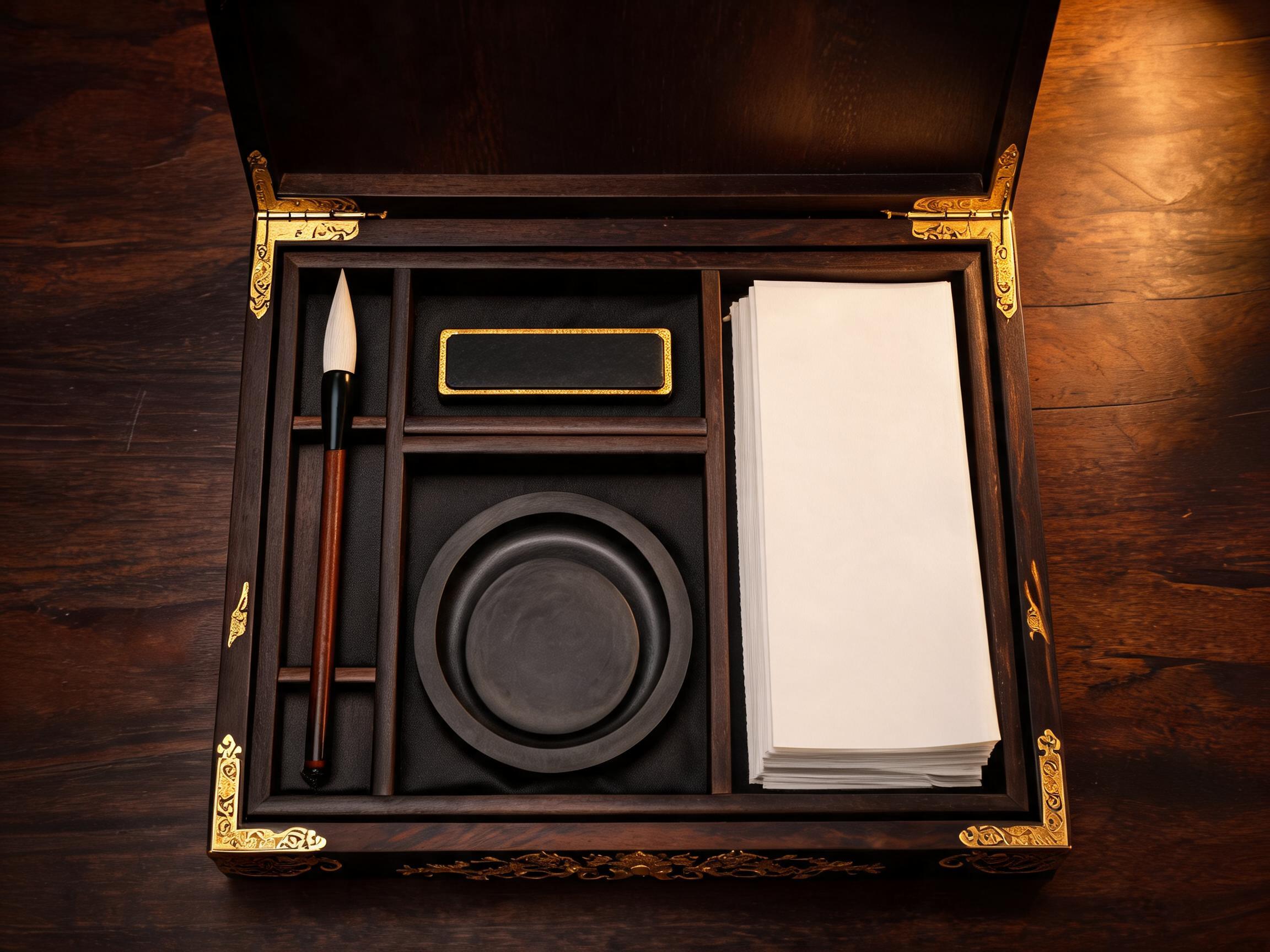
The core category has been stable for a long time: a brush, an ink source, an inkstone, and paper, usually with a felt mat and presentation box around them. Our Complete Scholar Desk Set follows this structure — ink stick, inkstone, brush, and Xuan paper in a custom magnetic-closure presentation box — with set-level quality control matching components before packing, and private-label branding available. What varies most between quotations is not the component count but the grade of each component. A three-piece set built around a well-made brush and correctly sized paper usually outperforms a ten-piece set built around a thin stone and a shedding brush — and it is easier to defend in reviews.
Specification table (Component / What to lock in the specification):
| Component | What to lock in the specification |
|---|---|
| Brush (fude) | Hair type and blend ratio, tip firmness, handle material and length, point recovery after washing. |
| Ink source | Stick (weight, soot type, surface finish) or bottled liquid ink (volume, flow, closure). |
| Inkstone (suzuri-type) | Stone type, grinding surface, size range, protective case for travel formats. |
| Paper | Fibre type, sheet size, raw or treated (sized) surface, sheet count. |
| Box and fittings | Box material and closure, insert fit, printed languages on the insert card. |
Grading the Components Before You Quote
Brushes: the component buyers under-specify most
Brush quality is felt rather than seen, which is why it is the easiest component to quietly downgrade between approved sample and mass production. Ask for the hair blend as written percentages and fibre names, not a marketing label. A goat hair soft-tip brush suits running and cursive scripts; a wolf hair stiff-tip brush suits regular and clerical scripts; a controlled blend splits the difference. Our Mixed Hair Combination Brush, for example, uses a precisely controlled 70/30 goat-to-wolf ratio with layered hair binding and blend-ratio documentation per batch, on a lacquered bamboo handle. Specify the same fields on your set's brush, then test practically: wet the brush, comb it straight, and check shedding and point recovery across several units.
Ink: stick or bottle changes the retail story
An ink stick signals tradition and photographs well in gift boxes; it is also brittle, so specify individual wrapping and a fitted slot that stops movement in transit. Our Hui ink stick line covers student pine-soot practice sticks at 20–50 g, oil-soot classics with a glossy black tone, and commemorative gold-edge sticks at 100–300 g with custom engraving for premium gift programs. Bottled liquid ink suits school, hobby, and everyday retail; our line runs from student-grade bottles to concentrated matte-black archival ink and 1L/5L bulk containers for institutions. If a set includes both a stick and a bottle, say so plainly on the insert card, in the destination language — buyers should never have to guess how the set is used.
Inkstone and paper: where perceived quality is won or lost
Inkstones range from affordable practice stones with a consistent grinding surface to hand-selected Duan inkstones from verified Zhaoqing quarry sources and She inkstones from verified Wuyuan sources; compact travel formats run 8–12 cm with an individual protective case. For gift sets, a lidded or cased stone protects the grinding surface and raises perceived value at modest cost. Paper is the cheapest component and the fastest way to ruin a set. Test it with the ink you actually intend to ship: write a heavy stroke and a light stroke, then check feathering, strike-through, and cockling as the sheet dries. Our Xuan paper range separates raw professional paper (traditional bark fibre, controlled bleed, 69 × 138 cm) from treated paper with controlled sizing for fine-line gongbi work, plus student practice grades and roll formats for large-scale work. Machine-made paper varies between batches, so retain a sample from each production run and compare before the full quantity ships.
How Importers Bundle for the Japan/Korea Gift Market
The two markets reward different bundling logic. In Japan, the box is part of the product: board stiffness, print registration, and a clean insert matter as much as the brush. Seasonal gifting, school-entry occasions, and corporate orders drive demand, and buyers expect tidy compartmentalisation with instructions in Japanese. In Korea, the strongest retail channel is hobby and stationery-led — calligraphy cafés and premium lifestyle shops — where compact starter kits often outsell formal stone-and-stick sets.
Tiering table (Tier / Typical build (from our assortment) / Retail role):
| Tier | Typical build (from our assortment) | Retail role |
|---|---|---|
| Entry | Starter kit with quality-graded components, illustrated usage guide, school-oriented packaging | Impulse, school, café retail |
| Gift | Four-component scholar desk set: ink stick, inkstone, brush, Xuan paper, magnetic-closure presentation box | Seasonal and corporate gifting |
| Premium | Gold-edge commemorative ink stick (100–300 g, custom engraving) with selected Duan inkstone in a luxury gift box | VIP and executive gifting |
Three practical rules apply to every tier. First, spread components so the box does not look half empty — cavity filler is cheaper than a larger carton. Second, watch weight: an inkstone can double a carton's chargeable weight, so compare landed cost per set rather than FOB per set. Third, plan component replenishment: paper, ink, and brushes should be orderable separately, because repeat purchase is where the margin sits.
Quantities, Lead Time and Documentation
For planning purposes: our four-component scholar desk set has a minimum order of 30 sets with a lead time of 35–50 days after sample approval; brush SKUs typically start at 100 pieces and Xuan paper at 200 sheets. Before approving a sample, request a component-level bill of materials listing each item's dimensions, weight, material, and carton packing ratio, plus the languages printed on the insert card. Our export documentation set — sample photos, spec sheets, and buyer approval records — is prepared for sign-off before mass production, and inline quality checks run at each production stage.
Claim Hygiene: "Japanese-Style" Is Not "Made in Japan"
If a set is described as a Japanese calligraphy set, clarify whether that describes the style, the component origin, or the place of assembly — these are three different claims, and only one of them may be supportable. "Japanese-style" is a design description; a made-in-Japan claim requires per-component documentation. Align the listing language with what the factory can actually evidence before the first shipment, and confirm destination labeling requirements with your compliance adviser rather than assuming from a previous order.
Requesting a Quote
Send your target tier, box format, destination market, and annual volume, and ask for a component-level quotation with a packed sample box shipped by your intended method. A supplier who answers at that level of detail is usually the one worth a second order.