
A collector-channel guide to jade inkstone sourcing: what the term covers in trade practice, material identification gates, carving checks that survive shipping, Duan and She stone certificates, and gift-set pairing with branded hardwood boxes.
Buyers searching for a jade inkstone for gift or collector programs often find that the term covers several products: genuine carved jade, serpentine and other green stones sold as "jade", and fine-grain carving stones such as Duan and She that occupy the same gift-and-collector shelf space. If you are sourcing inkstones for Japan, Korea or Chinese-community retail channels, the useful question is not "is it jade?" but "what stone is it, can the supplier prove it, and will the carving survive shipping and handling?" This article walks through the material-identification gate, the carving checks and gift-set pairing for collector channels.
What Buyers Mean by "Jade Inkstone"
In trade enquiries, "jade inkstone" usually means one of three things: an inkstone carved from jade or jade-like material (nephrite, jadeite, or serpentine marketed as "new jade" or "Xinjiang jade"); a decorative display inkstone in a green-coloured stone, regardless of mineralogy; or a collector inkstone from a traditional carving-stone family — Duan or She — which buyers sometimes lump into the same category because both are premium carved-stone gift items.
The distinction matters commercially. Serpentine is softer and cheaper than jade, and green stones of several mineral families are sold under jade names. A buyer who specifies "jade" without requiring material identification risks paying jade prices for serpentine goods, or receiving goods that fail collector-channel expectations. The same logic applies in reverse: a Duan or She inkstone sold honestly as carved natural stone can be a stronger collector product than an unidentified green stone, because those stones have documented quarry origins and established grading traditions.
Why Material Identification Is the First Gate
Whatever stone is specified, material identification should be the first checkpoint. For jade-family stones, require the supplier to state the mineral family (nephrite, jadeite, serpentine, or other), the treatment status (dyed, resin-filled, or untreated), and to provide documentation — a material certificate per shipment or per piece for high-value items. If a supplier cannot state mineralogy in writing, that is the answer.
For traditional carving stones, the equivalent gate is quarry origin. Duan stone is quarried around Zhaoqing in Guangdong; She stone comes from the Wuyuan area. Because both names are used loosely in the market, require origin documentation tied to verified quarry sources, not just the word "Duan" or "She" on an invoice.
Our listed specs reflect this. The Classic Duan Inkstone (GMO-INK-001) is specified as natural Duan stone from verified Zhaoqing quarry sources with a grain grading certificate per shipment. The She Inkstone Premium (GMO-INK-002) is specified as natural She stone from verified Wuyuan quarry sources with an origin certificate included. These are listed supplier specifications, not independently verified test results — review the certificates at sample stage and confirm what the per-shipment documentation covers.
How Fine-Grain Carving Stones Are Checked
The grading logic for Duan and She stone shows what "graded" should mean in a purchase order, even if you pursue jade. Fine-grain carving stones are assessed on grain fineness and consistency (which affects the grinding surface and the carving detail the stone can hold), on natural pattern and colouration (which drives collector value in Duan stone especially), and on structural soundness — no cracks, fissures or inclusions that will open during carving or transport. Grain selection is typically done by hand at the raw-material stage, which is why the inspection checkpoint sits at material verification, before any carving investment is made.
Structural checking matters for functional and decorative pieces alike: a hairline fissure invisible at packing can propagate under temperature change or impact in a shipping container. For the She line, our listed spec includes structural integrity tested per stone; for the carved line, inspection happens against carving proofs before finishing. Buyers evaluating jade should ask for the equivalent: per-piece checking for fissures and fill, since filler can mask internal flaws.
Carving Checks That Decide Whether an Inkstone Survives
Carving quality is the second gate, and it is where display inkstones fail in transit or disappoint on arrival. The checks below apply to any carved stone — jade, serpentine, Duan or She.
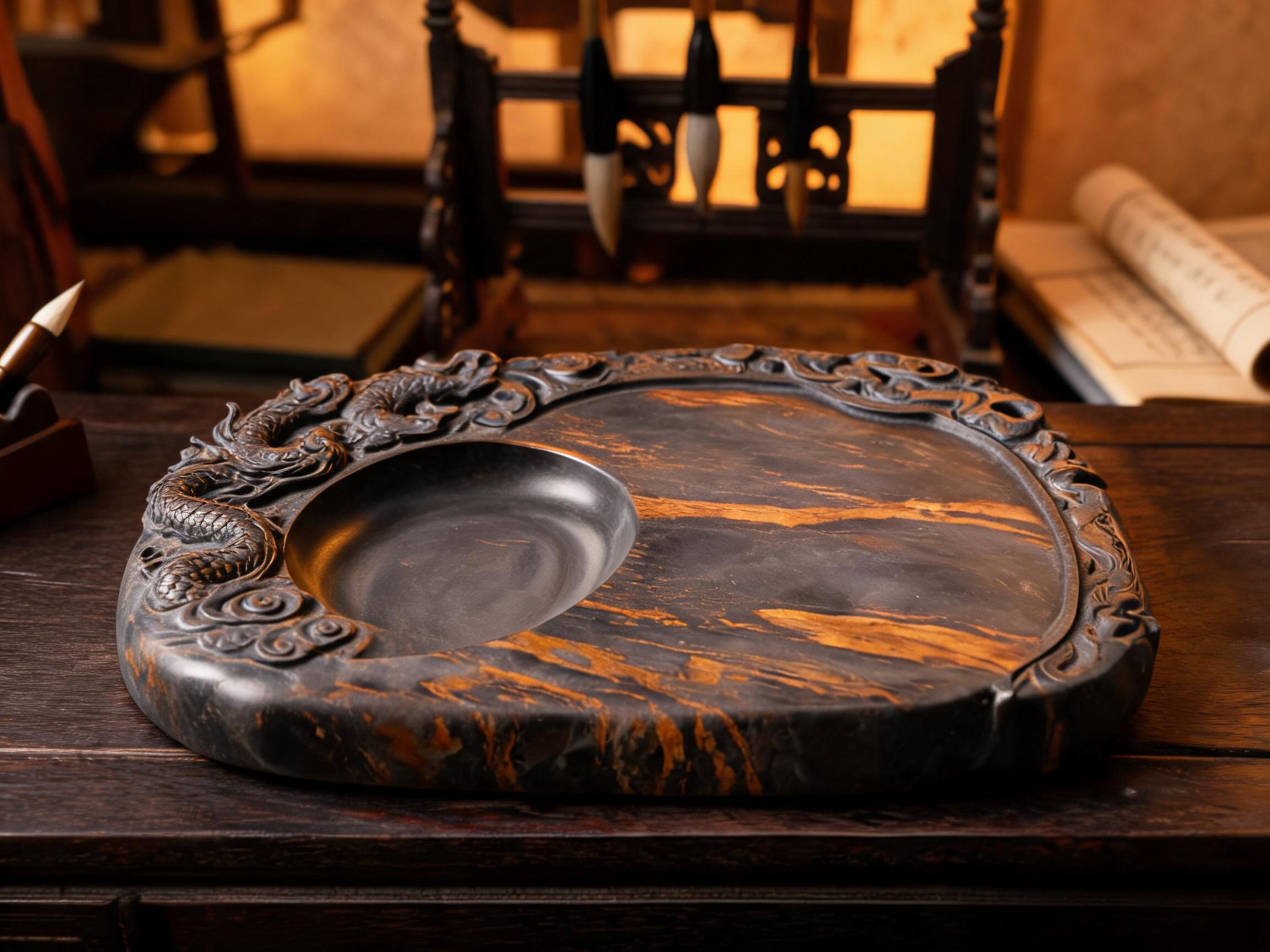
Relief depth versus stone thickness. Deep relief carving creates structural thin spots. The image below shows a deep-relief dragon carving around the ink well: visually strong, but exactly the kind of work that needs a per-piece check for thin walls and fissures near the carved edges. Ask how the supplier balances carving depth against remaining wall thickness.
Finish grading at edges and details. Chisel marks at fine details, uneven polishing on the grinding surface, and rough carved edges are the defects that end up as customer returns. A documented finish-grading checkpoint at the end of production — against an approved proof, not a verbal standard — catches these consistently across a bulk order.
Carving proof approval before mass production. For carved programs, the sequence matters: sample photos and carving proofs approved by the buyer, with spec sheets and approval records on file, before mass production starts. Because wrong stone or wrong carving entering production is costly, our process also includes documented inline QC checkpoints at each stage — material verification, pattern checks, finish grading — plus export-ready packing, carton marks and shipment documentation. The buyer's leverage sits at sample stage: approve the stone, the carving proof and the packaging insert together, and mass production runs against that record. Our carved line is specified this way — the Carved Decorative Inkstone (GMO-INK-004) includes carving proof samples provided, individually numbered pieces with a certificate of authenticity, and collectible valuation documentation, at an MOQ of 20 pcs.
Packaging engineered for stone. Carved stone fails in shipping more often from packaging than from carving. Reinforced foam inserts cut to the piece, and presentation boxes that immobilise the stone, are spec items, not extras. The Classic Duan line lists reinforced foam-insert packaging as standard; confirm insert design at sample stage for any carved program.
Comparing the Three Collector Inkstone Lines
The table below summarises our listed specs for the three collector inkstone SKUs, as a worked example of how to lay out a carved-stone program on paper:
| Spec | Classic Duan (GMO-INK-001) | She Premium (GMO-INK-002) | Carved Decorative (GMO-INK-004) |
|---|---|---|---|
| Material | Natural Duan stone, verified Zhaoqing quarry sources | Natural She stone, verified Wuyuan quarry sources | Premium Duan stone, fine grain |
| Size range | 15–25 cm length | 12–22 cm length | 18–30 cm length |
| Surface | Hand-polished natural pattern finish | Fine grain for smooth grinding | Hand-carved decorative patterns |
| Documentation | Grain grading certificate per shipment | Origin certificate included | Numbered piece, certificate of authenticity, collectible valuation documentation |
| Customisation | Custom engraving | Custom presentation box | Carving proofs; premium gift box with branding |
| MOQ | 50 pcs | 50 pcs | 20 pcs |
Note what each column makes verifiable: origin is tied to a certificate, grain is graded rather than claimed, and the carved line carries piece-level numbering. If you are evaluating a jade inkstone program elsewhere, this is the shape of the spec sheet you should demand — adapted to include mineralogy and treatment status.
Gift-Set Pairing for Collector Channels
Collector and corporate-gift channels rarely sell an inkstone alone. The pairing decisions that matter:
Box construction and branding. For VIP corporate gifting and cultural programs, we list a Premium Craft Gift Box (GMO-CO-005) with hardwood construction, magnetic closure and custom branding. Hardwood with a fitted insert protects the stone better than folding cartons and presents well unopened — which matters in gift retail where the box is part of the perceived value.
Set composition. An inkstone pairs naturally with ink sticks, brushes and paper as a Four Treasures set, or stands alone as a carved collectible. Museum and collector shops tend to favour numbered carved pieces with certificates; corporate programs tend to favour complete sets in a branded box. State composition, box and documentation in the order spec.
Documentation as part of the gift. Certificates of authenticity, origin certificates and valuation documentation are not just QC paperwork — in collector channels they are displayed with the product. Confirm whether certificates are printed in the destination market's language and whether numbering is sequential per shipment.
Requesting Quotes and Samples
If you are building a collector or corporate-gift inkstone program, we invite you to request a quote and sample proposals for the Classic Duan Inkstone, the She Inkstone Premium, or the numbered Carved Decorative Inkstone with the Premium Craft Gift Box pairing. Reviewing a sample with its certificate and packaging insert is the fastest way to judge whether a carved-stone program will hold up in your channel.