
A plain explanation of what Chinese calligraphy ink sticks are made of, how gold-edge commemorative ink differs from everyday practice ink, and the checks a B2B buyer should run before ordering — decoration, engraving, packaging and customization.
Ink Composition & Sourcing
If you buy for a gift retailer, a cultural institution, a temple shop or a collector market, the question behind "what is calligraphy ink made of" is rarely academic. You need to know what the ink actually is, why a gold-edge commemorative stick is positioned differently from a practice stick, and which details to verify before placing an order overseas.
Key takeaways
- Traditional Chinese ink sticks are built on two components: soot as the colourant, and animal glue as the binder.
- The stick is not used as it is: it is ground on an inkstone with water until the ink reaches the density the writer wants.
- Gold-edge commemorative sticks belong to the gifting and collection category — evaluate them on decoration, engraving and packaging, not on vague descriptions of "premium ink".
What Chinese calligraphy ink is made of
Chinese calligraphy ink in stick form is a solid manufactured object, not a liquid in a bottle. Two materials carry the whole structure:
- Soot — the pigment. Soot is collected from burning oils, woods or other carbon-rich materials. Its fineness and uniformity determine how the ink behaves on paper: a finer, more even soot fraction generally produces a cleaner black and a smoother flow.
- Animal glue — the binder. Glue holds the soot particles together so the stick can be moulded, dried and handled without crumbling, and it affects how the ink releases from the inkstone and adheres to paper.
Small amounts of additional ingredients may adjust working properties, help the stick resist mould in storage, or carry a scent. The manufacturing sequence is simple to describe without factory specifics: soot and glue are combined into a workable mass, kneaded, pressed into moulds, and dried slowly — a stage where control matters, because a stick that dries too fast can crack or warp.
How the stick becomes ink
A traditional ink stick is not dissolved like a tablet. The user places a small amount of water on an inkstone and grinds the stick against the stone in a circular motion; the abrasive surface wears off fine particles that disperse into the water. More grinding and less water give a dense, dark ink; lighter grinding gives a thinner ink for fine lines and washes. Bottled liquid ink exists as a convenience alternative for practice and teaching, but for gift, cultural and collector markets the stick is usually the product being requested — it is a physical object that can be presented, engraved and collected.
Why gold-edge commemorative ink sticks are a different category
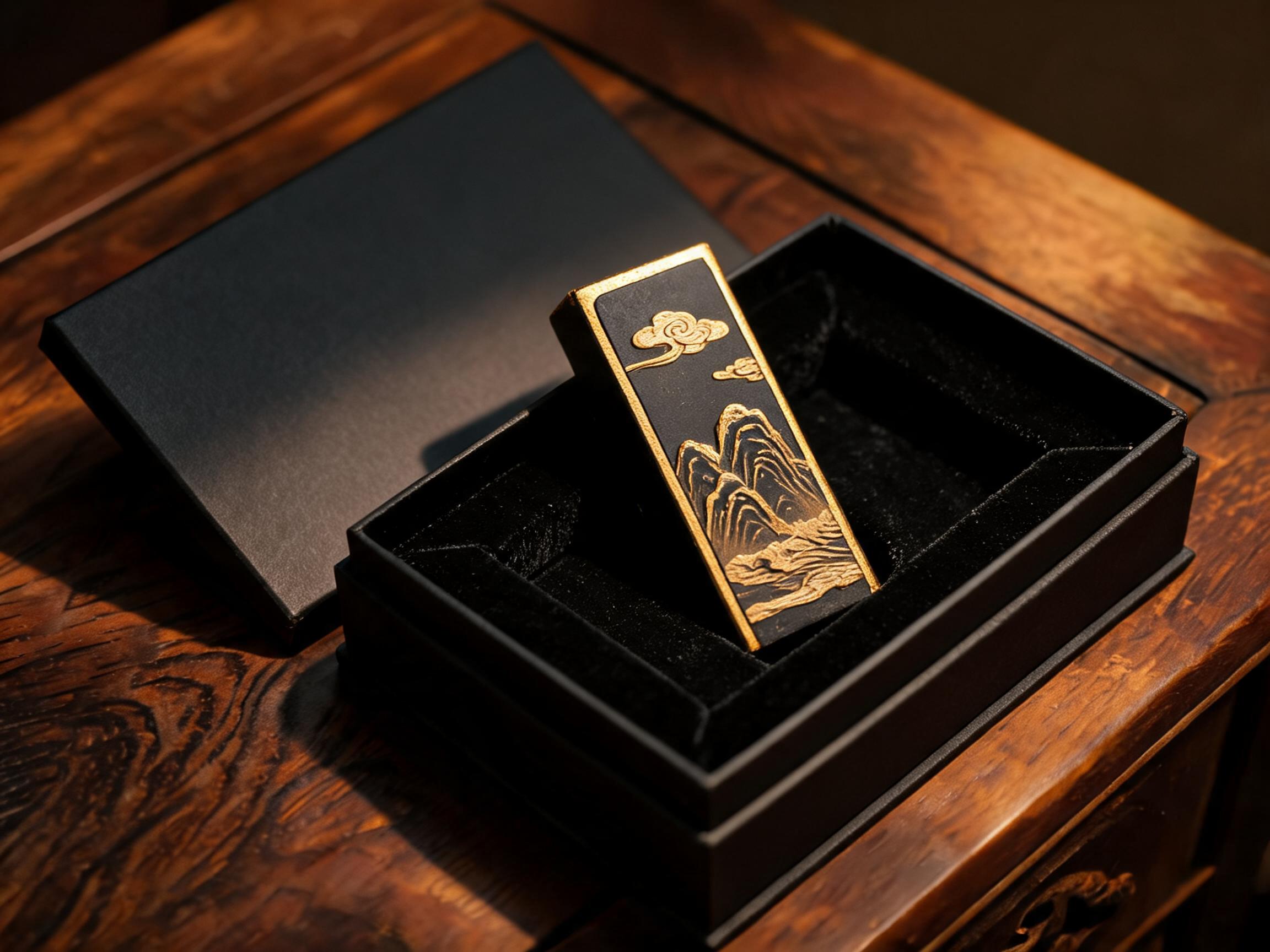
A gold-edge commemorative Hui ink stick sits at the intersection of a traditional ink stick and a presentation object. The ink-making logic above still applies, but the end use is gifting, display or collection, so the evaluation criteria shift to the presentation layer: the gold-edge decoration that gives the piece its character in a gift box or display case, and the engraving where the buyer's own content enters the product — an institution name, an anniversary line, a corporate mark, or a commemorative text.
This is why a question like "how much gold is in it" is usually the wrong starting point. When the gold appears as edge decoration, what matters is whether the decoration is cleanly applied, whether the engraved lines are sharp and legible, and whether the finished piece survives packing and shipping. For a concrete example of this positioning, the Commemorative Gold-Edge Hui Ink Stick (SKU GMO-HIS-004) is built as a premium commemorative Hui ink stick with gold-edge decoration and custom engraving, intended for corporate gifting and cultural institution programs.
Grades you will encounter when buying
Grading in this product family is not a single universal scale; in practice you will see tiers defined by use case and presentation level. Separate them before comparing quotations:
| Tier | Primary use | What buyers should focus on |
|---|---|---|
| Practice / student grade | Daily brush practice, classrooms, volume use | Consistency across the batch, clean grinding behaviour, cost per unit |
| General writing / studio grade | Regular calligraphy and painting work | Ink density when ground, even release, no grit or hard spots |
| Commemorative / gift grade | Corporate gifting, institutional programs, ceremonies | Decoration quality, engraving legibility, box quality, presentation consistency across units |
| Collector / display grade | Collector markets, cultural display, limited presentations | Mould detail, surface finish, integrity of decorative elements, packaging that protects the piece |
The commemorative and collector tiers are graded largely on presentation and repeatability, not only on the ink. A single perfect sample is not enough for a corporate gift program — every unit in the run has to look the same when the boxes are opened side by side.
Buyer verification checklist
The checks that decide whether a commemorative ink order is usable group into four areas.
Decoration quality
- Is the gold-edge decoration evenly applied, without gaps or bleeding over edges, and bonded so it does not flake or rub off in handling?
- Does the decoration read as clean and intentional from piece to piece under normal display lighting?
Engraving
- Are engraved lines sharp and legible at the size the product will actually be viewed, with depth consistent across a sample set?
- Does the engraved content match the approved artwork exactly — characters, spacing, order, punctuation?
Packaging
- Does the box or case hold the stick securely, with no movement that could cause chipping or edge damage in transit?
- Is the presentation suitable for the end recipient, and can it carry your own branding or insert if the program requires it?
Customization capability
- Can the supplier work from your text or artwork, show the layout before production, and offer sign-off on artwork and a physical sample before the full run?
- Is there a defined correction step before mass production if a detail is wrong?
When requesting quotations, ask every supplier for the same information — decoration method, engraving specification, packaging format, customization workflow and approval steps — so the offers can be compared. Guangdong Gumo Crafts Technology Co., Ltd. is a design, manufacturing, quality-control and export operation in this product family, so these questions can be addressed as part of the quotation and sampling process rather than after the order.
Handling and storage
Buyers searching for "how long does calligraphy ink last" usually want a number, but shelf life depends on storage conditions rather than a fixed duration. Ink sticks are sensitive to moisture: keep them dry and sealed, and avoid humid environments where the stick can soften, develop surface mould or lose the crispness of its decorated surface. For gift and institutional programs this becomes a packaging requirement — the box should protect the stick from handling and ambient moisture during shipping and storage — and if there is a long interval between delivery and the gifting date, ask the supplier how the pieces are packed for that interval. Grinding behaviour is a separate matter: a stick that has absorbed moisture may behave differently on the stone, another reason to keep presentation stock dry and sealed until it is used or displayed.
FAQ
What is calligraphy ink made of?
Traditional Chinese ink sticks are made of soot as the pigment, bound with animal glue; small amounts of additional ingredients may adjust working properties, improve storage resistance or add scent. The solid stick is ground with water on an inkstone to produce usable ink.
How is stick ink different from bottled ink?
The material basis is the same soot-and-glue system, but a stick is a solid object whose density the user controls by grinding, while bottled ink is a prepared liquid that is faster to use and common for practice and teaching.
Where can I buy calligraphy ink for a corporate gifting program?
Buy from a supplier that manufactures the presentation product — decoration, engraving and packaging as part of production — rather than a general stationery reseller. Request a physical sample with your own engraved content before committing to a full run, and confirm the artwork approval step in writing.
Is gold-edge decoration the same as gold content?
No. Gold-edge decoration refers to the decorative treatment applied to the stick's appearance. Assess the application quality of the decoration and the finish of the engraved details, and ask the supplier to state exactly what the decoration is.