A practical buyer's guide to sourcing Chinese soapstone seals (篆刻印章): how soapstone compares with other seal stones, the two main carving styles (zhuwen/baiwen), custom engraving options for gift programs, packaging considerations for gift channels, and a supplier evaluation checklist.
BUYER GUIDE · GIFT & COLLECTION TRADE
If you are sourcing Chinese soapstone seals (篆刻印章) for gift programs, cultural product retail, or collection channels, most of what you need to evaluate is in the stone, the carving, and the engraving workflow. This guide walks through the decisions in the order you will face them: choosing soapstone over other seal stones, understanding the two carving styles, specifying custom engraving, planning packaging for gift channels, and finally how to assess a supplier.
- Soapstone is the traditional default for name seals because it is soft enough for hand carving yet holds fine detail; harder stones change the carving economics and design possibilities.
- Two carving styles matter commercially: zhuwen (characters in red) and baiwen (characters in white). Your market and use case should drive the choice, not personal preference.
- Custom engraving is a service agreement, not a product spec. Confirm the workflow for sending names in Latin, Japanese kana, Korean Hangul, or Arabic script, and how proofs are handled.
- Gift channel packaging is a separate line item. Plan for presentation boxes, protective inserts, and language-specific instruction cards.
- Evaluate the supplier on carving consistency, stone quality control, engraving accuracy, and packaging reliability — not just on the sample you receive.
Soapstone vs. Other Seal Stones: What Changes for Your Order
Seal stones are not interchangeable. The material determines the carving method, the level of detail possible, the durability of the finished seal, and the price point you can offer your customers. For a buyer planning a product line, the differences are not academic — they change your cost structure and your quality control.
| Stone Type | Hardness & Carving | Typical Use | Buyer Consideration |
|---|---|---|---|
| Soapstone (e.g., Shoushan, Balin, Qingtian) | Soft (Mohs 1–2.5), hand-carved with ease, holds fine lines | Name seals, personal stamps, gift sets, beginner-to-mid collection | Best balance of detail, carving cost, and tradition. The default for most gift and retail programs. |
| Chicken-blood stone (Changhua) | Softer, prized for red inclusions | High-end collection pieces | Pricing is driven by the red color saturation and size. Not a gift-channel staple. |
| Jade / hard stones | Hard (Mohs 6–7), machine or diamond-tool carving | Commemorative pieces, high-value gifts | Higher material cost, slower production, and limited fine detail. Usually a separate product tier. |
| Wood / horn | Soft, easy to carve | Budget-friendly seals, beginner sets | Lower perceived value; suitable for promotional items but not for serious gift or collection lines. |
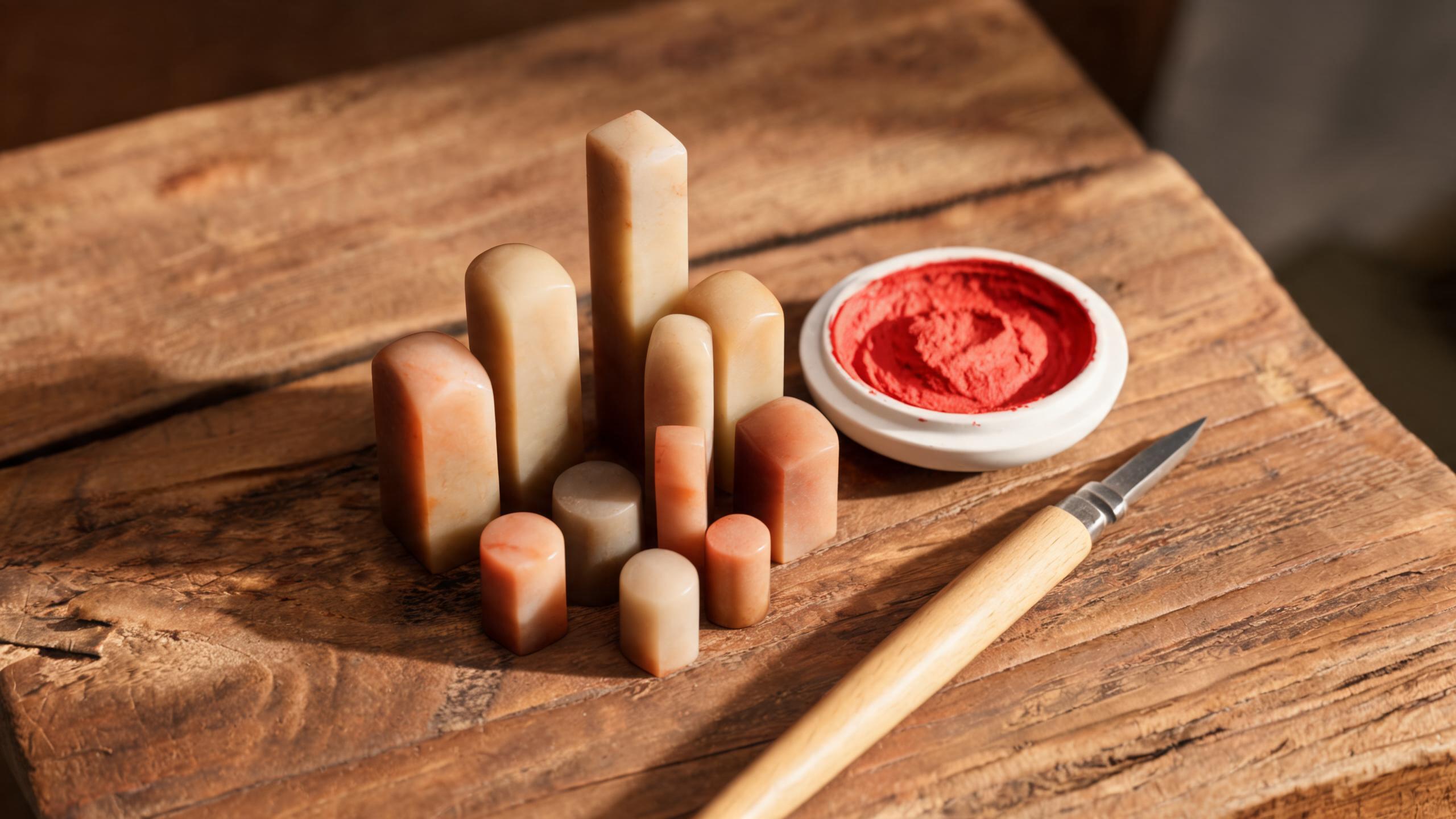
For most importers building a gift or collection assortment, soapstone is the practical starting point. It is the material most associated with the Chinese seal tradition, it carves cleanly enough for consistent quality across a batch, and it offers a range of natural color variations (white, yellow, green, red, brown) that give your catalog visual variety without custom dyeing. If you are unsure which stone family fits your target price points, ask the supplier to show you the range within soapstone first — the spread within one material is often wider than the spread between materials.
Carving Styles: Zhuwen vs. Baiwen and What Your Market Expects
Every Chinese seal is carved in one of two styles. This is not a decorative choice; it affects how the seal impression reads, which markets prefer which style, and how you should describe the product in your catalog.
- Zhuwen (朱文, "red characters"): The characters are cut in relief, so they print in red when stamped. The background is carved away. This style is common for name seals and is often chosen for its bold, clear impression.
- Baiwen (白文, "white characters"): The characters are cut into the stone, so they appear white (the paper color) when stamped, with red surrounding them. This is the older style and is frequently used for official or formal seals.
For gift and collection buyers, the practical question is which style your end customers expect. In Japan and Korea, where the seal tradition is also strong, buyers often have firm preferences based on the seal's purpose (personal name vs. official use). In Southeast Asia and Chinese communities worldwide, the choice is more often aesthetic. A reliable supplier should be able to produce both styles to the same quality standard, and you should confirm they can do so before placing a mixed order.
Some suppliers will also offer seals with a carved top (a decorative knob, often a lion or other traditional motif) or with side inscriptions. These are value-add options that can justify a higher retail price, but they also add production time. Decide whether your assortment needs plain-top or carved-top seals first, then confirm the supplier's capability and lead time for the carved-top option.
Custom Engraving: The Workflow That Makes or Breaks a Gift Order
Most gift and corporate orders require custom engraving — the buyer's name, a company name, or a short message in the seal face. This is where the supplier's process matters more than the stone quality. A beautiful stone with a poorly executed engraving is a failed product.
Before you commit to a supplier, clarify these points in writing:
- Script support: Can they engrave Latin letters, Japanese kana, Korean Hangul, Arabic script, or only Chinese characters? This is critical for your target markets. Not all carvers are equally skilled with non-Chinese scripts.
- Character layout: For multi-character names, how is the layout decided? Is there a standard grid, or can the buyer specify the arrangement?
- Proofing: Will you receive a digital proof or a physical test impression before the full batch is carved? For a corporate order, this is non-negotiable.
- Error handling: What happens if a character is carved incorrectly? Confirm the replacement or rework policy before ordering, not after a problem arises.
For a traditional craft manufacturer like Gumo Craftworks, which produces seals alongside ink sticks, xuan paper, inkstones, and brushes, custom engraving is part of the standard production workflow. When you send an inquiry, specify the exact text (in the correct script), the number of characters, and the carving style you want. The supplier should come back with a clear confirmation of what will be engraved and how it will be laid out.
Packaging for Gift Channels: It Is a Product Decision, Not an Afterthought
For gift and collection buyers, the packaging is part of the product. A seal that arrives loose in a plastic bag cannot be sold as a gift item, no matter how good the carving is. Plan your packaging requirements in the same way you plan the stone and the engraving.
- Presentation box: Traditional options include wooden boxes, brocade-covered boxes, or paperboard gift boxes. The choice should match your target retail price and market aesthetics.
- Protective insert: Seals are stone; they chip and scratch. The box needs a fitted insert that holds the seal securely during shipping and on the shelf.
- Instruction card: For non-Chinese-speaking end customers, a card explaining the seal's use (how to apply the ink paste, how to stamp, how to clean) adds value and reduces returns from misuse.
- Bulk vs. individual packaging: For corporate orders, you may need both an individual gift box and a bulk shipping carton. Confirm the carton strength and internal protection for international freight.
Ask the supplier for packaging samples alongside the product samples. A supplier who treats packaging as an integral part of the order — rather than as an extra fee — is more likely to deliver a consistent experience for your end customers.
How to Evaluate a Chinese Soapstone Seal Supplier
When you are comparing suppliers, use a checklist that goes beyond the sample you hold in your hand. The sample proves the carver's skill; it does not prove the supplier's consistency, quality control, or reliability across a production batch.
- Ask for batch consistency evidence. Request to see multiple seals from the same production run, not just the single best sample. Check that the carving depth, line width, and stone finish are uniform.
- Verify the stone quality control process. How does the supplier sort stones for cracks, soft spots, or color inconsistencies? Ask what percentage of stones is rejected at incoming inspection.
- Test the engraving accuracy. Send a test name in the script you will actually use (Latin, kana, Hangul, Arabic, etc.) and check the impression carefully. This is the single most important test for gift orders.
- Confirm the packaging and shipping plan. Get a written description of the packaging materials, the carton dimensions, and the protective measures for international shipping.
- Check the product range. A supplier that also produces related scholar's desk items (ink sticks, xuan paper, inkstones, brushes) can consolidate your sourcing and simplify logistics. This is a practical advantage, not just a marketing point.
For a buyer sourcing from a traditional craft manufacturer, the depth of the product line matters. Gumo Craftworks produces not only seals but also ink sticks, xuan paper, inkstones, brushes, and complete scholar's desk sets. This means you can build a coordinated gift collection — a seal paired with an inkstone and a brush, for example — from a single supplier, which simplifies quality control and reduces your vendor management burden.
Frequently Asked Questions from Buyers
What is the minimum order quantity for custom-engraved seals?
This varies by supplier and by the complexity of the engraving. Confirm the MOQ for custom engraving separately from the MOQ for plain seals, as the two may differ. Ask the supplier directly in your inquiry.
Can I get a proof before the full batch is carved?
Most reputable suppliers will provide a digital proof or a physical test impression. Request this explicitly in your inquiry and confirm the proofing process before placing the order.
How should seals be packed for international shipping?
Seals should be individually protected (in a fitted box or wrapped) and then packed in a sturdy carton with sufficient internal cushioning. Confirm the packaging details with the supplier before shipping, especially for fragile stone types.
What is the lead time for a custom order?
Lead time depends on the order size, the carving complexity, and the supplier's current production schedule. Request a confirmed lead time in your inquiry, and factor in extra time for proofing and revisions.
Next Steps for Sourcing
To move forward, prepare a clear specification sheet that covers: the stone type (soapstone family and color), the carving style (zhuwen or baiwen), the exact engraving text and script, the seal size, the packaging requirement, and your target quantity. Send this to the supplier and ask for a quotation that includes product, custom engraving, packaging, and shipping terms separately. This makes it easy to compare offers and to identify where costs can be adjusted.
For a supplier that produces seals as part of a complete line of traditional Chinese scholar's desk items, review the Gumo Craftworks product range and send your specification for a tailored quotation.