
A wholesale buyer's guide to Chinese carved wood decor: hardwood species options, carving depth checks, packaging for gift-channel distribution and the approval documents that protect bulk orders. Covers the listed carved ornament lines with flat-panel vs display-ornament differences.
Buyers searching for a chinese carved wood panel are usually sourcing decor for two channels: interior design distribution and cultural gift retail. Both channels care about the same fundamentals — what wood the piece is actually made from, how deep and clean the carving is, how the piece survives shipping, and what documentation proves the goods match the approved sample. This article walks through each of those checks from a wholesale buyer's perspective.
One clarification before the detail: many Chinese workshops offer both flat wall panels and free-standing carved ornaments, and the sourcing logic below applies to the category as a whole. The concrete product examples used here are hand-carved wooden ornaments — vase and box-form display pieces rather than flat wall panels — which is the carved-wood format currently listed by Guangdong Gumo Crafts Technology Co., Ltd. If your assortment specifically requires flat wall panels, that is a format to confirm directly with any supplier before quoting.
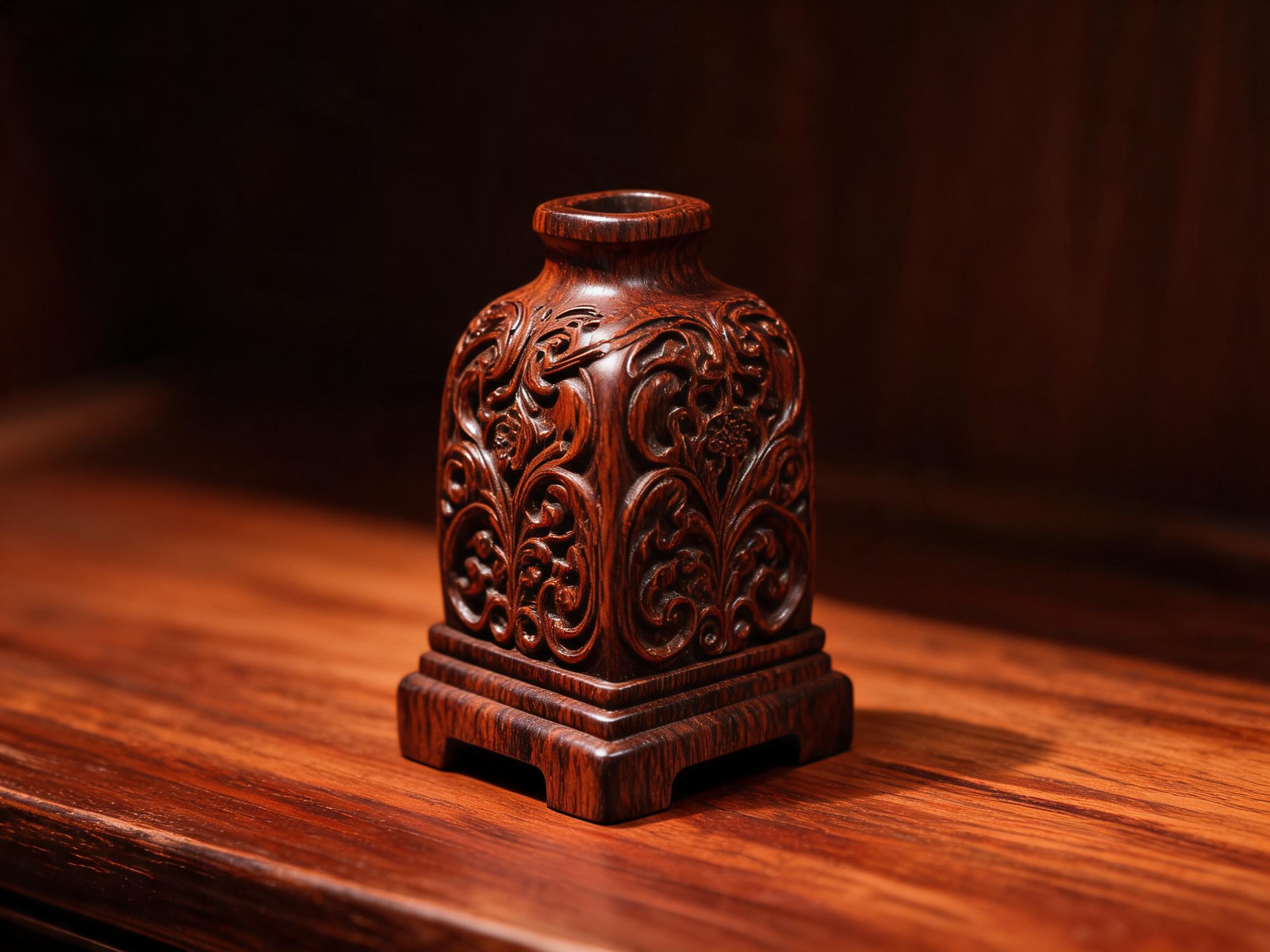
Why Wood Type Matters More Than Anything Else on the Spec Sheet
Wood species determines three things a buyer cannot recover later: dimensional stability, carving detail, and finish behavior. Dense hardwoods such as rosewood, sandalwood and walnut hold fine relief detail and take a smooth hand-sanded surface; they also weigh more per piece, which affects freight cost per unit. Softer or hollow-grain woods carve faster but show tear-out at fine details and warp more readily in dry or humid indoor climates — a real concern for decor shipped between very different environments, for example from a workshop in southern China to a heated showroom in Central Europe.
The hand-carved wooden ornament (GMO-CO-001) is listed with hardwood options of rosewood, sandalwood or walnut, in heights of 8–25 cm, hand-sanded with a natural oil seal finish, at an MOQ of 50 pieces with custom designs available. Treat these as listed specifications rather than independently verified performance: the practical step is to request samples in each wood option and compare weight, grain visibility and finish feel against your price tier. Walnut and rosewood will generally sit at a higher unit cost than mid-range alternatives, so the wood choice is effectively your first pricing lever.
Also ask how the wood is verified before carving starts. Material verification is one of the inline QC checkpoints documented at each production stage by this supplier, so a reasonable request is a record showing the incoming material matches the species named on your spec sheet. Without that checkpoint, substitution between visually similar hardwoods is difficult to detect after finishing.
Carving Depth: The Cost and Quality Driver
Carving depth separates a decorative piece from a display piece. As a general method in wood carving (not a claim about any single supplier), deeper relief requires removing more stock, more passes, and more hand finishing around the undercuts — all of which raise unit cost but produce stronger shadow lines and a more premium look under showroom lighting. Shallow surface carving is faster and cheaper but reads flat, especially on gift items photographed for catalogs.
When comparing quotes, ask each supplier to state carving depth on the ornament, or at minimum to photograph the piece at an angle showing relief height. Pattern checks — another documented inline QC checkpoint here — matter as much as depth: motif alignment on symmetrical ornaments and consistent line weight across a batch are the defects wholesale buyers most often discover only after unpacking cartons. A useful contract habit is to approve a physical or photographed sample and reference it in the spec sheet as the binding standard for pattern, depth and finish grade.
Finishes and the Lacquer Alternative
Natural oil seal finishes preserve the grain and suit retailers selling "authentic material" decor, but they can require care instructions for end customers. Multi-layer lacquer finishes, by contrast, build a harder protective surface and support custom branding — which is why lacquer pieces dominate corporate gifting programs. The lacquer craft ornament (GMO-CO-003) is listed with multi-layer coating and custom branding options, positioned for corporate gifting programs and premium cultural gift collections. If branding is part of your program, confirm in writing how logos or program marks are applied and what the finish grading checkpoint inspects for (uniformity, no drips or bubbles at edges).
For coordinated assortments — seasonal events, exhibitions, or tiered gift sets — the themed craft ornament collection (GMO-CO-004) offers custom designs with coordinated materials, which is relevant when one purchase order needs several SKUs sharing a visual theme.
Flat Panels vs. Display Ornaments: What Changes for the Buyer
| Consideration | Flat carved wall panel | Display ornament (vase/box form) |
|---|---|---|
| Mounting | Needs a hanging system or buyer-supplied hardware; confirm load capacity and wall-fixing method | Self-standing; confirm base stability and contact-point finish |
| Packaging stress | Flat pieces flex in transit; edge and corner protection is critical | Reinforced foam inserts cradle irregular 3D forms |
| Freight economics | High carton volume relative to value | Higher value density per carton |
| Inspection focus | Flatness/warping, back-frame integrity | Relief detail, base joints, finish grading |
If wall panels are on your sourcing list, warping is the check that matters most: ask how panels are dried and conditioned before carving, and what tolerance the workshop holds for flatness after finishing. For display ornaments, the equivalent risk is base joints and contact points, which a finish grading checkpoint should cover.
Packaging That Survives Wholesale Distribution
Carved wood fails in transit at edges, corners and protruding relief. Foam-insert packaging is the standard answer for 3D ornaments: the GMO-CO-001 ornament is listed with reinforced foam-insert packaging, which is what you want to see specified for gift-channel goods that pass through multiple distribution hands. When requesting quotes, ask for the pack configuration — pieces per inner box, cartons per master, carton dimensions and gross weight — because those numbers drive your landed cost per unit more than the ex-works price does.
Export documentation is the second half of the packing story. This supplier lists export-ready packing with carton marks and shipment documentation, and a buyer approval document set issued before mass production: sample photos, spec sheets and approval records. For a wholesale order, that document set is your traceability chain — it ties the goods that ship to the sample you approved, which is the basis for any claim if cartons arrive out of specification.
A Practical Inspection Checklist
Before committing to a carved wood decor order, request and file:
1. Wood verification. The species named on the spec sheet, supported by an incoming material verification record from the production line.
2. Approved sample references. Sample photos plus a written spec sheet covering size, carving depth or pattern standard, finish type, and packaging — signed off before mass production.
3. Finish grading criteria. What the finish checkpoint accepts and rejects: oil coverage uniformity for oiled pieces, coating consistency for lacquered pieces.
4. Packing specification. Foam insert layout, carton marks, and the shipment documentation set supplied with the order.
Suppliers who already run documented inline checkpoints will answer these requests with existing paperwork; hesitation to put checkpoints in writing is itself a useful signal.
Frequently Asked Questions
Can carved wood decor be used in bathrooms or high-humidity rooms?
No hardwood decor should be assumed humidity-proof. Oil-sealed pieces especially are indoor display items; for humid environments, confirm with the supplier whether the finish system suits the intended room and whether alternative coatings are available.
Is 50 pieces a workable MOQ for a test order?
It depends on your channel. The listed MOQ of 50 pieces for GMO-CO-001 allows a market test across mixed wood options without committing to full-carton economics of large assortments. Confirm whether the MOQ applies per design or across a mixed order when you request the quote.
Do carvings differ between machine and hand work?
Hand carving typically shows tool marks and slight variation between pieces; uniform repetition suggests machine assistance. Neither is inherently better for wholesale — but state your preference, because consistent batches and individual character demand different QC standards.
Requesting Quotes and Samples
The fastest way to evaluate any carved wood supplier is a sample in each wood option plus the approval document set described above. You can request quotes and samples for the hand-carved wooden ornament, the lacquer craft ornament, or the themed ornament collection via the product pages linked throughout this article, and use the checklist in this piece to structure the conversation with any supplier you shortlist.