A practical procurement guide for gift-channel retailers and corporate-gift buyers in Southeast Asia and the Americas. Learn how to configure a Chinese calligraphy set wholesale assortment that outperforms mass-market kits—covering set content, packaging tiers, and supplier selection criteria with real product facts.
BUYER GUIDE · GIFT CHANNELS
If you buy Chinese calligraphy sets for gift retail or corporate programs, you already know the problem with mass-market kits. They look fine in a catalog photo. Then the inkstone arrives with a rough grinding surface, the brush sheds bristles on first use, and the Xuan paper is too thin to practice on. Your customer opens the box once, and the gift feels cheap. That is not a product problem—it is a sourcing problem.
This guide is written for gift-channel retailers and corporate-gift buyers in Southeast Asia and the Chinese diaspora markets of North and South America. You are not buying for a stationery store shelf. You are buying for a gift that represents a relationship, a brand, or a cultural connection. The assortment you build needs to justify a premium price while protecting your margin and your reputation.
Here is how to build a wholesale Chinese calligraphy set assortment that competes on substance, not just packaging.
- Differentiate on set content configuration—ink stick, inkstone, brush, Xuan paper—not just the box.
- Use packaging tiers to segment retail, corporate, and premium gifting without multiplying SKUs.
- Evaluate suppliers on component quality control and set-level matching, not just MOQ and price.
- Private-label branding turns a commodity kit into a gift product your channel owns.
Why mass-market calligraphy kits fail in gift channels
Mass-market kits are built to a price point. The typical configuration includes a machine-ground inkstone, a synthetic brush, a small bottle of liquid ink, and a few sheets of low-grade paper. The components are sourced separately from the cheapest suppliers and packed together without any matching.
For a child's first practice set, that might be acceptable. For a gift that is supposed to honor a recipient—a retiring executive, a wedding guest, a client in Singapore or Vancouver—it is a risk. The recipient who knows calligraphy will immediately notice the difference. The recipient who does not know calligraphy will still notice that the brush sheds or the inkstone does not grind properly.
The gift channel demands a different logic. Your assortment needs components that work together, packaging that signals value before the box is opened, and the option to put your own brand on the product. That is what separates a gift product from a commodity.
Set content configuration: the four components that matter
A traditional Chinese calligraphy set has four core components. How each one is made, and how they are matched, determines whether the set performs or disappoints.
Ink stick (墨锭)
The ink stick is the soul of the set. Mass-market kits often substitute liquid ink to cut cost. A real ink stick, ground on an inkstone with water, produces a richer, more controllable ink—and it is part of the ritual that makes calligraphy a contemplative practice. For a gift set, an ink stick also has a longer shelf life and a more premium feel than a bottle of liquid.
When evaluating an ink stick, ask about the formula and the pattern. OEM customization is common: suppliers can emboss your brand, a blessing character, or a custom design on the stick. This is a low-cost way to make the set unmistakably yours.
Inkstone (砚台)
The inkstone is the work surface where the ink stick is ground. The quality of the stone determines how smoothly the ink grinds and how fine the particles become. A rough or uneven surface ruins the experience. For gift sets, the inkstone also carries visual weight—it is the largest, most tactile component in the box.
Check whether the supplier grades the grinding surface before assembly. A set-level QC check should include a practical test: does the ink stick grind evenly on this specific stone? That is component matching, not just component sourcing.
Brush (毛笔)
The brush is where quality differences are most obvious to the user. A cheap brush sheds bristles, loses its point, and makes clean strokes impossible. A well-made brush holds its shape and responds to pressure. For gift sets, the brush material matters—wolf hair, goat hair, or a blend—and the ferrule and handle should feel solid, not flimsy.
Ask the supplier how they test brushes before packing. A simple test is to wet the brush and check for loose bristles. If the supplier cannot describe a brush QC step, treat that as a red flag.
Xuan paper (宣纸)
Xuan paper is the traditional choice for calligraphy because of its absorbency and texture. Mass-market kits often include thin, machine-made paper that bleeds or tears. For a gift set, the paper should be a grade that actually performs. The number of sheets matters for perceived value—a set with 20 sheets of decent paper beats a set with 5 sheets of poor paper.
Paper is also a practical consideration for shipping. It should be packed flat and protected from moisture. Ask the supplier how the paper is packaged inside the set to avoid damage in transit.
| Component | Mass-market kit | Gift-channel set |
|---|---|---|
| Ink stick | Liquid ink substitute | Real ink stick, OEM pattern available |
| Inkstone | Machine-ground, ungraded | Graded surface, matched to ink stick |
| Brush | Synthetic, sheds bristles | Quality hair, tested before packing |
| Xuan paper | Thin, low-grade, few sheets | Performing grade, adequate sheet count |
Packaging tiers: segment without multiplying SKUs
Gift channels are not one market. You have retail customers who buy a set for a friend, corporate buyers who need a branded gift for a hundred clients, and premium buyers who want something truly special. You do not need a different product for each—you need packaging tiers that let you position the same core components at different price points.
Here is a practical tiering strategy:
- Starter tier: A functional set with the four components in simple, sturdy packaging. This is your volume product for retail shelves and entry-level corporate orders. It should look clean, not cheap.
- Mid tier: The same or upgraded components in a presentation box with a magnetic closure. This is your corporate-gift default. The unboxing experience matters here—the box should feel substantial and protect the components during shipping.
- Premium tier: Upgraded components, larger format, and a more elaborate box. This is for executive gifts, weddings, and high-value occasions. The packaging should justify a significantly higher price.
This approach keeps your inventory manageable. You are not stocking three completely different products—you are stocking variations that share components and quality standards. That simplifies QC, warehousing, and supplier relationships.
Wholesale selection criteria: what to ask a supplier
When you evaluate a supplier for a Chinese calligraphy set, go beyond price and MOQ. The questions below will separate a serious manufacturing partner from a trading company that just assembles boxes.
1. Do they control the components, or just pack them?
A supplier with an integrated chain—from raw material selection to export delivery—can guarantee consistency. If a supplier buys pre-made components from different factories, they cannot control quality variations or match components effectively. Ask directly: where are the ink sticks, inkstones, brushes, and paper made? Are they produced in-house or sourced?
2. What is their set-level QC process?
Component-level QC is not enough. A set can have four individually good components that do not work well together. The inkstone surface might be too rough for the specific ink stick. The brush might be too stiff for the paper grade. Ask the supplier how they test the complete set before packing. Do they grind a test ink stick on each inkstone? Do they check brush performance with the actual paper?
SET-LEVEL QC
Look for a supplier that performs matching checks—not just visual inspection—before the set is sealed. This is the difference between a gift that works and a gift that disappoints.
3. Can they handle private-label branding?
For gift channels, private-label branding is often the point. You want your logo on the box, your brand on the ink stick, and your story on the insert card. Ask the supplier about their OEM capabilities: custom ink stick patterns, box printing, insert cards, and packaging design support. The more they can do, the less you have to coordinate with separate vendors.
4. What is the realistic lead time and MOQ?
Gift orders are often seasonal. A supplier who can deliver in 35–50 days after sample approval gives you a workable planning window. MOQ matters too—a lower MOQ lets you test a market before committing to a large order. For example, a set with a MOQ of 30 sets is practical for a first trial or a small corporate program.
A real example: the Complete Scholar Desk Set
To make this concrete, consider the Complete Scholar Desk Set from Gu Mo Craft Technology. This set includes the four core components—ink stick, inkstone, brush, and Xuan paper—in a magnetic-closure presentation box. The MOQ is 30 sets, and the lead time is 35–50 days after sample approval.
What makes this set relevant for gift channels is the set-level QC. The supplier performs component matching checks, ensuring the inkstone surface works with the specific ink stick in the box. Private-label branding is available, so you can put your own mark on the ink stick and the packaging.
Gu Mo Craft Technology, founded in 2011, operates an integrated chain from raw material selection to export delivery. That means they control the quality of the components, not just the final assembly. For a buyer, this reduces the risk of receiving a set where the components do not work together.
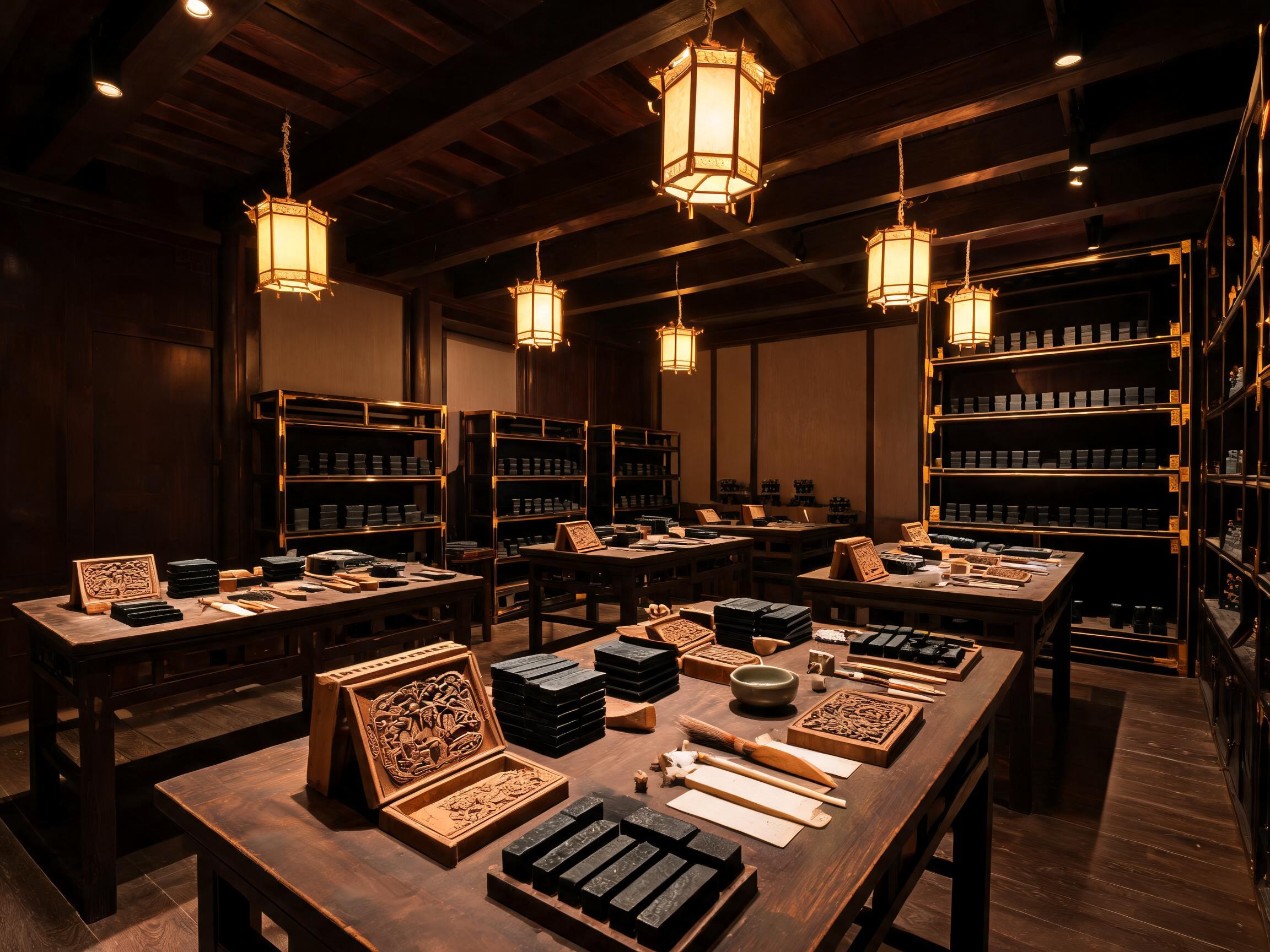
Ink craft sample room with material cards and quality grading records.
Building your assortment: three product tiers
Based on the criteria above, here is a practical assortment structure for a gift-channel catalog. You can adapt this to your market and price points.
| Tier | Product type | Use case | Key features |
|---|---|---|---|
| Entry | Calligraphy Starter Kit Set | Retail shelves, student gifts, first-time buyers | Functional components, simple packaging, accessible price |
| Mid | Premium Craft Gift Box | Corporate gifts, client appreciation, holiday programs | Upgraded presentation, better components, branding options |
| Premium | Premium Scholar Desk Gift Set | Executive gifts, weddings, high-value occasions | Largest format, finest components, elaborate packaging |
This structure lets you offer a complete range without overcomplicating your supply chain. Each tier shares the same quality philosophy—real components, matched performance, and packaging that protects the gift—while serving different budgets and occasions.
Common mistakes when sourcing calligraphy sets
Even experienced buyers make these errors. Avoid them to protect your margin and your reputation.
- Judging by the box, not the components. A beautiful box with poor contents will be opened once and never used. The recipient will remember the disappointment, not the packaging.
- Ignoring component matching. Four good components that do not work together create a bad experience. Insist on set-level QC.
- Choosing liquid ink to save cost. Liquid ink signals cheapness to anyone who knows calligraphy. An ink stick is a small cost difference with a large perceived-value difference.
- Skipping private-label branding. A generic set is a commodity. Your brand on the ink stick and box turns it into a product your channel owns.
- Not testing the unboxing experience. Ship a sample to yourself. Open it. Does the box protect the components? Does it feel like a gift? If it does not impress you, it will not impress your customer.
FAQ: quick answers for gift-channel buyers
What is the minimum order quantity for a quality calligraphy set?
It varies by supplier. A set with a MOQ of 30 sets, like the Complete Scholar Desk Set, is practical for testing a market or fulfilling a small corporate program without overcommitting inventory.
How long does a custom order take?
For a set with private-label branding, expect a lead time of 35–50 days after sample approval. This includes component sourcing, set assembly, QC, and packaging. Plan your seasonal orders accordingly.
Can I put my own brand on the ink stick?
Yes. OEM customization of ink stick patterns, specifications, and packaging is a standard capability for suppliers like Gu Mo Craft Technology. This is a key differentiator for gift channels.
How do I know the components will work together?
Ask the supplier about their set-level QC process. A supplier that performs component matching—testing the ink stick on the specific inkstone, checking brush performance with the paper—will give you a set that performs as a whole.
What is the difference between a gift-channel set and a mass-market kit?
Gift-channel sets use real components (ink stick, graded inkstone, quality brush, performing paper), undergo set-level QC, and offer private-label branding. Mass-market kits are built to a price point with the cheapest components and no matching.
Next steps for building your assortment
Building a competitive Chinese calligraphy set assortment is not about finding the cheapest kit. It is about finding a supplier who treats the set as a designed product—with real components, matched performance, and packaging that protects the gift.
Start by requesting samples from suppliers that meet the criteria above. Test the components yourself. Open the box. Grind the ink. Write a character. If the set does not perform, move on. If it does, you have found a product your gift channel can stand behind.
For a concrete starting point, review the Complete Scholar Desk Set and the other tiers mentioned in this guide. Ask the supplier about their set-level QC, OEM capabilities, and lead times. Then build an assortment that makes your gift channel the obvious choice for buyers who want more than a box.