A practical guide for art supply dealers and collectors on choosing Chinese calligraphy ink stones by material, origin, MOQ, and quality judgment, with sourcing tips for wholesale buyers.
BUYER GUIDE
For art supply dealers and collectors, the ink stone (yan, 砚) is not just a grinding surface—it is the foundation of every brushstroke in Chinese calligraphy and ink-wash painting. Yet sourcing the right inkstone wholesale can be confusing: dozens of materials, regional origins, quality grades, and MOQ terms vary widely across suppliers. This guide gives you the practical criteria to evaluate an inkstone before you commit to a bulk order.
- Material determines performance: Duan and She inks tones are prized for fine grain and water retention; Tao and Chengni offer cost-effective alternatives.
- Origin matters for authenticity and quality—Guangdong, Anhui, Gansu, and Shandong are the classic producing regions.
- Quality judgment relies on tactile tests: grain fineness, water absorption, and carving precision—not just appearance.
- MOQ and customization vary by supplier; always request samples and specify your target market before bulk orders.
- Verify supplier consistency: ask for production capacity, inspection reports, and export experience to avoid batch variations.
Why Material Choice Is the First Decision
The inkstone's material determines how well it grinds ink, how long it retains water, and how it feels under the brush. For wholesale buyers, material choice directly affects your product range and pricing. Here are the four main categories you will encounter in the market.
Duan Inkstone (端砚) – The Premium Standard
Quarried in Zhaoqing, Guangdong Province, Duan stone has been the first choice of scholars for over a thousand years. Its fine grain produces smooth, dense ink with excellent layering. Duan is known for its "eyes" (stone eyes, 石眼) and other natural markings that increase collector value. For your high-end line, Duan is a must—but it is also the most expensive, and genuine Duan is limited.
She Inkstone (歙砚) – The Rival from Anhui
From She County, Anhui, She stone is slightly harder than Duan but equally prized. It grinds quickly and holds water well, with a distinctive golden or silver grain (金星, 银星) that adds aesthetic appeal. She is a strong second-tier option for mid-to-high-end products.
Tao Inkstone (洮砚) – The Green Classic
Mined in Gansu Province, Tao stone is famous for its green or purple-green tones. It is softer than Duan and She, which means faster ink grinding but less durability. Tao is a good choice for a mid-range product with historical appeal.
Chengni Inkstone (澄泥砚) – The Ceramic Alternative
Unlike the stone types, Chengni is made from fired clay (a type of ceramic). It is produced in several regions, including Shanxi and Shandong. Chengni can mimic the look of stone at a lower cost, making it ideal for entry-level or promotional products. However, quality varies widely—some are porous and absorb too much water, affecting ink quality.
| Material | Origin | Hardness | Grain Fineness | Typical Price Range | Best For |
|---|---|---|---|---|---|
| Duan (端砚) | Guangdong | Medium-hard | Very fine | High | Collectors, professional calligraphers |
| She (歙砚) | Anhui | Hard | Fine | Medium-high | Serious practitioners, gift sets |
| Tao (洮砚) | Gansu | Soft | Medium | Medium | Mid-range art supply |
| Chengni (澄泥砚) | Shanxi, Shandong | Varies (fired clay) | Varies | Low to medium | Entry-level, student sets |
How Origin Affects Authenticity and Price
Origin is not just a label—it directly impacts the stone's physical properties. A Duan stone from Zhaoqing has a specific mineral composition that cannot be replicated by stones from other regions. When sourcing, ask the supplier for the exact quarry or region. Beware of "generic" inkstones labeled only as "Chinese inkstone"—these are often made from low-grade stone that may not perform well.
For authentic Duan and She, expect higher prices and limited availability. Some quarries are depleted or regulated, so genuine pieces are becoming rarer. If your market demands authenticity, consider working with suppliers who can provide a certificate of origin or at least a clear regional description. For cost-sensitive products, Chengni or lower-grade Tao may suffice, but be transparent with your customers about the material.
Quality Judgment: What to Check Before You Buy
Quality is not about how pretty the stone looks on the outside. It is about how it performs when grinding ink. Here are the key tests you can do—or ask your supplier to do—before placing a bulk order.
1. Grain Fineness (石质细腻度)
Rub your finger across the surface. A high-quality inkstone feels smooth, almost like silk, with no visible pits or rough patches. The finer the grain, the better the ink will be ground—this is the single most important factor.
2. Water Retention (吸水率)
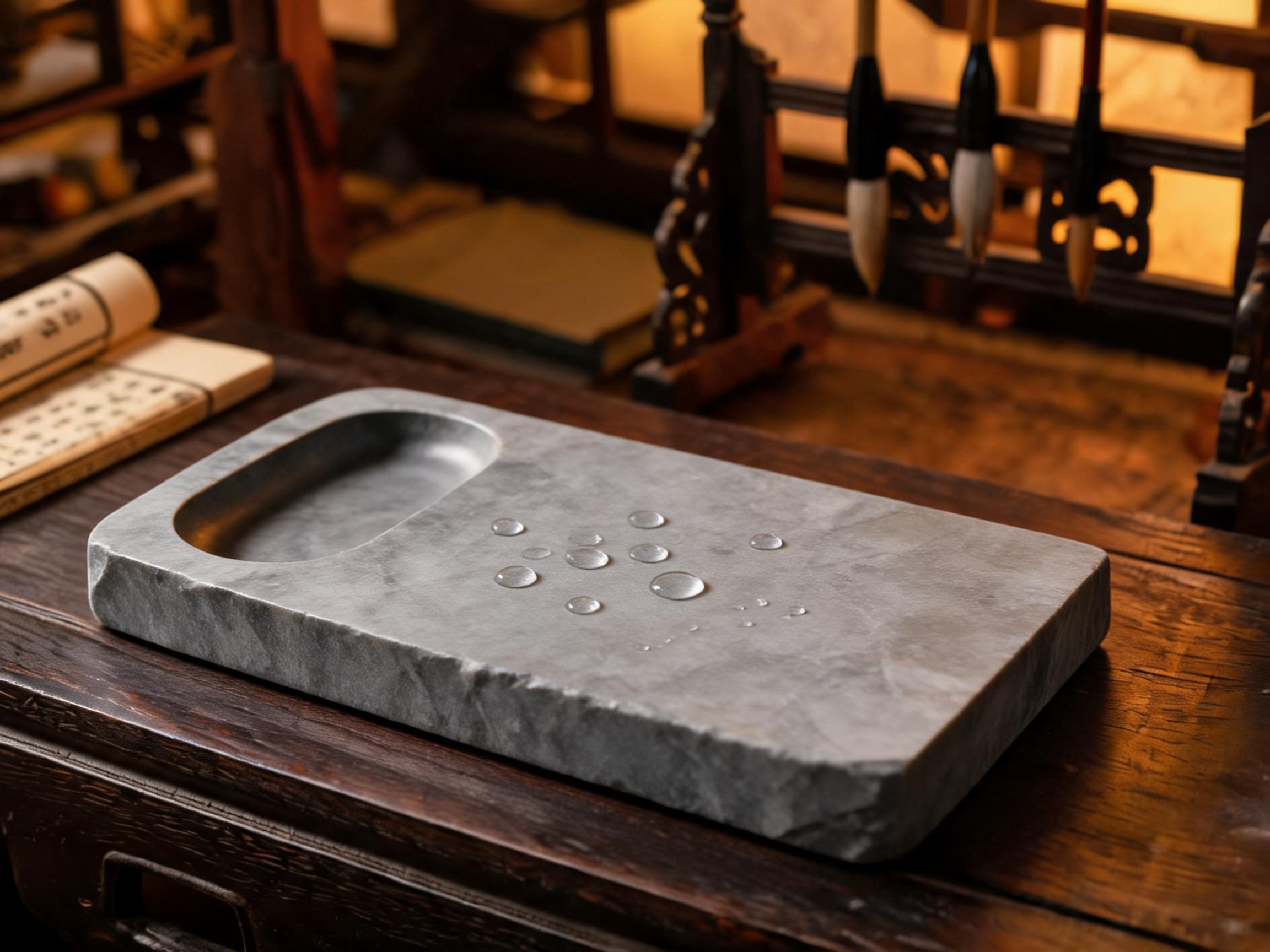
Place a drop of water on the surface. A good inkstone will hold the water for several minutes without absorbing it quickly. If the water disappears immediately, the stone is too porous and will dry out during use. This is a common flaw in low-grade Chengni.
3. Grinding Test (研磨测试)
Use a standard ink stick and grind it with a few circular motions. The ink should form a smooth, dark paste quickly, without scratching or producing a gritty texture. If the stone is too hard, it takes too long; if too soft, it sheds particles into the ink.
4. Carving and Finish (雕刻与做工)
Inspect the carving on the sides and the ink pool (砚池). The lines should be clean and symmetrical. The pool should be shallow enough to hold a small amount of water but deep enough to prevent spillage. Poor carving can trap ink residue, making cleaning difficult.
5. Sound Test (声音测试)
Gently tap the stone with a fingernail or a small metal object. A high-quality stone produces a clear, ringing sound. A dull thud indicates internal cracks or a soft, low-grade material. This test is not absolute, but it helps identify structural issues.
- Over-polished surfaces that hide rough grain—ask for an unpolished sample.
- Artificial coloring or resin treatment to imitate high-end stones—check with a magnifying glass.
- Inconsistent batch quality—always request a pre-production sample.
MOQ, Customization, and Supplier Evaluation
When you move from single pieces to wholesale, the terms of the deal become as important as the product itself. Here is what to clarify with every supplier.
Minimum Order Quantity (MOQ)
MOQs for inkstones vary widely. Small workshops may accept orders of 20–50 pieces, while larger factories might require 200 or more. Ask for the MOQ per design and per material. Some suppliers offer mixed MOQs—you can combine different designs to reach the total, which is useful for testing the market.
Customization Options
Many buyers want their own branding or specific shapes. Confirm whether the supplier offers:
- Custom carving (your logo, name, or pattern) on the stone or wooden box.
- Custom box design (wood, silk, or paper).
- Size and shape variations (round, oval, rectangular, or natural form).
- Packaging for retail or gift sets.
Customization usually increases MOQ and lead time. Plan for at least 4–6 weeks for production, plus shipping.
Supplier Evaluation Checklist
- Request a sample set covering different materials and price points.
- Ask for production capacity and typical lead time.
- Check if they have export experience to your target region (e.g., EU, US, Japan).
- Inquire about quality control procedures—do they inspect each piece?
- Clarify payment terms (T/T, L/C) and whether samples are refundable.
Always ask for a pre-production sample before mass production. This is non-negotiable. The sample should be identical to the bulk order in material, carving, and finish. If the supplier hesitates, treat it as a red flag.
Practical Sourcing Tips for Art Supply Dealers
Your customers—calligraphers, painters, students, and collectors—have different needs. Tailor your product mix accordingly:
- Entry-level (students, hobbyists): Chengni or low-grade Tao, simple designs, affordable. MOQ can be higher because cost is low.
- Mid-range (serious amateurs): She or mid-grade Tao, with decorative carving. Offer a few designs to appeal to gift buyers.
- High-end (collectors, professionals): Genuine Duan or She with natural markings. Low MOQ, but higher margin. Emphasize authenticity and provenance.
Also consider the inkstone's compatibility with ink sticks. Some stones work better with certain ink stick formulas. If you sell both, test them together and mention the pairing in your product descriptions.
Common Mistakes in Inkstone Sourcing
- Ignoring the stone's water retention: A beautiful stone that dries out quickly is useless for painting.
- Assuming all "Duan" is the same: There are different grades within Duan; ask for the specific quarry or layer.
- Overlooking packaging: Inkstones are heavy and fragile. Ensure the supplier uses sturdy wooden boxes and adequate padding for international shipping.
- Skipping the sample: Photos can be misleading. Always test the actual product.
Frequently Asked Questions
What is the best inkstone material for beginners?
Chengni is often recommended for beginners because it is affordable and easy to use. However, some low-quality Chengni absorbs too much water. Choose a mid-grade Tao or a well-made Chengni from a reputable supplier.
How can I tell if an inkstone is genuine Duan?
Genuine Duan comes from Zhaoqing, Guangdong. Look for characteristic markings like stone eyes or fire marks. The stone should feel cool to the touch and have a fine, smooth grain. Ask the supplier for a certificate of origin if available.
What is the typical MOQ for wholesale inkstones?
It varies. Some suppliers accept 50 pieces, others require 200+. Always ask for the MOQ per design and whether mixed designs are allowed.
Can I get custom shapes and carvings?
Yes, most suppliers offer customization, but it may increase MOQ and lead time. Provide clear specifications and approve a sample before production.
How should inkstones be packed for export?
High-quality inkstones are usually packed in individual wooden boxes with foam or silk padding. For bulk orders, ensure outer cartons are reinforced to prevent breakage during transit.
Conclusion: Build a Reliable Supply Chain
Sourcing Chinese calligraphy ink stones is a balance of material knowledge, quality control, and supplier trust. Start with small test orders to validate quality and communication. As you build relationships, you can negotiate better MOQs and customization terms. Always keep your target market in mind—what works for a student in the US may not suit a collector in Japan.
If you are looking for a dependable inkstone wholesale partner, we invite you to Request a quote with your target material, quantity, and design preferences. Our team can provide samples and discuss MOQ terms tailored to your market.