
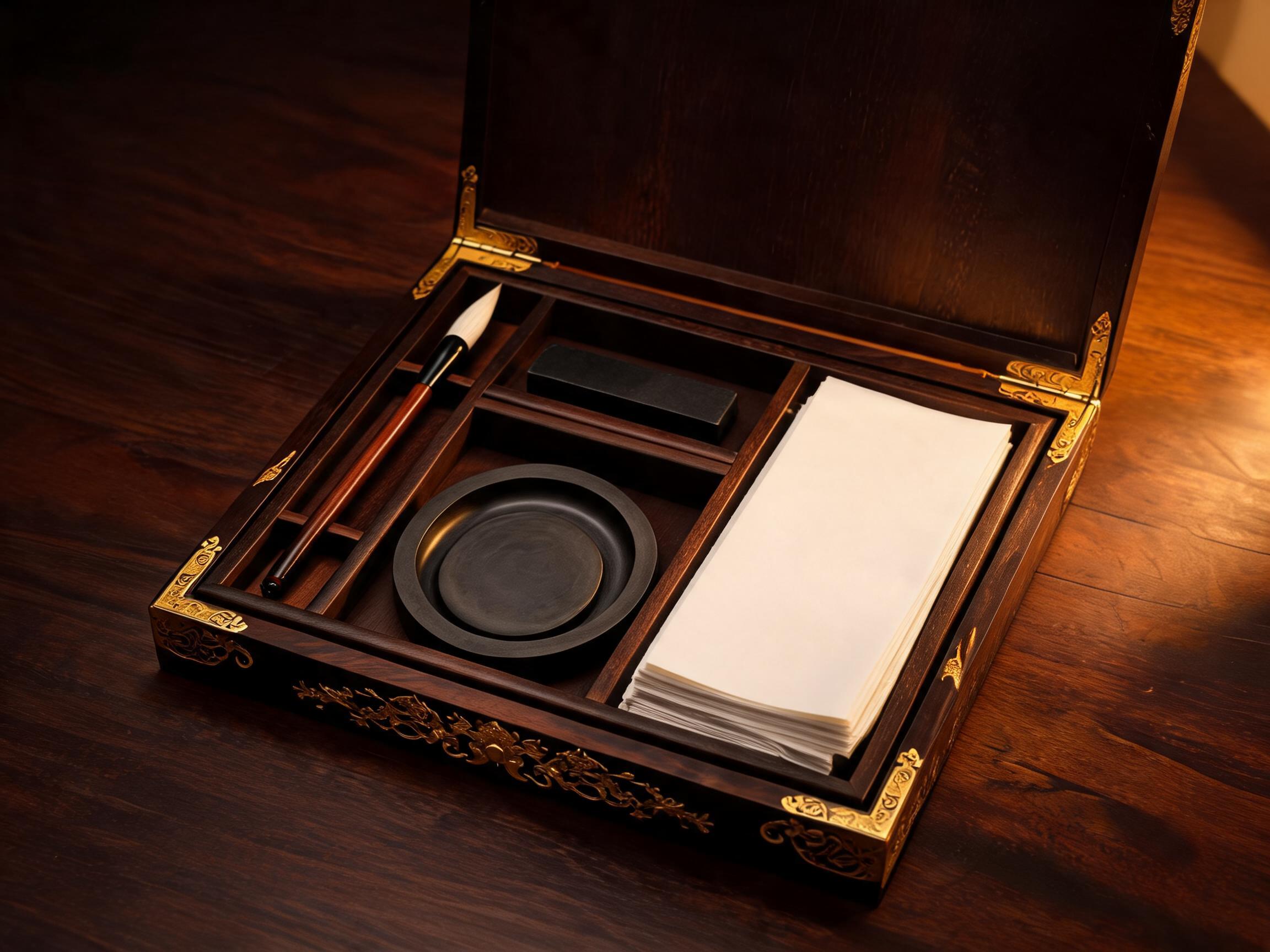
A category-level stocking guide for art supply retailers and importers in Japan, Korea, North America and Southeast Asia: how to pair ink, paper, brushes and inkstones into kits that sell, plus which combinations to hold for students, gift sets and collectors.
Assortment Planning Guide
Sumi-e supplies sell as a system, not as four separate categories. A customer who buys a pine soot ink stick but has no paper that shows its tonal range, or a student who wants a starter kit and finds only collector-grade inkstones on the shelf, is a lost sale. This guide lays out how to build ink, paper, brushes and inkstones into assortments that match real buyer groups: institutional and classroom orders, gift and tourism retail, and the collector market in Japan, Korea, North America and Southeast Asia.
Key takeaways for buyers
- Stock ink and paper as matched pairs. The ink grade decides which paper grade the customer needs.
- Hold one practice, one travel and one fine-grade inkstone per market tier rather than a single mid-range stone.
- Brushes are the most size-sensitive item; confirm barrel and tip dimensions with the supplier before committing to a full size run.
- Gift sets should be built from a defined set of SKUs with consistent packaging, not from leftover stock.
- Ask suppliers for packaging, MOQ and shelf-life details on liquid inks; do not assume them.
What this guide covers
- How ink grades map to paper grades
- The four paper formats and which customer each serves
- Brushes: sizes, tiers and the questions to ask
- Inkstones from practice to collector grade
- Turning the four groups into boxed sets
- A workable stocking ratio
Start with the ink-to-paper pairing
Sumi-e buyers do not choose ink in isolation. Pine soot and oil soot inks behave differently on absorbent versus treated paper, and the buyer who understands that will buy both at the same time. Approach the assortment as four ink tiers, each with a paper counterpart.
| Ink tier | Typical buyer | Paper pairing |
|---|---|---|
| Pine soot premium stick | Collectors, advanced students, gallery-quality work | Raw Xuan, cut to working size |
| Oil soot classic stick | General studio use, gift sets | Raw Xuan or bound album |
| Student practice stick | Schools, workshops, high-volume teaching | Student practice Xuan |
| Colored ink stick set | Hobbyists, illustrated sumi-e, gifts | Treated Xuan for finer color work |
Our Premium Pine Soot Hui Ink Stick and Oil Soot Hui Ink Stick Classic both belong in the mid and upper tier. Placing them side by side lets a customer compare the two on price and intended use, which is exactly the conversation a trained retail staff member should be having. The Student Practice Hui Ink Stick should sit in a separate, clearly labeled budget section so teachers can restock quickly.
Liquid and bottled ink
Bottled liquid ink is the practical entry for large classroom programmes and for buyers who do not want to grind. It is also the item most likely to create problems in transit and on the shelf. Before listing bottled ink, confirm with your supplier the bottle format, closure type, shelf-life guidance, and any restrictions on air or sea shipment. Do not assume that a liquid ink can be shipped the same way as a dry ink stick.
Paper: four formats, four distinct customer groups
Paper is where assortment decisions most often go wrong. Retailers typically stock two formats and then find that neither serves the workshop or gift buyer. Four formats cover the field.
- Raw Xuan for brushwork. Ungraded absorbency, the standard surface for expressive freehand sumi-e. Our Raw Xuan Paper Professional is the reference SKU in this group.
- Treated Xuan for controlled work. Sized to slow absorption, so lines hold. Relevant for gongbi and detailed color work; see Treated Xuan Paper for Gongbi.
- Student practice paper. Volume-priced, sold in packs, aimed at classrooms and trial workshops: Student Practice Xuan Paper.
- Rolls and bound albums. The Xuan Paper Roll suits customers working large or cutting to custom sizes; the Bound Xuan Paper Album is the strongest gift and tourism SKU because it needs no framing and photographs well.
Pair student ink sticks with student paper as a bundled teaching pack. Giving students a matching ink and paper set at the start of a course makes it easy for teachers to standardize supplies and reorder the same pack for the rest of the term.
Brushes: the size-sensitive category
Brushes carry more variety per SKU than any other item in the sumi-e group, and they are harder to compare from photographs. Stock by function rather than by individual size: a large absorbent brush for washes, a medium all-purpose brush, a fine detail brush, and a dedicated calligraphy brush if your customer base includes writing practice as well as painting.
Before committing to a full size run, ask the supplier to confirm tip length, barrel diameter and total length for each brush in the range, plus whether handles are uniform across the set. Size charts matter here the same way they matter in apparel: a nominal size designation is not a substitute for measured dimensions. Buyers in Japan and Korea will judge a brush line closely on these details, and a supplier who can supply measurements in writing is easier to work with long term.
Inkstones: three tiers, not one
Retailers often stock a single mid-range stone and lose both ends of the market. Three tiers work better:
- Practice grade. Practice Inkstone is the classroom and workshop unit. Buy it in multiples so teaching customers can order in class-sized quantities.
- Travel grade. The Compact Travel Inkstone serves the growing number of painters who work on location, and packs well into gift bundles.
- Collector grade. Classic Duan and She inkstones are the top of the range. These are bought as objects as much as tools, and they belong in a display context with written material on origin and stone type.
For the collector tier, buyers will ask questions about stone origin and grain before they ask about price. If the categorization and descriptions in your product data are not yet defined for these stones, settle that with the supplier first; the existing Sumi Ink Stone Order Checklist for Japan and Korea Buyers covers the stone-specific checks, and this article assumes those checks are already settled before the four groups are combined.
Building the boxed set
The set is where the assortment earns its margin, and it is also where inconsistent SKUs show up. Build sets from a fixed, named list rather than from whatever is in stock.
| Set | Contents | Market |
|---|---|---|
| Student starter | Practice ink stick, student paper pack, practice inkstone, one medium brush | Schools, workshops, Southeast Asia volume orders |
| Travel kit | Compact travel inkstone, oil soot stick, small paper pad, two brushes | Tourism retail, hobbyists |
| Gift set | Oil soot or pine soot stick, bound album, elegant brush, presentation box | North America gift retail, Japan and Korea seasonal gifting |
| Collector presentation | Pine soot premium stick, Duan or She stone, high-grade brush, album | Gallery shops, specialist retailers |
Two practical points govern set quality. First, packaging: confirm box construction, insert type and whether your supplier can print or label to your specification, along with the MOQ that applies. Second, consistency: if a set is advertised with a particular stone or ink grade, every unit in the shipment must contain that grade. Inconsistent gift sets generate returns in every market, and they are harder to resolve across borders.
A stocking ratio to start from
For a first order, weight the assortment toward volume and let the collector tier stay thin until you have a customer asking for it.
- Ink: roughly half student grade, a quarter oil soot, a quarter split between pine soot and colored sets.
- Paper: student paper as the volume leader, raw Xuan next, treated Xuan and albums as a smaller but steady line.
- Brushes: a full functional range in modest quantities, expanded once specific sizes prove out.
- Inkstones: practice stones in cartons, travel stones as a small add-on, one or two collector stones as display pieces.
These ratios are a starting hypothesis, not a rule. Adjust them after one selling season, using reorder data per customer type rather than overall unit sales.
What to confirm before you place the order
A few items in this category cannot be settled from a catalogue. Ask your supplier to confirm in writing: measured dimensions for each brush size; packaging specifications and MOQ for every boxed set; shelf-life and shipping restrictions for liquid inks; and the stone categorization used in the collector tier. Once those are fixed, the four groups can be ordered as one coherent assortment instead of four unrelated lines.
For many small and mid-sized retailers, a workable sumi-e assortment is small, matched and clearly labelled by customer type. If you are planning a first order or rebalancing an existing one, send your target markets and the customer groups you serve, and we can indicate which combinations in the range fit them.