
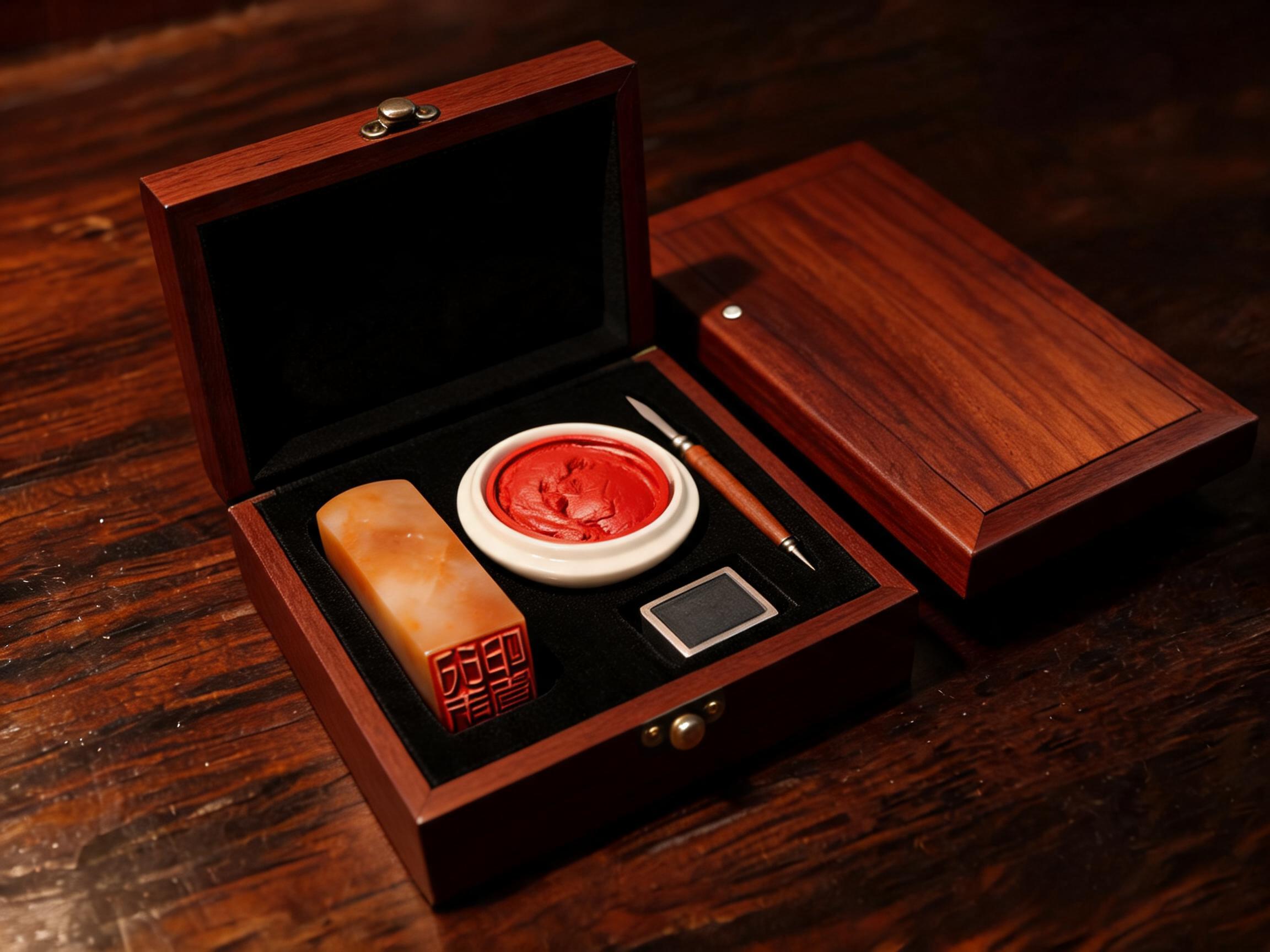
A channel-stocking checklist for gift retailers, cultural-gift channels and stationery importers: what to verify in red seal ink paste itself, and how paste pairs with seal stones, carved seals and complete sets as retail or gift SKUs.
If you are stocking chinese red ink paste for the first time, the questions you cannot answer from a photo are the ones that decide whether a reorder happens: does the paste still look and behave the same on arrival, does it stay moist in the jar through a retail season, and does it hold up when a customer opens a gift box and stamps a seal for the first time? This article is written for gift retailers, cultural-gift channels and stationery importers preparing bulk orders, and it separates the checks you can make on the paste itself from the way paste pairs with stones, carved seals and complete sets as sellable SKUs.
What this article covers
- Qualitative checks on the paste itself: consistency, colour behaviour and container sealing.
- Why paste is sold as an accessory to seals, not on its own, in most gift channels.
- How paste pairs with practice stones, carved name seals and complete presentation sets.
- Questions to put to suppliers before you commit to a quantity.
On this page
Checks on the paste itself
Red seal paste is a supporting product. Nobody walks into a gift shop looking for paste; they look for a seal, a set or a keepsake, and the paste is what makes it usable. That changes what you need to verify. You are not buying a decorative consumable — you are buying the component that determines whether the seal you sold actually prints on the first try.
Because paste is difficult to describe in a specification sheet, most of the useful assessment is qualitative. Ask for a physical sample and judge it on three dimensions.
Consistency
Open the jar and look at how the paste sits. A paste that has separated, hardened at the edges or formed a dry skin has already lost moisture before it reaches your warehouse. Ask how the paste behaves when a seal is pressed into it and lifted: it should transfer evenly onto the seal face without dragging or leaving clumps. If your supplier can send a short demonstration video alongside the sample, that is more informative than a written description, because consistency is defined by how it performs under the seal.
Colour behaviour
Colour on the seal face and colour in the jar are two different things. What matters for retail is that the impression dries to an even tone across the whole stamp, without patchy areas at the edges or a lighter centre. Ask for impressions made on the paper type your channel sells alongside the paste — absorbent uncoated paper and coated card take the same paste differently. Do not accept a claim about colour stability or lightfastness unless the supplier can support it; the practical check is a set of impressions you can compare across a sample order.
Container sealing
This is the check that most often gets skipped in sampling and then causes problems in a bulk shipment. The jar is part of the product. Ask about the lid design, whether there is an inner seal or liner, and how the jar is protected during transit. A paste that samples well but arrives with lids loosened, or with paste pushed into the threads, presents badly in a gift box and generates returns. If the paste is packed inside a set, check whether the jar is held in its own recess so it does not move against the stone during shipping.
Consistency, colour and sealing are best judged on a sample you can open and test yourself. Treat supplier descriptions as a starting point, not a substitute for handling the paste.
How paste pairs with seals and stones
In most gift and stationery channels, paste is not the SKU — it is what completes a SKU. The pairing you choose determines your price band, your packaging cost and how the product reads to an end buyer who may never have used a seal before.
Paste with a practice stone
The entry-level pairing is paste with a practice stone. A practice seal stone is positioned for calligraphy schools and beginner programmes, with consistent hardness and a tested carving surface. In this pairing the paste is a working consumable: the buyer carves, stamps and repeats. Your end customer here is a learner or a teacher, not a gift-giver, so packaging can be simpler and the paste jar needs to survive repeated opening and closing rather than look decorative in a box.
Paste with a carved name seal
The mid-tier pairing is paste with a finished, engraved seal. A custom carved name seal involves multi-language engraving with proof sample approval before production — which means the paste is shipped as part of a personalised item, and the two have to match in quality perception. A carefully engraved seal next to a jar with a loose lid or uneven paste undercuts the whole purchase. When you order carved seals and paste together, ask your supplier to assemble and pack them as one unit so the quality you approve in the proof stage is the quality the end buyer opens.
Paste inside a complete set
The gift-channel pairing is the complete set. A seal carving gift set brings together a stone, ink paste, knife and ink pad in a custom presentation box, positioned for cultural gifting and corporate programmes. Here the paste is one element of a presented object, and the checks shift accordingly: colour and presentation consistency across a production run matter more than individual jar performance, and the paste must sit securely in the box cavity so the set looks intact when the lid opens. For corporate programmes, where all units are opened in the same room at the same event, uneven paste between units is visible immediately.
Choosing SKU shapes for your channel
The same paste can be sold three ways, and the right shape depends on who buys it and why.
| Channel | What the buyer buys | Paste's role | Main check |
|---|---|---|---|
| Stationery / craft retail | Practice stone, replacement paste | Working consumable | Consistency under repeated use; jar sealing for shelf life |
| Cultural gift retail | Carved seal, sometimes with paste | Completes a personalised item | Paste quality matches the engraved seal; packed as one unit |
| Corporate & institutional gifting | Complete presentation set | One element of a presented object | Unit-to-unit consistency; secure fitting in the box |
Two practical notes follow from this table. First, paste sold as a standalone refill competes on supply reliability, not on presentation — your customer is replacing something they already own. Second, paste bundled into a set competes on presentation, and a supplier who can assemble and pack the set as a unit saves you a secondary packing step. Decide which of the two you are buying before you discuss terms.
Questions for the supplier
These are the questions worth asking before a bulk order, grouped by what they resolve.
- On the paste: Can you send a physical sample of the paste as it will ship, in the production jar? How is the jar sealed, and is there an inner liner? What is the recommended storage condition between arrival and sale?
- On pairing: If I order paste with stones or carved seals, are they packed together or separately? Can I approve a packed unit before the full run?
- On sets: For a complete set, can you confirm the paste is held in its own recess? Can I see a packed sample set, not just the components?
- On consistency: How do you keep paste presentation even across a production run, and what should I check on arrival?
Where a supplier cannot answer a question with evidence, note it as an open item rather than assuming the standard industry answer. Nothing in this article should be read as a statement about any particular supplier's certification, capacity or test results — those are things you confirm directly, per order.
FAQ
Is red seal ink paste sold on its own or only with seals?
Both formats exist. Standalone paste works as a refill for customers who already own a seal; in gift channels it is more commonly bundled with a stone, a carved seal or a complete set, because the paste is what makes the seal usable.
What can I actually check before placing a bulk order?
Consistency in the jar, colour behaviour on your paper type, and how the container is sealed. A physical sample in the production jar is the most reliable way to judge all three; ask for impressions on the paper you intend to sell alongside the paste.
Should paste be packed with the seal or separately?
If the paste is part of a gift or personalised item, assembling and packing it with the seal gives you one approved unit and avoids mismatched quality between components. If the paste is a standalone refill, separate packing is normal.
How does paste affect a complete gift set?
In a set, the paste contributes to first-impression presentation. Unit-to-unit consistency and secure fitting in the box cavity matter more than the performance of any single jar, especially for corporate programmes where sets are opened side by side.
Next step
Before you commit to a quantity, request a paste sample in its production jar and, if you are buying sets, a packed sample unit as well. Compare the impressions on your own paper, check the lid and liner, and confirm how the paste is held inside the box. Those three checks answer most of the questions that otherwise surface after the shipment lands.