
A procurement-focused guide for B2B buyers on bamboo calligraphy brushes: how handle materials and construction affect durability and feel, how wolf, goat and mixed hair bristles pair with different brush bodies, and which points to verify before committing to a bulk order.
Bamboo Is the Default Handle. The Differences Are in How It Is Finished.
Search for bamboo calligraphy brushes and you will find hundreds of listings that all say the same thing: bamboo handle, natural hair, professional quality. For a buyer placing a bulk order, that description is almost useless, because bamboo is the default material for Chinese brush handles, not a differentiator. What actually varies between suppliers — and what determines whether a shipment holds up in your market — is how the bamboo is sealed and shaped, which hair is paired with it, and what the supplier can show you about batch behaviour before the goods leave.
This article walks through the three handle constructions in our current brush range, the hair pairings we build on each, and the inspection points that catch the failures buyers complain about most: split handles, shedding heads, and loose ferrules.
Why Bamboo Dominates, and Where It Fails
Bamboo is light, stiff along the grain, and takes a carved grip well — three properties that matter in a tool you hold for hours. It is also hygroscopic and prone to splitting at the ends once the outer skin is cut or the tip is left bare. That single fact explains most after-sales complaints in this category. A brush handle does not fail in the showroom; it fails three months later in a humid warehouse or a dry heated shop, when the end grain opens.
So the practical question is not "is it bamboo" but "what has been done to the bamboo".
Three Handle Constructions in the Current Range
| Construction | Model | Handle spec | Paired hair |
|---|---|---|---|
| Carved grip | Premium Wolf Hair Calligraphy Brush (GMO-CB-001) | Bamboo with carved grip, 25 cm, secure ferrule | Premium wolf hair, resilience-graded, hand-bound head |
| Sealed | Student Practice Brush Set (GMO-CB-005) | Sealed bamboo, 22 cm, sealed against splintering | Synthetic-blend hair, tip-retention rated |
| Reinforced | Large Format Calligraphy Brush (GMO-CB-004) | Reinforced handle for a heavy, densely packed head | Dense hair packing for exhibition work and sign painting |
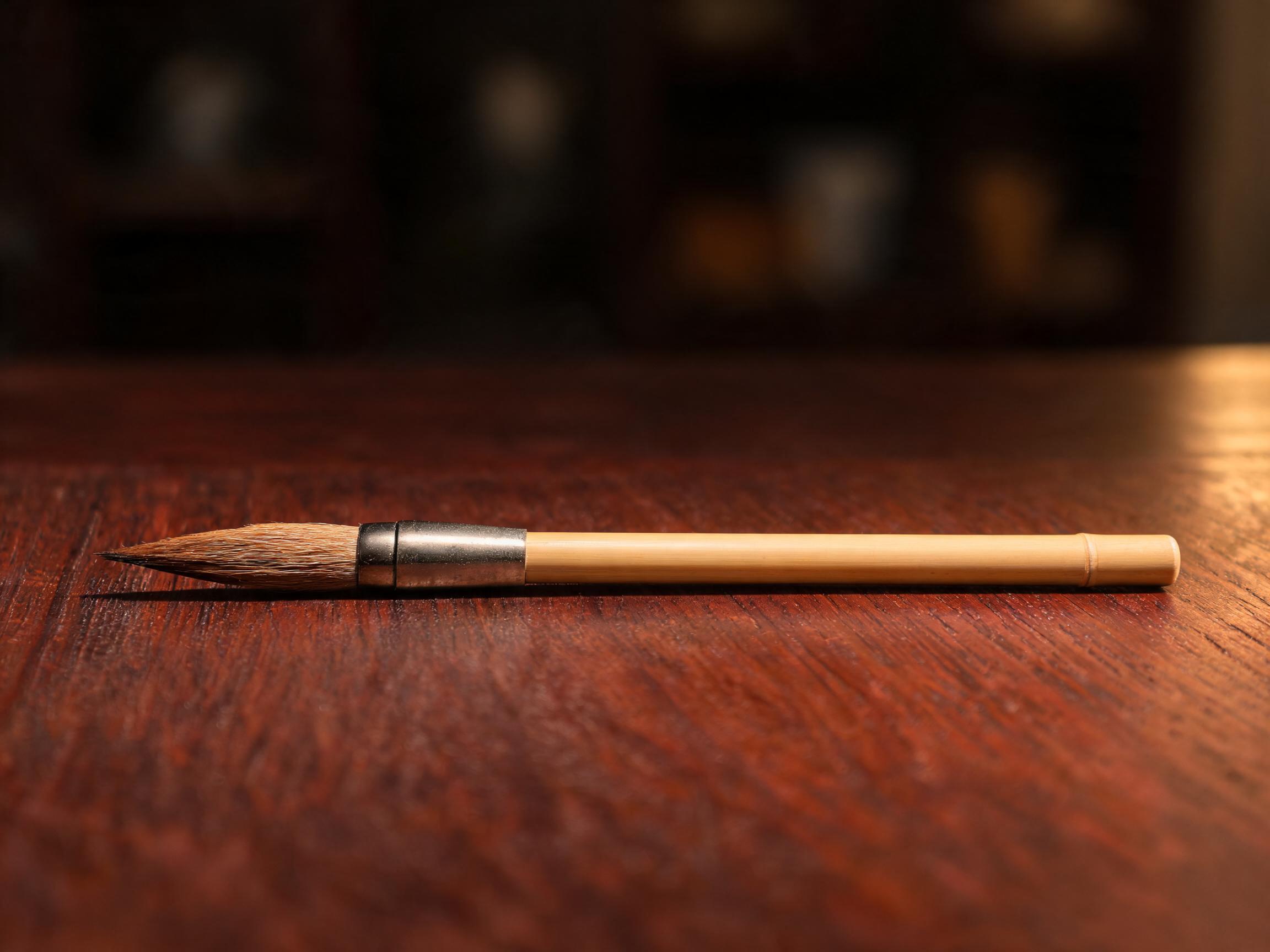
These are not cosmetic variations. A carved grip is a hand-feel decision on a brush the calligrapher holds for an hour. A sealed handle is a logistics decision for a school programme that will store thousands of brushes in a humid climate. A reinforced handle is a structural decision, because a dense head puts load on the joint that an ordinary handle will not take.
Bristle Pairing: The Half of the Decision Buyers Underweight
Handle material is easy to compare. Hair is where the real performance difference lives, and where supplier claims are hardest to verify. Our range uses four pairings, each chosen for a different job:
- Wolf hair, resilience-graded — springy, recovers its point quickly, suits regular and clerical script where the stroke has to stop cleanly. It is the most demanding pairing to bind, because a weakly bound wolf head shows shedding early.
- Goat hair, length-graded — softer, holds more ink, suits running and cursive script. The goat hair soft tip brush is length-graded with ink absorption tested.
- Mixed goat and wolf at a controlled 70/30 — the mixed hair combination brush is built for buyers who need one SKU to cover multiple script styles, which is often the difference between a clean range and a confusing one at retail.
- Synthetic blend, tip-retention rated — used in the student set, where cost and consistency across thousands of units matter more than writing character.
What to Verify Before a Bulk Order
Ask for these on the sample, then again on the bulk order. A supplier who can only answer on the sample is telling you something useful.
- Shedding under load. Hand-bound heads are checked for batch shedding on our wolf hair line. Ask how shedding is measured and what the acceptance limit is per batch.
- Tip retention and point recovery. Wet the head, write, dry it, and repeat. A head that blooms open and stays open will not survive retail returns.
- Ferrule security. Twist and pull the ferrule on several units. A loose ferrule is a press-fit problem, not a cosmetic one.
- Handle end grain. Look at both ends under light. Sealed ends should show continuous coating, no lifted skin, no visible crack line.
- Length and diameter consistency. Measure a random sample across the carton. The stated lengths are 25 cm for the carved-grip wolf hair brush and 22 cm for the sealed student handle; a widening spread across the carton means the forming step is drifting.
- Batch-level performance reports. Our wolf hair line ships with batch-level performance test reports. If a comparable supplier cannot produce any batch record, treat the "professional grade" claim as unverified.
Minimum Quantities and Order Shape
Minimums differ by model, so build the order around the model mix rather than a single figure. As a reference point, the premium wolf hair brush books from 100 pieces and the student practice set from 200 sets. Custom handle engraving and custom packaging are available on the wolf hair line; confirm the branding scope you want, because engraving and packaging are priced separately from the brush itself.
FAQ
Is sealed bamboo better than carved bamboo?
They solve different problems. Sealing protects against splitting and suits humid storage or high-volume school use. Carving improves grip and hand feel on a premium brush. A single order can include both.
Can we specify hair type per SKU within one handle construction?
Yes, and it is common for distributors to keep one handle format across a range while varying hair by price point. What changes is the binding and grading work, so expect the cost to move with the hair, not the handle.
How do we handle humidity in our warehouse?
Order sealed handles where storage is humid, keep cartons off concrete floors, and inspect end grain on arrival rather than only at dispatch. If you are shipping to a climate very different from the production environment, say so when you enquire — it changes the packing recommendation.
What about brushes for large characters?
The large format brush uses a reinforced handle because the head is densely packed. Do not size up an ordinary handle for exhibition work; the load at the joint is different.
Next Step
Tell us the script styles your market actually sells, the storage climate, and the price points you need to hit. We will map those onto handle construction and hair pairing, then send the sample and the batch inspection points to sign off before mass production.