
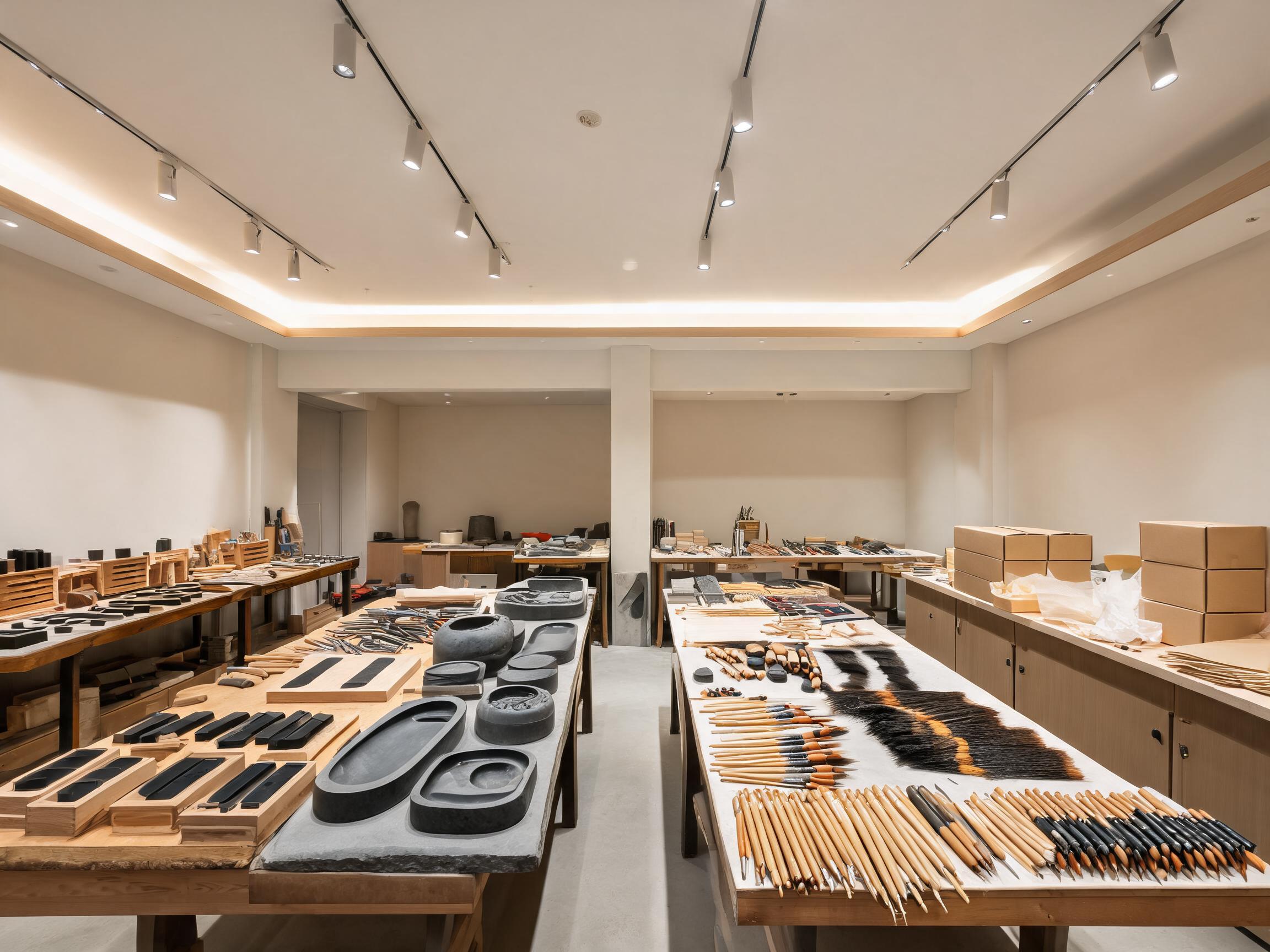
A procurement guide for overseas importers on assembling Chinese calligraphy set assortments for cultural gifting, school/student retail, and corporate programs. Covers component pairing, set-level QC, MOQ and lead-time planning, and private-label packaging decisions.
Building a Chinese calligraphy set assortment for a gift channel, a school supplier, or a corporate program usually means answering the same question: which components go into the box, and how do you keep quality and margins under control once the order scales?
This guide focuses on three specific sales channels and how each one pulls set composition in a different direction. It covers component pairing (ink stick + inkstone + brush + Xuan paper), set-level quality control, MOQ and lead-time planning, and private-label packaging decisions. It is written for importers and gift-channel buyers who already know their market and need to match a supplier’s offer to it.
Key Takeaways
- Set composition should follow the channel: cultural gifting favors presentation and complete components; school retail favors durability and replaceable parts; corporate programs need private-label packaging and reliable lead times.
- Component pairing matters more than individual quality. A mismatched ink stick and inkstone can make the whole set feel off to the end user.
- MOQ and lead time are set at the completed-set level. For the Complete Scholar Desk Set, MOQ is 30 sets and lead time is 35–50 days after sample approval.
- Private-label branding and export documentation are available, so you can plan channel-specific packaging early.
Why set composition is a channel decision
A Chinese calligraphy set is not a single product. It is a group of components that have to work together: ink stick, inkstone, brush, and Xuan paper are the classic four. The way you combine them changes what the buyer can sell it as.
A cultural gift buyer may want a presentation box that looks right on a desk. A school supplier needs sets that survive classroom handling and can be reordered without changing the spec. A corporate program buyer is often buying hundreds or thousands of units with a logo on the box and a fixed delivery window.
The same supplier can serve all three, but the assortment has to be built differently for each. That is where component pairing and set-level QC start to matter more than the catalogue photo.
Channel 1: Cultural gifting
Cultural gifting covers museum shops, cultural centers, diplomatic gifts, and premium tourist retail. These buyers usually care about presentation, authenticity, and completeness. A box that contains all four treasures reads as a serious gift; a box that omits the inkstone often gets returned as “incomplete” in this channel.
What to pair
- Ink stick + inkstone + brush + Xuan paper in a single presentation box.
- A magnetic-closure presentation box is the baseline for this channel because it protects the inkstone during transit and opens flat on a desk.
- Logo printing or a cultural motif on the box lid, with no change to the components, is usually enough for a limited run.
Set-level QC for gifting
The QC question in this channel is whether the set arrives looking like a gift. Check that the inkstone sits firmly in its recess, that the brush is straight and the ferrule is cleanly set, and that the Xuan paper is not creased. A set-level check before packing catches the mismatch that a component-level check would miss.
For a verified example, the Complete Scholar Desk Set contains an ink stick, inkstone, brush, and Xuan paper in a magnetic-closure presentation box. That is the composition this channel normally asks for.
Channel 2: School and student retail
School and student retail buyers — stationery chains, online education suppliers, and art material distributors — look for sets that can be used, replaced, and reordered. The end user is often a beginner, so the set has to be forgiving: easy to hold, easy to clean, and not so expensive that a classroom order becomes a budget problem.
What to pair
- A starter set built around a brush, liquid ink or an ink stick, and a modest inkstone is often easier for beginners than a full four-treasures box.
- Xuan paper in a smaller sheet size keeps the pack compact and reduces waste in a classroom.
- If the channel sells refills, the brush and paper should be available as separate items so the buyer can restock without reordering the whole set.
Set-level QC for school retail
This channel punishes inconsistent sets. If one carton has a brush that sheds and the next does not, the retailer hears about it. Set-level QC with component matching means the brush, ink, and paper are checked together against the same reference, not just individually against a loose tolerance.
A calligraphy starter kit set is the natural fit here. It gives the buyer a lower entry price point than a full scholar desk set while still being a complete, teachable package.
Channel 3: Corporate programs
Corporate programs — employee gifts, client appreciation, conference giveaways, and cultural exchange events — combine two requirements that gifting and school retail do not always share: private-label packaging and a fixed delivery date.
What to pair
- A complete set with a clear brand area on the box is easier to approve internally than an unbranded product.
- Components should be robust enough to survive bulk shipping and still look presentable when the recipient opens the box.
- If the program has a theme, the packaging insert can carry it without changing the calligraphy components inside.
Set-level QC for corporate programs
Corporate orders are often approved in one batch and delivered in another. The set-level QC record should match the approved sample: same components, same pairing, same packaging. If you change the brush or the paper between the sample and the bulk order, the set is no longer the set that was approved.
For a higher-presentation corporate option, a premium scholar desk gift set keeps the same component logic but upgrades the presentation layer. That is often what corporate buyers mean when they ask for a “gift-ready” version.
Component pairing: ink stick, inkstone, brush, Xuan paper
The four components are not interchangeable parts. They are a system, and the pairing affects how the set performs for the end user.
| Component | What it does | Pairing consideration |
|---|---|---|
| Ink stick | Ground with water to make ink | Should match the inkstone surface and the buyer’s expected use; a beginner set may pair better with liquid ink |
| Inkstone | Grinding surface for the ink stick | Needs a stable recess in the box; size should suit the brush and paper in the set |
| Brush | Writing and drawing | Ferrule and tip should suit beginner or experienced use; the handle should fit the box layout |
| Xuan paper | Writing and painting surface | Sheet size and packing format should match the channel: gift boxes, classroom packs, or corporate kits |
A set that pairs these four consistently will feel right in any of the three channels. A set that pairs them loosely — a large inkstone with a small box, or a stiff brush with a beginner-oriented kit — will generate returns in gifting and school retail and revisions in corporate programs.
MOQ and lead-time planning across channels
For a complete set, MOQ and lead time are quoted at the set level, not the component level. The verified data for the Complete Scholar Desk Set is MOQ 30 sets and lead time 35–50 days after sample approval.
That gives you three planning anchors:
- Sample first. Lead time starts after sample approval, so the sample round is part of your calendar. Build it in before you commit to a delivery date.
- 30 sets is the floor. If a corporate program needs multiple variants (for example, two packaging designs), plan them as separate set-level orders unless the supplier confirms otherwise.
- 35–50 days is the post-approval window. For a fixed event date, work backward from the delivery date and confirm the sample approval milestone with your supplier.
If your channel needs a different component mix — for example, liquid ink instead of an ink stick for a school set — confirm the MOQ and lead time for that specific configuration. Set-level quoting means the numbers can change with the composition.
Private-label packaging decisions
Private-label branding is available on the set, which is usually the single biggest lever a buyer has over channel fit.
Decide early on three things:
- Where the brand goes. Box lid, inner card, or both. The magnetic-closure box gives you a flat, printable surface.
- Whether the packaging changes the set. A logo on the box is a packaging change. Changing the insert, the paper size, or the brush is a component change. Keep those decisions separate in your brief.
- What stays standard. The fewer component changes you make, the easier it is to keep the set-level QC reference stable across reorders.
Export documentation is included, so your customs and compliance team can work from the same order record as your packaging team.
FAQ
Can I mix components from different product pages into one custom set?
Ask your supplier to quote the specific configuration. Set-level MOQ and lead time apply to the completed set, and changing a component can change both.
Is a magnetic-closure box suitable for bulk shipping?
It is the verified packaging for the Complete Scholar Desk Set. For high-volume corporate programs, confirm the carton configuration with your supplier so the box protection matches the shipping method.
How do I handle QC across multiple production runs?
Use set-level QC with component matching: check the completed set against the approved sample, not just individual components against a loose spec. Keep the approved sample as the reference for every reorder.
What is the typical lead time for private-label sets?
For the verified Complete Scholar Desk Set, lead time is 35–50 days after sample approval. Private-label packaging is reviewed during the sample round, so it should not add a separate approval stage unless you change the packaging structure.
Next steps for buyers
Start by naming your channel. Cultural gifting, school retail, and corporate programs each pull the component pairing and packaging in a different direction, and the supplier’s quote will only be accurate if the brief says which one you are buying for.
From there, request a sample set that matches the intended channel, confirm the MOQ and lead time for that exact configuration, and decide your private-label packaging scope before sample approval. Gu Mo Craft Technology integrates design, manufacturing, QC, and export, and its product lines include Hui ink sticks, liquid ink, four-treasures sets, inkstones, brushes, seals, Xuan paper, and craft ornaments — useful when a channel needs a component variation rather than a standard set.
If you are comparing configurations for a specific program, send the component list, packaging direction, and target delivery window to your supplier first. That is the fastest way to get a set-level quote that reflects what you actually need to import.