
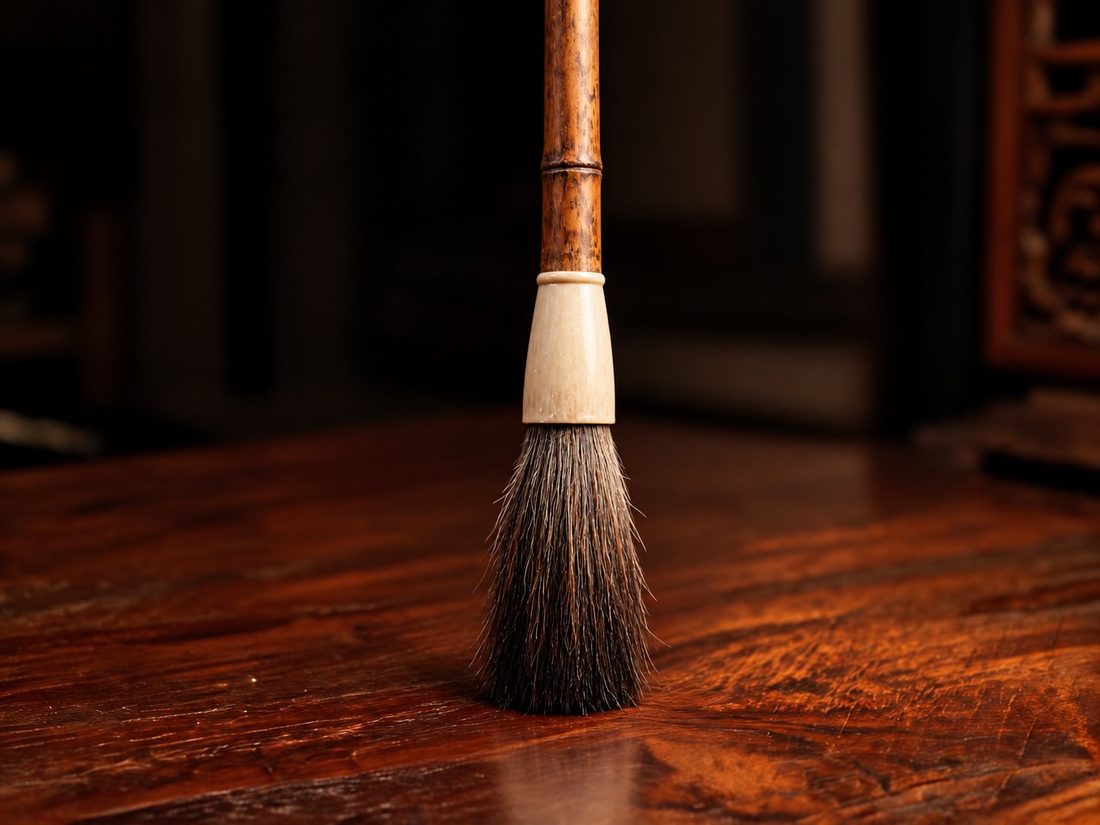
A buyer's four-point sample check for a single wolf hair stiff-tip brush: tip formation, spring-back, hair coverage and ferrule security.
A wolf hair calligraphy brush is usually bought as one SKU inside a wider brush line, but it is the piece that decides whether a retailer's brush wall earns repeat orders. One brush, judged on sample, tells a buyer most of what they need to know about the supplier's brush sourcing as a whole.
What "wolf hair" means in an export listing
In export catalogues, "wolf hair" describes a stiff-tipped brush made from dark, resilient hair that returns to a point after each stroke. It is the stiff end of the common hair spectrum: goat hair is the soft end, and mixed hair sits between them.
The name is a category label, not a species guarantee. Buyers should therefore treat the listing term as the start of a conversation and confirm three things in writing: the hair family claimed, whether it is a single hair or a blend, and how the supplier describes the expected stiffness. A supplier who can answer these precisely is usually one whose other brush descriptions can be trusted too.
Testing one brush on sample
A single brush can be evaluated without equipment, and the sequence matters less than covering all four properties.
| Property | What to do | What a good result looks like |
|---|---|---|
| Tip formation | Wet and form the tip, then inspect | A single fine point, no stray hairs crossing it |
| Spring-back | Bend the tip and release | Returns to point without staying bent |
| Hair coverage | Press the tip flat and look at the belly | Hair fills the ferrule evenly, no gaps at the edge |
| Handle and ferrule | Wiggle, then flex the handle lightly | No movement at the ferrule joint |
Any brush that fails the ferrule check will fail in the customer's hands too, because a loosening joint is the most common reason brushes are returned. The three hair checks together predict how the brush performs on the first few uses, which is what retail customers judge.

Where a single stiff-tip brush sits in a retail range
Most buyers stock wolf hair alongside a soft counterpart so that customers can choose by feel. The Wolf Hair Stiff Tip Brush serves the stiff end and the Goat Hair Soft Tip Brush the soft end, with a mixed-hair option bridging the two. A single wolf hair brush is therefore not a niche item; it is the anchor of the stiff side of a three-way display.
For premium shelves, the same hair family is offered in a higher-grade version as the Premium Wolf Hair Calligraphy Brush, which lets a retailer carry one hair type at two price points without confusing the display.
What to confirm before ordering in volume
- The hair family and blend described for the specific SKU, not just "wolf hair".
- Whether tip size is stated by the supplier or must be specified by the buyer.
- How brushes are protected in transit so tips arrive straight.
- Whether the handle material matches the market's expectation at that price point.
- Whether a retained sample is possible so reorder quality can be compared directly.
Frequently asked questions
Is wolf hair suitable for beginners?
Stiff hair is more predictable for a first-time user because it holds its shape, which is why teaching channels often start there. It is harder to ruin a stiff brush than a soft one in untrained hands.
How is a wolf hair brush different from a mixed-hair brush?
A single-hair brush behaves consistently across the whole tip; a mixed-hair brush combines stiffness in the core with softness at the edge. Retailers usually explain this by feel: one is springy, the other is springy with a softer surface.
Can one supplier cover all hair types?
Many do, but the buyer should confirm each hair type separately, because sourcing and grading differ. A supplier who describes one hair type carefully usually applies the same discipline to the others.
What should be checked first on arrival?
Tips first: straightness and point formation show transit damage immediately. Then ferrule joints, which take longer to fail but are the costliest defect.
Next step for buyers
Buyers building a brush line should start with one wolf hair sample and judge it against the four checks above. Review the Wolf Hair Stiff Tip Brush and the Premium Wolf Hair Calligraphy Brush, then send your channel and the price tiers you plan to stock for sample arrangement.