
Suzuri is the Japanese word most overseas buyers meet first, and it is also the word most likely to be misunderstood in a purchase order. The term names a class of object, not a specification, so an order written around it can be met by several different products.
What the term does and does not describe
Suzuri identifies the object: a stone used to raise ink from a stick and water. That is all it settles. It does not describe size, weight, stone type, grinding behaviour, whether a lid is present, or whether a box is included.
Two consequences follow. First, a supplier can legitimately quote very different items against the same word. Second, a buyer cannot use the word as a specification in an order confirmation and expect a repeatable result.
Translating the term into order lines
| Term-level description | What the order line should state instead |
|---|---|
| Suzuri, size 6 | Measured length, width and height in millimetres |
| Suzuri, with lid | Lid material, fit and whether the lid doubles as the box |
| Suzuri, natural stone | Stone family claimed, and how the grinding face is prepared |
| Suzuri, gift quality | Box type, lining, closure, and whether paper or a brush is included |
The right-hand column is what a production team needs. The left-hand column is what a search box needs. Confusing the two is the single most common cause of a first order that cannot be repeated.
Sizes, formats and what actually changes
Format is a stocking decision before it is an aesthetic one. A larger stone carries more weight, needs a larger box and occupies more volume in transit, so a step up in format is a step up in landed cost even when the stone price moves very little.
Working formats and display formats also behave differently in a range. A working stone is bought for the grinding face and is consumed by daily use. A display stone is bought for appearance and is judged at unboxing. Both can sit in the same catalogue, but they need different box decisions: a working stone can travel in a simple carton, while a display piece needs presentation packing agreed in advance.
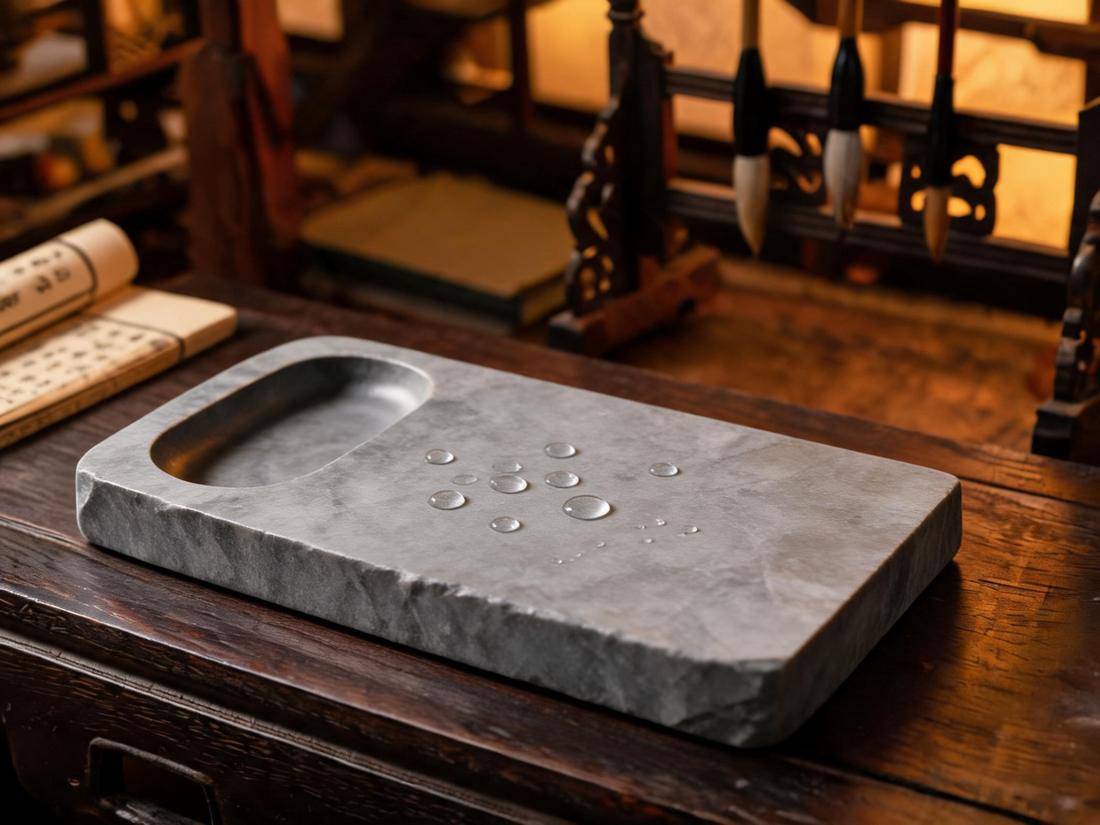
On this site that split shows up clearly between the plain Practice Inkstone and the carved Classic Duan Inkstone.
The accompanying items that decide the price tier
Once a stone ships in a box, three additional decisions appear: what else is in the box, how the contents are held in place, and what documentation travels with it. Each one moves the item between channels.
A stone alone suits a studio or classroom. A stone with a brush, a stick and paper suits a gift channel, which is how complete configurations such as the Complete Scholar Desk Set are built. The buyer's job is to know which of the two they are ordering, since the packing requirement and the price tier change together.
Agreeing behaviour, not appearance
Because stone is natural, two pieces from the same order can look alike and behave differently. Buyers should agree in writing how the supplier describes grinding behaviour for the batch, and keep a retained sample so the next shipment can be compared against a physical reference rather than a memory.
Checks before confirming a suzuri order
- The word translated into measured dimensions, weight and format.
- Stone family claimed, and grinding face preparation stated.
- Whether a lid is supplied, and what the lid is made of.
- Box specification if the item is sold as a gift, including insert and closure.
- Which accompanying items are included, listed individually.
- Retained sample kept for reorder comparison.
Frequently asked questions
Is suzuri a brand or a product type?
It is a product type. It identifies the object rather than a maker or a specification, which is why it cannot be used as a substitute for measured values.
Does a larger stone always hold more ink?
Not automatically. What matters is the dimensions of the grinding area, which should be stated separately from the overall size of the stone.
Should the order line mention a box?
Yes, whenever the item will be sold in a box. If the box is not on the order line, the buyer has no basis for a repeat order.
How should the item be described on a retail listing?
By the properties the supplier is prepared to state — material, format and what is included. Trade names can accompany that description but should not replace it.
Next step for buyers
Send the format, the channel and the components you want in the box, and the item can be specified as a single order line. Review the inkstone and set options above, then ask for measured values before the order is confirmed.