
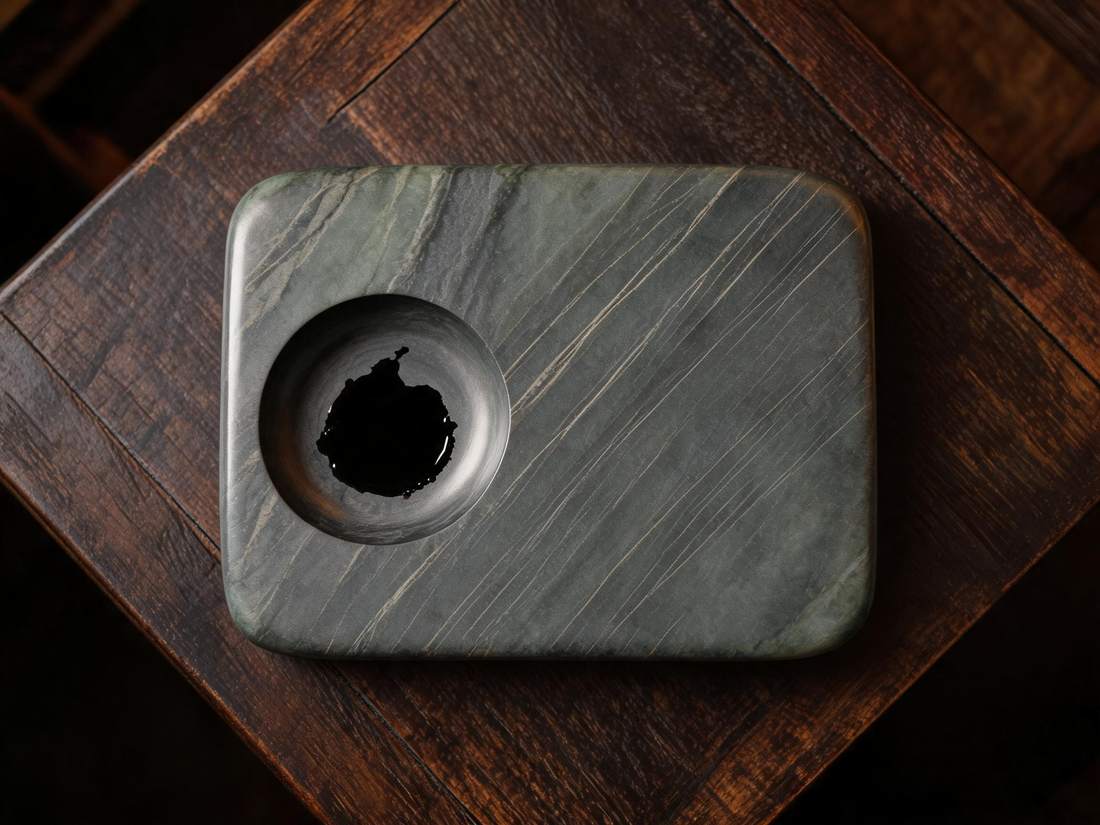
A buyer's guide to She inkstone sourcing: what the stone name covers, how grain, grinding-face finish and stone condition decide performance, and the size, packing and disclosure checks to confirm before ordering.
She inkstone is one of the two stone types most often named in Chinese inkstone sourcing, and it is regularly quoted alongside Duan stone without either side explaining what actually differs. For a buyer comparing offers, the useful question is not which name is more prestigious, but which stone suits the customer you are selling to and how the stone behaves under a brush.
What the seller means by "She stone"
She inkstone refers to inkstones made from stone associated with the She region, in what is now Anhui province. The name describes a family of stone rather than a single quarry product, and stones sold under it vary in appearance from fine, dense dark stone to pieces with pronounced natural banding.
That variation is the first sourcing issue. Because the name covers a range, two suppliers can both quote "She inkstone" and be offering products that differ substantially in density, grain and finish. Buyers should treat the name as a starting category, not as a specification.
Gumo Craftworks supplies She Inkstone Premium alongside Duan stone in the Classic Duan Inkstone line, so the two can be compared directly for the same channel.
The properties that decide grinding behaviour
An inkstone has one functional job: to turn a solid ink stick and water into usable ink. Three stone properties drive how well it does that.
- Grain and density. Finer stone with a dense structure typically grinds ink smoothly. Coarse or uneven grain shows up as grit in the ink and as faster wear on the ink stick.
- Surface preparation. The grinding face is worked to a finish. A face that is too rough abrades the stick quickly; one that is too polished can be slow to raise ink. The finish is a manufacturing choice, so it should be a stated part of the specification.
- Stone condition. Natural cracks, inclusions and repairs are the risks specific to stone products. A piece that looks sound on a photograph may carry a filled line, which can open further when the stone is used or shipped.
These are the questions worth putting to a supplier, because they translate directly into the two complaints an inkstone buyer receives from customers: the ink grinds gritty, or the stone is slow to raise ink.

Reading stone quality without handling it
Buyers seldom see inkstones before ordering, which makes the written and photographic evidence more important than in most product categories.
| What to check | Useful evidence | Why it matters commercially |
|---|---|---|
| Stone name and origin claimed | A clear statement of the stone family, not only a trade name | Determines whether your product description is defensible |
| Grinding face finish | A description of how the face is worked | Drives the customer's first experience of the product |
| Dimensions and weight | Measured figures per size tier | Sets packing design and freight cost |
| Surface condition | Views of the stone from more than one angle, including edges | Cracks and repairs are most visible at the edges |
| Carving versus utility | A statement of whether the piece is decorative or intended for regular grinding | Decorative pieces sell differently and carry different expectations |
The last row is the one buyers most often leave undefined. A heavily carved inkstone can be a beautiful object and a poor daily grinder if the grinding area has been sacrificed to the decoration. Both are legitimate products, but they serve different customers, and a buyer who does not establish which one they are selling will end up with returns from the wrong segment.
Sizing, packing and freight
Inkstones are dense and hard. That combination makes freight packaging a real part of the cost rather than an afterthought.
Weight per unit rises quickly with size, and a larger stone does not necessarily sell for proportionally more. Buyers should decide the size tiers they want to stock and check how price and weight move between them before committing, because a stone that is expensive to ship can be unprofitable even at a healthy unit margin.
Packing has to prevent stone-to-stone contact. Stones packed touching each other can chip at the rim even when the outer carton is undamaged, and rim damage is immediately visible to a customer. Individual wrapping or a fitted insert is the difference between a clean delivery and a claim.
Comparing She and Duan stone for a channel
The two are often treated as alternatives, and for most buyers the choice is commercial rather than technical. Duan stone is the more widely recognised name and carries strong associations for collectors and gift buyers. She stone is also named in traditional references and is frequently specified by buyers looking for a different visual character.
Since both stones work as inkstones, the deciding factors are usually price tier, appearance, and what your customer base recognises. A distributor selling into a market where neither name is familiar should choose on the basis of the object itself — how it looks and how it performs — rather than on the strength of a stone name the customer has never encountered.
Checks before confirming an inkstone order
- The stone family claimed, stated in writing rather than as a trade name only.
- How the grinding face is prepared and finished.
- Whether the piece is intended for regular grinding or mainly decorative use.
- Measured dimensions and weight per size tier.
- How cracks, inclusions or repairs are disclosed, and how they are photographed.
- Inner packing method that prevents stone-to-stone contact.
Frequently asked questions
Is She stone better than Duan stone?
Neither is better in general; they are different stones with different appearance and recognition. The right choice depends on your price tier, your customer's expectations and how the object looks in the box.
How can a buyer assess stone quality remotely?
Ask for statements rather than impressions: stone family, grinding face preparation, measured dimensions and multi-angle views including the edges, where cracks and repairs show first.
Should a decorative inkstone be sold as a usable one?
Only if the supplier confirms the grinding area is workable. Many carved pieces are display objects, and selling one as a daily grinder invites a return.
What causes chipping in transit?
Stone-to-stone contact inside the carton is the usual cause, even when the outer box arrives intact. Confirm the inner packing method before ordering.
Next step for buyers
Buyers specifying an inkstone line should settle the stone family, the intended use and the size tiers first. Review the She Inkstone Premium against the Classic Duan Inkstone, then send your target channel, size tiers and expected volume so the specification can be matched to what your market will recognise.