
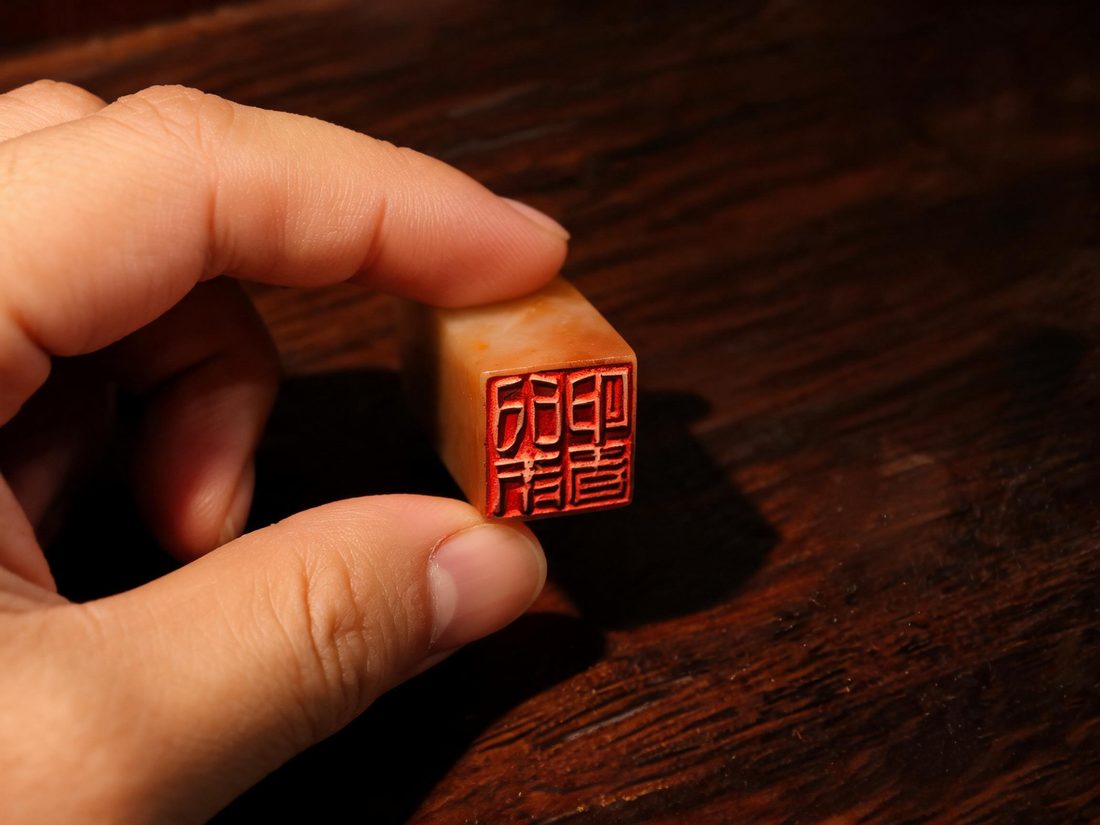
A name seal stamp is a personalisation product, and personalisation changes the sourcing conversation. Unlike a stock SKU, a seal order carries text supplied by the end customer, which means the approval step is where most of the risk sits. A buyer who manages that step well can run seal programmes profitably at volume. A buyer who treats it like a normal catalogue item usually discovers the problem after the seals are already carved.
Why name seal orders behave differently
Every other line in a calligraphy range can be sampled, approved and then repeated unchanged. A name seal cannot, because the thing being produced is the text itself. If the text is wrong — wrong character, wrong orientation, wrong arrangement — the unit is unsellable, and the cost of the error sits with whoever approved it.
The practical consequence is that the approval workflow matters more than the per-unit price. Ask how many proofs are included, how a revision is handled, and who confirms the final version before carving begins. A supplier who can describe a clear approval sequence is worth more on this product than one who is simply cheaper per unit.
Engraving options buyers should be able to explain
Buyers do not need to carve seals, but they do need to describe the options accurately to their own customers, because the choice is usually made at the point of sale.
- Script style. Seal script and regular script read very differently at small sizes, and the arrangement of characters affects legibility more than the size of the seal.
- Layout. Characters can be arranged in columns or rows. The layout decision usually belongs to the customer, which means the buyer needs a clear way to capture it.
- Positive or negative cutting. The two produce visibly different impressions, and customers often have a strong preference once they see examples.
- Language coverage. A supplier who can carve non-Latin scripts widens the markets you can serve, which matters if you sell into more than one diaspora community.
Gumo Craftworks produces custom-carved name seals with multi-language engraving and a proof sample approval step, alongside the Premium Shoushan Seal Stone line for higher-grade work and the Practice Seal Stone for volume programmes.

Designing an approval workflow that scales
At low volume, a buyer can handle each seal individually. At programme volume that breaks down, and the fix is a repeatable sequence rather than more effort.
| Step | What happens | What it prevents |
|---|---|---|
| Collect | Customer text, script preference, layout and size are captured in one form | Incomplete orders that stall mid-production |
| Proof | Supplier returns a layout proof for the buyer to review | Layout errors that only become visible after carving |
| Approve | Buyer confirms the proof in writing; no further changes are accepted | Ambiguity over which version was authorised |
| Carve and pack | Production begins against the approved proof | Rework caused by late changes |
| Retain | The approved proof is kept with the order record | Disputes where neither side can show what was agreed |
The last step is the one buyers most often skip, and it is the one that protects them. If a customer later claims the seal is wrong, the retained proof settles the question in one document.
Stone, size and price tier
Seal programmes usually span more than one grade, because the same customer base buys differently for daily use and for gifting. A practice-grade stone suits high-volume personalisation where the seal will be used and handled constantly. A premium stone suits gift and collector channels where the object itself is presented.
Size interacts with both. A larger seal gives the carver more room, which makes complex characters easier to read, but it also raises stone cost and changes the packing required. Buyers should confirm the size tiers offered and how the price moves between them before quoting a customer.
Packing follows the same logic. A personalised seal is almost always given to someone, which makes the presentation box part of the deliverable. The Seal Carving Gift Set illustrates how a stone, paste and tools are grouped when the item is bought as a gift rather than as a tool.
Checks before placing a seal programme order
- Which scripts and languages the supplier can carve.
- How many proof rounds are included, and what a revision costs.
- Who confirms the final version, and how that confirmation is recorded.
- Size tiers offered and how price changes across them.
- Which stone grades are available for the volume you plan.
- Box and pack options for the personalised unit.
Frequently asked questions
Can a seal be produced from a photograph of a signature?
That depends on the supplier's capability and on how legible the source image is. The reliable approach is to ask for the text or artwork in a defined format, then confirm it through a proof before carving.
How many revisions should a buyer expect?
Revision terms are part of the quotation, so ask rather than assume. What matters more than the number is that the workflow defines a clear point after which the design is fixed.
Do personalised seals take longer than stock items?
They usually do, because proof approval sits in the timeline before production. Ask for the lead time measured from proof approval rather than from order placement, so the schedule is realistic.
Should seals be ordered with ink paste?
Paste is the consumable that makes a seal usable, so many gift and retail programmes pair the two. Confirm whether paste is included, supplied separately, or sold as part of a set.
Next step for buyers
Buyers running a personalisation line should define the proof workflow before negotiating price, because that is where the cost of errors sits. Review the Custom Carved Name Seal and the Seal Carving Gift Set, then send your planned volume, the languages you need and your proof-review process so the supplier can match it.