
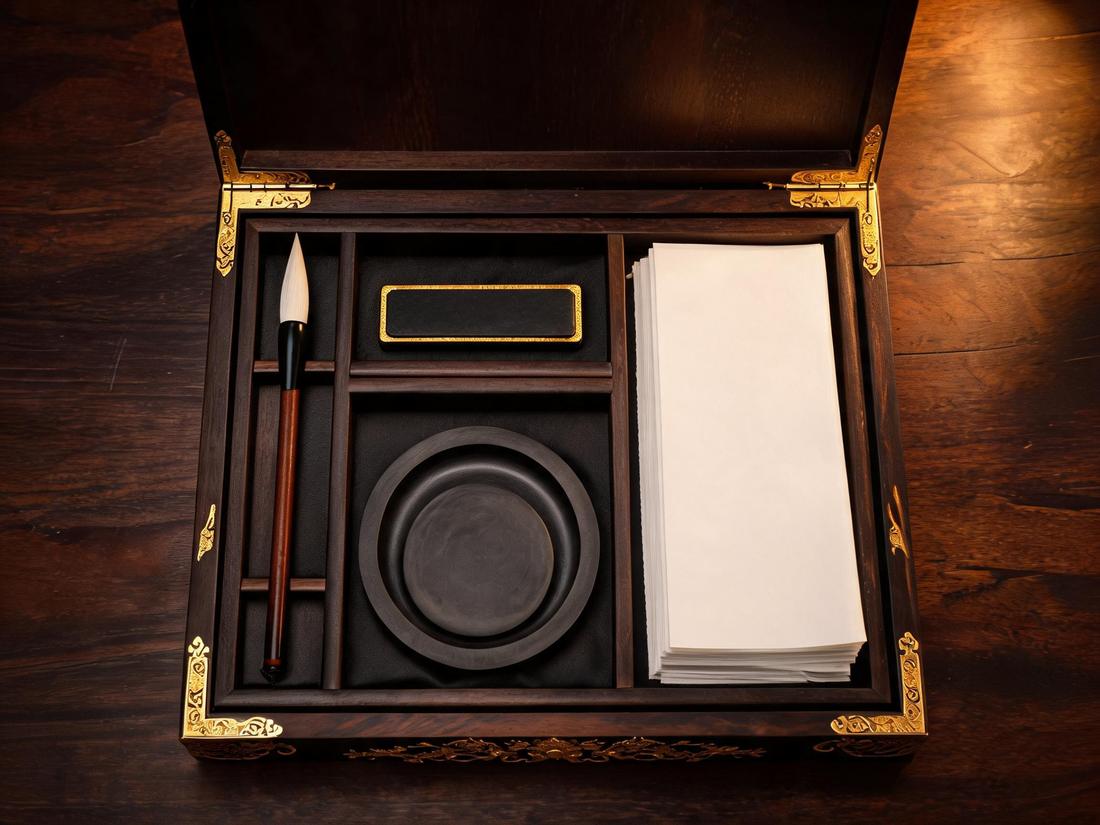
Buyers who search for Japanese ink stones usually already know what the object does. What they do not have is a reliable way to read a supplier's catalogue, because the naming convention used in Japanese-market listings is not the same as the naming convention used in export catalogues. That mismatch is where orders go wrong.
Why the naming does not match the specification
A catalogue entry commonly gives three things: a trade name, a size code and a packaging description. None of the three is the same as a specification. The trade name describes the market the item was made for, the size code describes a format rather than measured dimensions, and the packaging description describes a box rather than the stone inside it.
That is workable as long as buyers translate the entry into measured values before ordering. It becomes a problem when a purchase order repeats the catalogue name and expects the second shipment to match the first.
The four values worth putting in writing
| Value | Why it decides something commercial |
|---|---|
| Measured length, width and height | Sets the box, the freight volume and what the end user's desk can hold |
| Weight per piece | Drives freight cost, and in this category weight rises faster than size |
| Grinding area dimensions | Decides how much ink can be raised in one session |
| Box type and closure | Whether the item can be sold as a gift, or only as a working tool |
Where a supplier can state these four values, the catalogue name becomes a label rather than a risk. Where it cannot, the buyer is ordering by name and hoping.
The box is part of the product in this category
Inkstones in the Japanese-market tradition are frequently bought as presentation objects, which means the box is not shipping material. It is the object's second half.
Two consequences follow for buyers. First, the box and the stone should be quoted together and reordered together, because a stone that fits one box will not necessarily fit the next. Second, the box has to be checked for the same things a gift box is checked for: lid fit, lining, and whether the stone is held firmly enough that it cannot move in transit.
Where the offer is a gift configuration rather than a single stone, the packing becomes the packaging item in its own right, which is the logic behind pieces such as the Premium Craft Gift Box.

What the stone can and cannot tell you at inspection
Stone is a natural material, so appearance at inspection proves less than buyers expect. Grain, colour and markings can be described and photographed, but they do not by themselves prove how the stone behaves under a stick.
The practical approach is to treat the two questions separately. Appearance is a commercial decision about which tier the stone belongs in. Behaviour is a specification question that has to be answered by the supplier for the specific batch, and then checked against a retained sample when the next order arrives.
For buyers building a range, the tiers usually resolve into a working stone for daily use and a carved stone for display, as with the Classic Duan Inkstone and the smaller Compact Travel Inkstone. Both are stones; they are not interchangeable in a stocking plan.
Packing stone for long transit
These items are small, dense and often boxed, which is a difficult combination. The two failures seen most often are stone-to-stone contact in a shared carton and the stone moving inside its own box.
The fix is unglamorous and should be agreed before shipment: individual protection for each piece, a transit carton separate from the retail box, and confirmation that the insert actually holds the stone rather than merely surrounding it.
Checks before confirming an order
- Catalogue name translated into measured dimensions and weight.
- Grinding area dimensions stated, not estimated from photographs.
- Box type, closure and insert confirmed, with the box quoted as part of the item.
- How batch-to-batch variation is described and checked.
- Retained sample kept from the approved run.
- Transit carton specified separately from the retail box.
Frequently asked questions
Is a Japanese-market stone a different product from a Chinese-market stone?
The markets differ in naming, box conventions and presentation expectations. What a buyer should specify is the object in front of them, which is why measured values matter more than the trade name.
Can I order by size code only?
Size codes are useful for building a range, but they do not tell you dimensions or weight. Both should be stated in the order confirmation.
How do I check consistency between shipments?
Keep a retained sample from the approved order and compare the new delivery against it, rather than against a description.
Should the box be quoted separately?
In gift and presentation channels, no. The box is part of what the customer buys, so it should be specified, priced and reordered with the stone.
Next step for buyers
Send the format you intend to stock, the channel it is sold through and your volume, and the stone, box and packing can be quoted as one item rather than three. Review the inkstone range above, then ask for measured dimensions before the order is confirmed.