
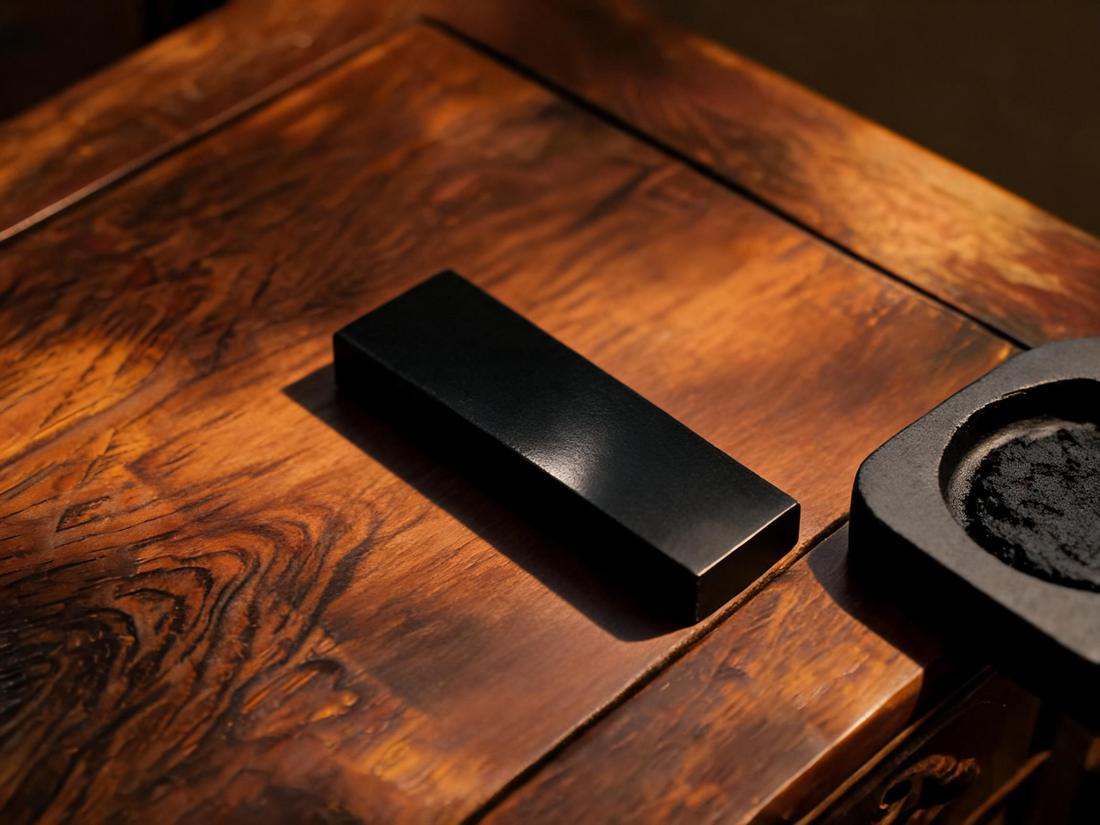
A hui ink stick is a slow product. It is ground by hand, stored for years, and bought repeatedly by the same customers. That makes it unusually dependent on batch consistency: a buyer who gets the tone right once can build a decade of reorders out of it, and a buyer who gets it wrong once usually loses the account.
What distinguishes a hui ink stick from other ink
A hui ink stick is a solid block of refined soot and binder, ground with water on a stone to produce ink on demand. The hui tradition is associated with the historic ink-making region around Huizhou, and it covers both pine soot and oil soot formulations.
For buyers, the useful distinction is not regional language but process. Traditional production involves refining the soot, mixing it with a natural binder, hammering the mixture into a uniform paste, pressing it into moulds, and then drying the sticks slowly over an extended period. Each of those steps leaves a mark on the finished product that a buyer can check.
Gumo Craftworks produces across this range: the Oil Soot Hui Ink Stick Classic for studio work, the Premium Pine Soot Hui Ink Stick with hand-carved gold-filled patterns, and the Student Practice Hui Ink Stick for volume programmes.
Soot type is the first decision, not the price
The soot decides the ink's character, and the two common types behave differently enough that they serve different customers.
| Soot type | Typical character | Buyer segments that usually specify it |
|---|---|---|
| Pine soot | Warm, matte black; generally the more affordable grade | Teaching programmes, practice ranges, general calligraphy |
| Oil soot | Glossier, higher-contrast black | Studios, professional supply, premium retail lines |
| Coloured sticks | Pigment-based colour rather than black | Painting studios, gift sets, art supply retail |
A buyer comparing two quotations on price alone will often be comparing a pine soot grade against an oil soot grade without realising it. Naming the soot type in the enquiry is the fastest way to make quotations comparable.

The checks that separate a repeatable stick from a one-off
Four properties decide whether a hui ink stick can be reordered with confidence.
- Soot purity and refining. Fine, even soot grinds smoothly. Gritty grinding is the complaint that most often reaches a distributor, and it usually traces back to soot processing.
- Binder proportion. Good binder holds the stick together without making it brittle. A stick that crumbles or chips easily is a handling problem before it is an ink problem.
- Drying control. Slow drying is what prevents cracks and warping. Sticks that are dried too quickly can look correct at packing and develop hairline cracks later — exactly the failure a buyer cannot see at the sampling stage.
- Tone consistency across the batch. Bulk buyers need the same reading from every stick, which is a batch control question rather than a single-stick question.
Buyers should ask how each of these is recorded, and whether a retained sample is kept so a reorder can be compared against the approved one.
Carving, gold work and the gift channel
Once a stick moves into a gift or collector channel, the decorative surface becomes part of the product. Carving depth, gold application and pattern clarity all affect how the item reads in a box, and they are also the things that vary most visibly between batches.
The Commemorative Gold-Edge Hui Ink Stick and the Colored Hui Ink Stick Set illustrate two different gift directions — a single commemorative piece and a multi-colour set. Both raise the same sourcing question: whether the decorative finish can be held consistent across a production run, and what happens to the order if it cannot.
Packing, storage and shelf life
Ink sticks are dry, brittle objects, and most transit damage is mechanical rather than chemical.
- Individual protection. Each stick should be wrapped or cradled so it cannot strike a neighbour in transit.
- Rigid outer packing. Sticks stored loose in a carton will chip at the corners and edges.
- Storage conditions. Ask your supplier what conditions the grade tolerates, because moisture and heat are the two factors most likely to soften a stick or dull a carved surface.
- Display handling. If the stick will sit in a retail display, confirm how much handling the surface tolerates before the finish shows wear.
Checks before confirming a hui ink stick order
- Soot type stated for every grade quoted.
- Which properties are recorded per batch, and how.
- Drying approach and the time allowed, since it drives long-term cracking risk.
- Carving and gold application standard for any gift-channel grade.
- Individual wrapping and outer carton design for your route.
- Whether a retained sample is kept for reorder comparison.
Frequently asked questions
How long does a hui ink stick last in storage?
Solid ink sticks are supplied dry and are intended for long storage, but the conditions matter. Ask your supplier what storage conditions apply to the specific grade rather than relying on a general figure.
Can a buyer test a stick before committing to bulk?
Sampling terms are part of the quotation, so ask. The more useful question is whether the supplier retains a sample from the approved order, since that is what protects your reorders.
Is oil soot always better than pine soot?
No. They serve different purposes. Pine soot suits practice and general calligraphy; oil soot suits studios seeking a glossier, higher-contrast black. Matching soot to end use matters more than ranking the two.
What causes hairline cracks in ink sticks?
Cracks are usually associated with drying control and with handling in transit. Both are production and packing questions, which is why buyers should ask about drying time and inner protection before ordering.
Next step for buyers
Buyers building an ink stick line should settle the soot type and the batch documentation before discussing price. Review the oil soot classic, the premium pine soot stick and the student practice stick, then send your channel, quantity and the ink tone you need to match.