
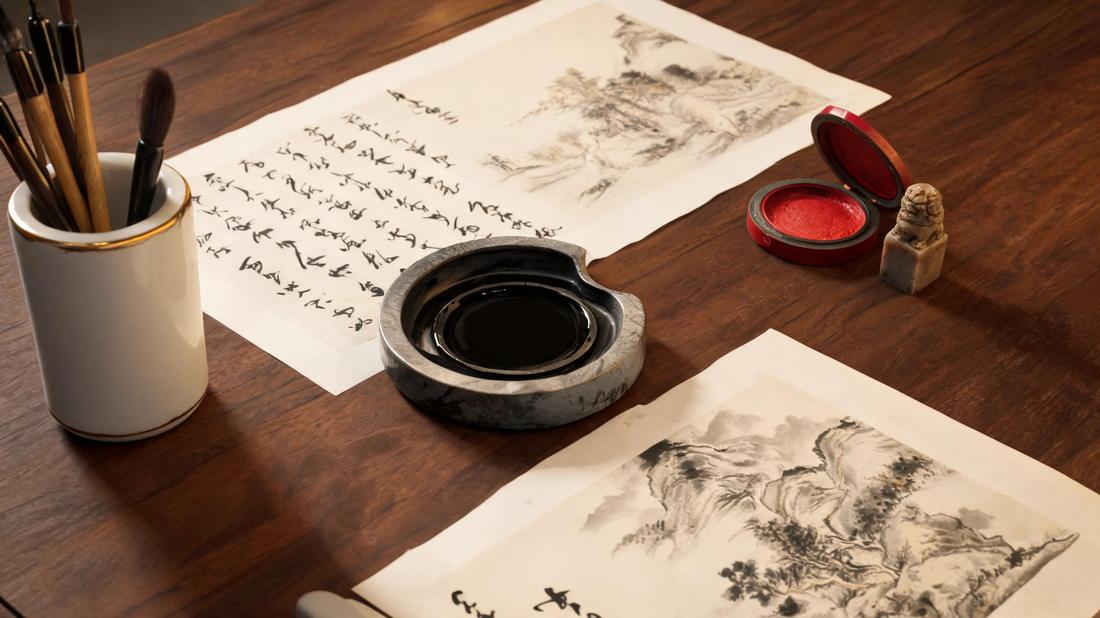
Buyers treat the four treasures of calligraphy as one purchase. Suppliers know they are not. In use, two of the four are consumed and two are kept, and treating them as a single line item is how a programme ends up with a drawer full of inkstones and no paper.
The four treasures split into durables and consumables
The set is usually listed as brush, ink, paper and inkstone. Read that list again as an inventory manager would.
- Brush. A durable with a working life. It is kept, cleaned and reused, and it fails gradually rather than running out.
- Inkstone. A durable with no reorder rhythm. It is bought once per user and replaced only after loss or damage.
- Ink. A consumable. Whether it is a stick or a liquid, it is the item that disappears as the user works.
- Paper. The fastest-moving consumable in the set, and the one that decides whether a reorder is urgent or optional.
That split, not the packaging, is what should drive a reorder plan. Two of the four items will be reordered by the end user; two will not. A buyer who builds a range on a single boxed configuration without thinking about which parts run out is effectively selling one-time purchases and calling them a category.

What that means for reorder intervals
Interval is not a fixed number a supplier can quote from a catalogue; it depends on how often the user works, how large the format is and how much ink a session takes. What a buyer can fix is the relative ranking: paper moves fastest, ink next, and the brush and stone last.
That ranking changes what belongs in the second and third shipments. A retail programme that ships sets only will lose the repeat business to whoever supplies the paper and ink refills, so distributors usually do best to keep consumables available as separate, orderable items — for example the Student Practice Xuan Paper and Student-Grade Liquid Ink alongside the boxed configurations.
The set only works if the four match
Four good items can still make a bad set. The failure happens at the pairing: a very absorbent paper with a very wet ink, or a small inkstone paired with a large brush that holds more water than the stone can serve.
| Pairing | What goes wrong | What to check |
|---|---|---|
| Brush too large for the inkstone | The user cannot load the brush comfortably from the stone's well | Size relationship between brush head and stone |
| Paper and ink mismatched | Lines spread or dry too fast for the intended script | Stick or liquid ink against the paper surface |
| Stick supplied without a stone | The set cannot be used as delivered | Whether the ink format needs grinding to work at all |
Conventional configurations pair a ground ink with a stone and a liquid ink with any paper, but the choice has to be confirmed per configuration rather than assumed. Gumo Craftworks builds desk configurations such as the Complete Scholar Desk Set and the Premium Scholar Desk Gift Set, with the consumable side supplied separately through items such as the Student Practice Hui Ink Stick and the Practice Inkstone.
Channel fit changes the accent
- Gift channel. Presentation carries the sale and the box is part of the product. Consumables still need to be findable afterwards.
- Teaching channel. Repeat volume sits in paper and ink, so the configuration should be chosen for what it teaches and what can be reordered cheaply.
- Studio and professional channel. Tools are specified individually; buyers here rarely want a boxed set at all.
- Collector channel. The stone and the ink stick carry the value, and the brush and paper matter less to the decision.
Checks before confirming a four-treasures order
- Which items in the configuration are consumables, stated explicitly.
- Whether the ink format requires grinding, and whether the stone is included if it does.
- Brush head size against inkstone size in every configuration.
- Paper format matched to the intended use, not carried over by default.
- Whether consumables can be ordered separately for repeat business.
- Individual packing inside the set, so a broken item does not scrap the box.
Frequently asked questions
Which of the four treasures runs out first?
Paper, in almost every routine. Ink follows, and the brush and inkstone are kept rather than consumed. The relative order is stable even though the interval is not.
Should a set include a liquid ink instead of a stick?
That depends on what the set is teaching or presenting. A stick implies grinding and therefore a stone; a liquid ink is ready to use. The two are not interchangeable inside one box without changing the pairing.
Can I sell the four treasures as a single SKU and stop there?
You can, but the repeat business will go to whoever supplies paper and ink separately. Buyers usually keep the consumables orderable on their own.
Do professional users buy boxed sets?
Rarely. They specify tools individually, so a boxed configuration is better aimed at gift, teaching and retail channels.
Next step for buyers
Buyers should decide which configurations to stock first, then map the consumables behind them. Review the Complete Scholar Desk Set and Compact Travel Inkstone, then send your channel mix, the configurations you plan to stock and your annual volume.