
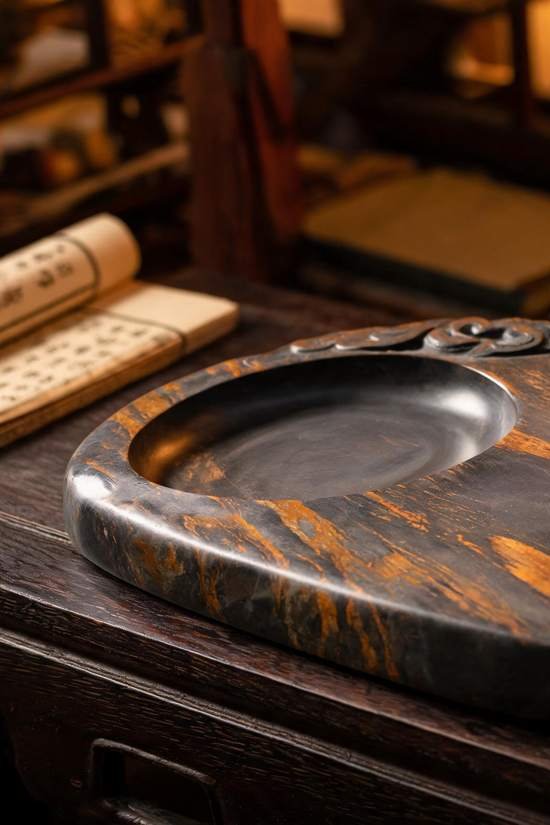
Stone eyes are natural formations inside Duan stone and a recognized grading signal in gift and collector channels. How eyes differ from carved decoration, and how to specify and verify eyes in bulk inkstone orders.
A Round Mark in the Stone: What Buyers Are Actually Looking At
On Duan inkstones, a "stone eye" is a natural mineral formation inside the stone — a rounded marking, often ringed with concentric bands, resembling the eye of a bird or fish. Stone eyes grew inside the rock while the stone formed in the Zhaoqing quarries, so no two eyes read exactly alike. An eye is not paint, not engraving and not damage: the feature belongs to the stone body itself, which is precisely why collectors treat eyes as evidence of genuine Duan material.
Why Stone Eyes Move Prices in Gift and Collector Channels
In the Duan inkstone trade, clear, well-positioned eyes have long been read as a sign of fine stone, and gift and collector channels price accordingly: two inkstones of the same size can sit in different price bands when one carries visible eyes and the other does not. Buyers assembling collector editions therefore treat eyes as a grading signal worth specifying.
Studio and school programs often read the same feature differently: for daily grinding work, grain quality and grinding feel decide value, and a stone without eyes can outperform a decorated piece on pure function. Both readings are legitimate. Trouble starts when a buyer orders at one channel's price logic while the supplier grades at another's — a mismatch invisible until cartons are opened.
Stone Eyes Are Not Carved Decoration
Natural eyes and hand-carved patterns are different value claims, and quotations sometimes blur them. Carving is judged on depth consistency, line quality and finish against an approved design; an eye is judged on clarity, position and how the natural marking sits in the stone. When comparing suppliers, ask which claim stands behind each price line. A "hand-carved decorative" price covers cutting work; a collector price on an eye-bearing stone covers the stone itself. Asking early keeps two different products from being compared as one.
Writing Stone Eyes Into a Bulk Order
- State the requirement level. Decide whether eyes are required, welcome or irrelevant for the program, and write the decision into the inquiry. Vague wording such as "nice stones" invites the supplier to grade by a different standard.
- Ask for photographs of offered stones. Eye position and clarity vary piece by piece; photographs of the actual grade on offer, rather than stock imagery, are the only fair basis for comparison.
- Confirm the documentation. Duan inkstones from Gumo Craftworks ship with grain grading certificates and quarry origin certificates per shipment. Grain grading and origin are the documented properties; natural pattern and eye features are appearance qualities, so confirm at sample stage how pattern details are recorded for the order.
- Fix the acceptance basis before production. Agree whether acceptance runs on photographs of actual pieces before packing or on pre-shipment inspection. Eyes cannot be added after cutting; the acceptance method has to exist before production starts.
Sample Before Scale
The fastest way to align grading language is to put a real stone on the buyer's desk. Gumo's Classic Duan Inkstone line is natural Duan stone from the Zhaoqing quarry, hand-selected for fine grinding grain and hand-polished with the natural pattern preserved, supplied in lengths from 15 cm to 25 cm with a minimum order of 50 pieces. The Carved Decorative Inkstone line uses premium Duan stone in 18 cm to 30 cm lengths, hand-carved and individually numbered with a certificate of authenticity, minimum order 20 pieces. A sample lets the buyer read grain, pattern and any eye features — and then put the agreed description into the purchase order.

Questions Buyers Ask About Stone Eyes
Does an eye affect grinding performance? Grinding quality is graded on grain and grinding feel; eyes belong to appearance grading. Judge the two separately, and confirm both properties on the sample stone before production.
Can a bulk order request stones with visible eyes? Eye presence depends on the stone blanks available at production time. State the requirement at inquiry, verify against photographs of the actual offered grade, and lock the acceptance basis before cutting begins.
What documents accompany a Duan inkstone shipment? Grain grading certificates and quarry origin certificates ship with each order, and AQL inspection precedes dispatch.
Requesting a Quotation
Product pages for the Classic Duan Inkstone and the Carved Decorative Inkstone list sizes, minimum orders and documentation. When enquiring, include the size range, quantity, whether natural pattern and eye features are part of the program, and any engraving or presentation box needs — a complete first message shortens the path from sample to confirmed order.