
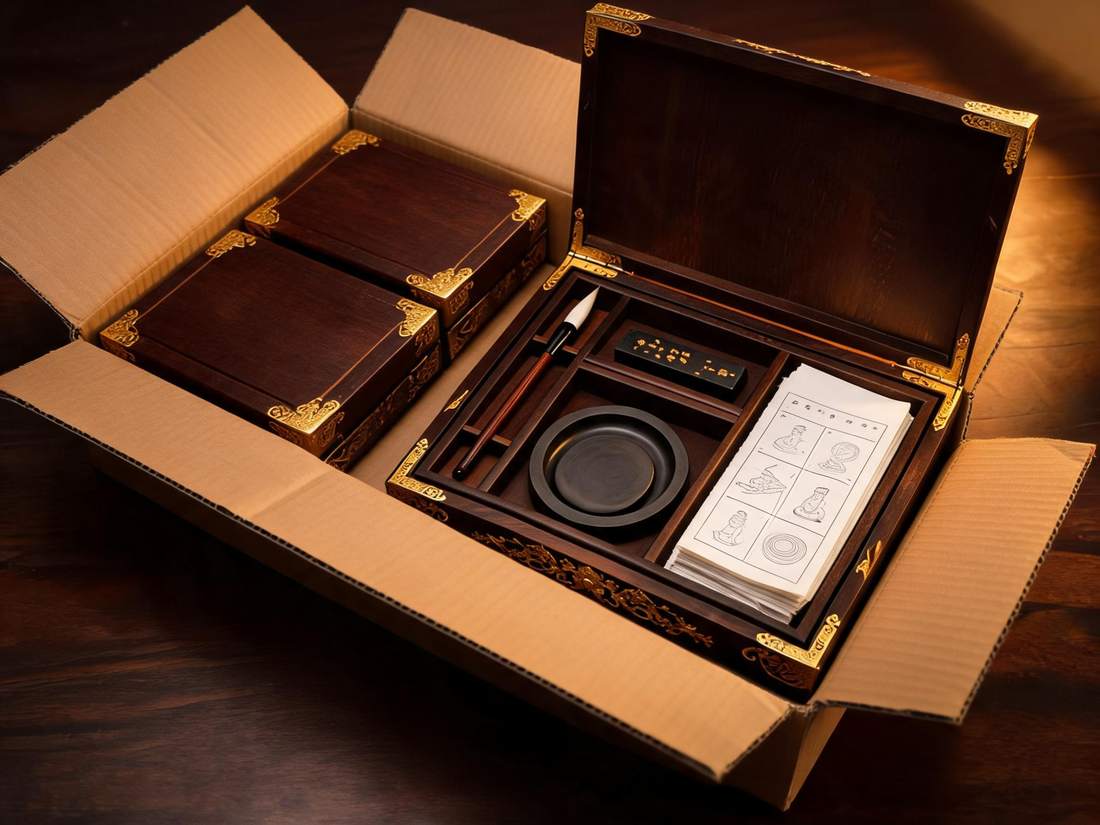
A writing set travels badly. It contains a rigid box, a long thin object, a dense stone and a stack of paper, and all four behave differently under the vibration of a container. Buyers who plan the transit packing at the same time as the set tend to have far fewer claims than buyers who treat it as an afterthought.
Why boxed sets fail in transit
Four failure patterns account for most of the damage on a shipment of boxed writing sets:
- Corner crush. The retail box takes the load of everything above it when cartons are stacked.
- Movement inside the box. Components shift into each other, and the lining or the brush handle takes the damage.
- Moisture. Paper inside a box in a humid container will pick up moisture before anything else does.
- Handling at the destination. A set that has already lost its insert arrives as a pile of loose parts.
None of these are solved by adding more material. They are solved by separating the retail box from the transit carton, and by making the components unable to move.

Separating the retail box from the transit carton
The single most useful packing decision is that the presentation box is a retail unit and the carton is a shipping unit, not the same object. A set shipped in its own gift box arrives with a marked corner, and a marked corner is what the recipient sees first.
In practice this means an inner protective layer around each retail box, a carton sized for the packed dimensions rather than the loose ones, and a load plan that does not put weight directly onto a lid.
Moisture and paper
Paper is the component most sensitive to humidity, and a boxed set gives moisture a place to sit. Two practical measures apply to any humid route: keep the paper wrapped inside the box, and avoid packing sets against the container wall without an intervening layer.
Where a set uses loose sheets, a wrapped or bound format travels better than a loose stack — the Bound Xuan Paper Album is held together as a unit, and the Xuan Paper Roll format protects the sheet inside the roll rather than at its edges.
What to check when the shipment arrives
| Check | What it reveals |
|---|---|
| Outer carton condition before opening | Whether compression or moisture occurred in transit |
| Retail box corners | Whether inner protection was adequate |
| Component positions inside the insert | Whether fit was designed for transit, not just for display |
| Paper condition | Whether the moisture route is under control |
| Count against the packing list | Whether sets were assembled completely |
Keeping one carton unopened from each shipment is good practice: it is the only way to compare later deliveries with the approved packing standard rather than describing it from memory.
Packing a set that will be split
Many buyers import sets to break them up — a retail channel may sell the brushes separately from the paper. That changes the packing requirement, because the components then need to arrive undamaged as individual units.
Where this is the plan, it should be stated before the order: components can be supplied in their own inner packs rather than inserted into the box, and the Student Practice Brush Set or Student Practice Xuan Paper supplied this way can be shelved without unpacking a gift box first.
Checks before confirming a writing set export order
- Retail box and transit carton specified separately.
- Inner protection per box, and the stacking plan for the container.
- Moisture protection appropriate to the route and the season of shipment.
- Whether the buyer will sell sets intact or split them.
- A retained sample of the approved packing.
- Who inspects the cartons at the destination, and how findings are recorded.
Frequently asked questions
Does stronger cardboard solve transit damage?
Only partly. Most damage on boxed sets comes from movement inside the retail box, which thicker cartons do not address.
Should ink be shipped inside the set?
Dry sticks travel without restriction in this respect. Where liquid ink is included, the bottle and its sealing become the critical item and should be specified separately.
How should a shipment be inspected?
At carton level first, then by opening a sample of sets rather than all of them, with findings recorded against the approved packing sample.
Can the set be packed to reduce volume?
Sometimes, by choosing flatter components and a shallower box. That is a product decision, taken before the carton is designed.
Next step for buyers
Send the destination, the route and whether the sets will be sold intact. Packing can then be specified for the shipment rather than inherited from the last one, and the retail boxes arrive in a condition worth selling.