
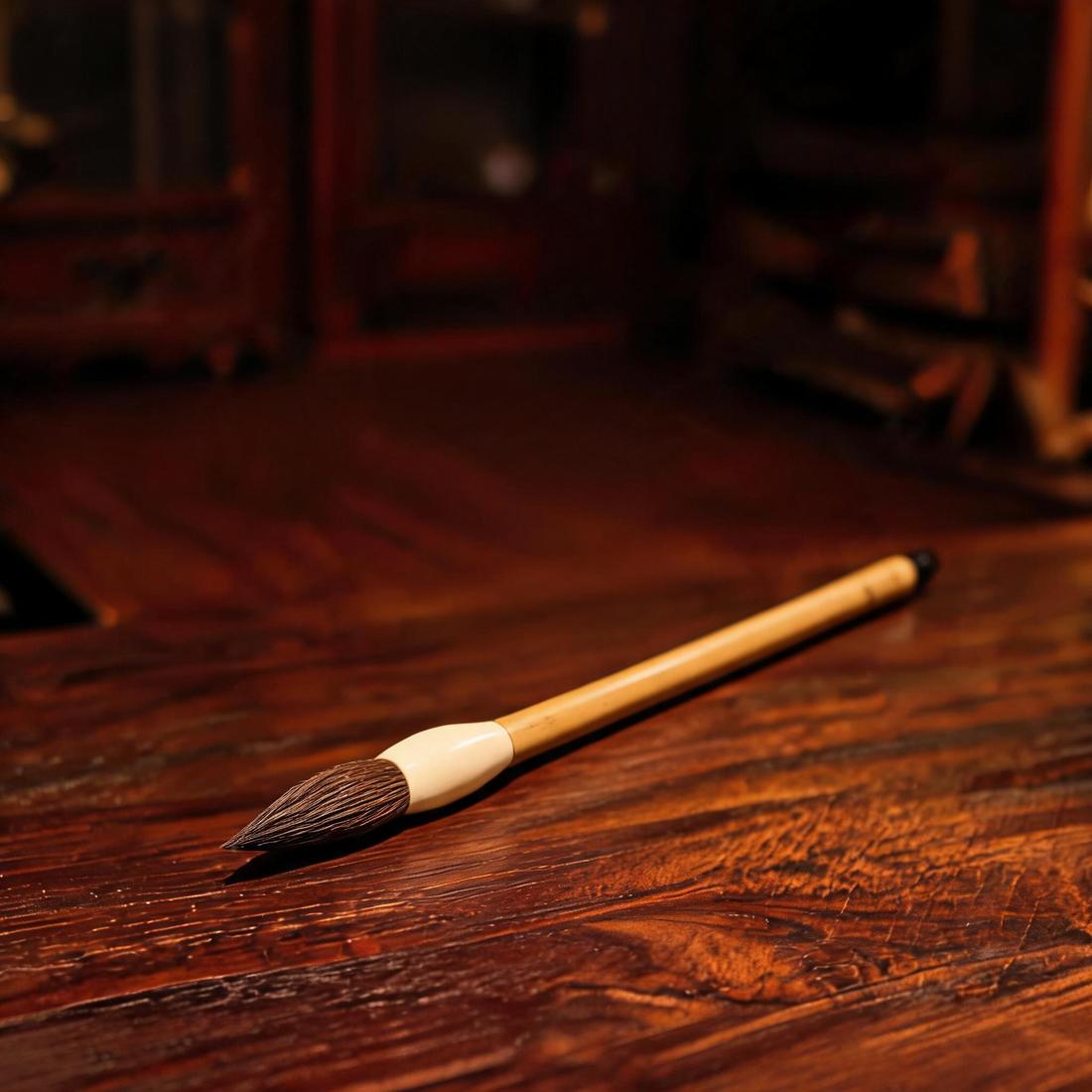
When buyers compare Chinese ink brush quotations, most of the conversation goes to the hair. Hair type decides how a brush performs, so that focus is deserved — but the handle decides whether the brush survives its first month in a customer's hands, and whether it can carry a brand. Handle material is also one of the easiest lines to specify precisely, which makes it a useful place to start when you are trying to compare two suppliers on equal terms.
What the handle actually has to do
A calligraphy handle has three jobs. It has to hold the ferrule and hair head securely through repeated washing. It has to stay straight, because a bowed handle throws off the angle of the stroke. And it has to feel balanced in the hand, since the writer's control comes from the whole assembly rather than from the tip alone.
Balance is the part buyers underestimate. A heavy head on a light handle makes a brush feel tip-heavy; a dense handle on a small head makes it feel remote. When you specify a handle, you are really specifying the balance of the finished brush, and that is why handle material and head size should be decided together rather than independently.
The three common handle materials and what each suits
- Bamboo. Light, straight-grained and inexpensive to produce at volume. Sealed bamboo handles resist moisture reasonably well, which matters because brushes are washed. Bamboo suits school and practice ranges, and it is the natural choice for high-volume student sets where durability and unit cost both matter.
- Hardwood. Heavier and denser than bamboo, giving a more substantial feel that many professional buyers associate with quality. Wood takes lacquer and engraving well, so it tends to appear in gift and premium lines rather than classroom supply.
- Lacquered or coated handles. The base material may be bamboo or wood; the lacquer layer is what carries the finish, the colour and often the branding. Lacquer also seals the grain, which reduces the swelling that unsealed wood shows after repeated wetting.
Gumo Craftworks produces lines across all three directions. The Student Practice Brush Set uses sealed bamboo handles with synthetic-blend hair for classroom supply. The Premium Wolf Hair Calligraphy Brush pairs resilience-graded hair with a hand-bound head for studio work. The Wolf Hair Stiff Tip Brush uses length-graded hair and hand-formed points for regular and clerical script.

Handle length, weight and head size move together
Buyers often specify handle length because it is easy to measure, and then leave head size to the supplier. That ordering creates mismatches. A long handle paired with a small head feels unbalanced to the end user; a short handle on a broad, saturated head gives the writer less leverage than the head needs.
| Brush role | Handle characteristic that usually fits | What to confirm on the quotation |
|---|---|---|
| Fine-script studio brush | Straight, light handle with a modest head | Head diameter and length alongside handle length |
| Regular and clerical script | Firm handle that resists flex under pressure | Ferrule tightness, handle straightness tolerance |
| Running and cursive script | Handle that allows a relaxed grip through long strokes | Overall balance, head absorption, handle finish |
| Large format and exhibition work | Reinforced handle with dense hair packing | Reinforcement method, weight, how the head is secured |
| Classroom sets | Sealed handle that tolerates repeated washing | Sealing method, bulk pack format, size grading across the set |
The Large Format Calligraphy Brush is the clearest illustration of the reinforcement point: dense hair packing and a reinforced handle are what let the brush carry a saturated head through a large character. The Mixed Hair Combination Brush shows the opposite approach — a controlled blend lets one brush cover several script styles, so the handle only has to suit a generalist.
Customisation: where the handle becomes the brand
Handle engraving, lacquer colour and printed packaging are the usual customisation requests on a brush order, and all three sit on the handle rather than the head. That makes the handle the practical place to put a private-label identity.
Two cautions are worth carrying into the brief. First, engraving adds a review step, so artwork should be approved before production rather than after. Second, a lacquer finish changes the feel of the handle as well as its appearance, and a highly polished finish will read differently in the hand from a matte one. If the brush is going into a gift pack, that difference is part of the product; if it is going to a classroom, it is largely irrelevant.

Handle checks that protect a bulk order
- Straightness. Ask whether handles are inspected for bow before assembly, and what tolerance applies.
- Ferrule tightness. A loose ferrule shows up after washing, not before, so the check has to happen at the factory.
- Sealing or lacquer coverage. Confirm that the finish covers the full handle, including the end grain, which is where unsealed wood takes on water first.
- Head securing method. Ask how the head is bound to the handle; it is the single joint that carries every stroke.
- Storage packing. A brush packed without head protection can arrive with a deformed tip even when the handle is perfect.
If your supplier can describe these five checks and offers batch records for them, you have something to compare against the approved sample on the next order.
Frequently asked questions
Does handle material affect how the brush writes?
It affects balance and control rather than the mark itself. A handle that is too heavy or too light changes how the writer applies pressure, which in turn affects stroke consistency — particularly over long sessions.
Is bamboo less durable than wood?
Not inherently. Sealed bamboo handles handle repeated washing well, which is why they dominate classroom ranges. Unsealed bamboo or unsealed wood will both take on moisture; the finish matters more than the base material.
Can handles be engraved for a private-label programme?
Engraving is a common request on handle materials that hold detail. Because it adds a review step, artwork approval should happen before production, and the sample should be checked for legibility at the actual handle size.
Should a gift brush and a school brush use the same handle?
They can share a material, but not a specification. Gift brushes benefit from a finish and engraving that present well; school brushes benefit from sealing and a pack format that survives classroom storage.
Next step for buyers
Buyers building a brush range should decide the handle direction alongside the hair type, then ask for the specification in writing. Review the premium wolf hair brush, the goat hair soft tip brush and the student practice brush set to see how handle specification changes across channels, and send your target channel, script type and quantity to get a matched recommendation.