
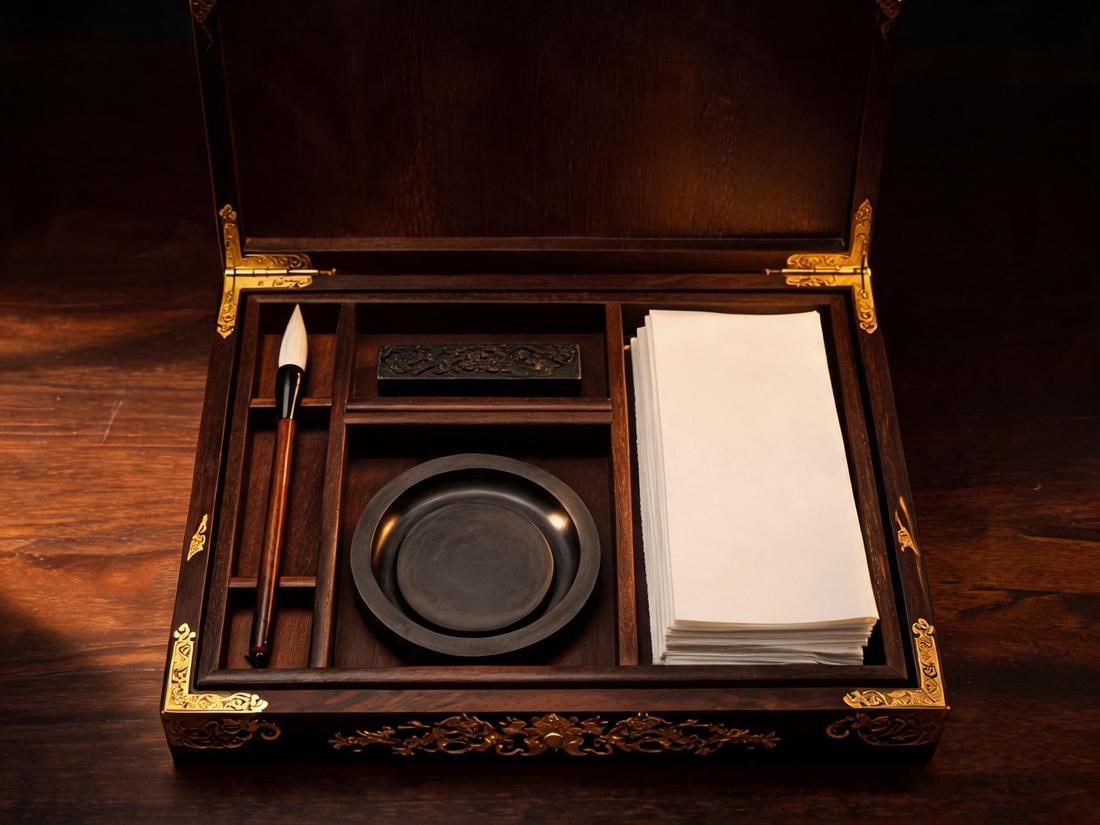
A kit and a set are not the same purchase. A set is a group of items sold together. A kit is a group of items chosen so that the buyer can start work with nothing else added. That distinction decides how many components go in the box, and it decides what happens to the range after the first season.
The component count test
The simplest way to judge a kit is to ask what is still missing once the box is open. If the answer is "nothing", it is a kit. If the answer is "a stone, or paper, or a bottle", it is a set with a kit label.
Most starter kits resolve into three groups:
- Brush and ink only. The smallest useful unit, usually for channels where paper and a stone are already available locally.
- Brush, ink and paper. Everything needed to write on a sheet, with the stone replaced by liquid ink.
- Full four-component kit. Brush, ink, paper and stone, which is the configuration most often requested for beginner programmes.
On this site the two ends of that ladder are the Calligraphy Starter Kit Set and the more completely equipped Complete Scholar Desk Set.

Assembly is a specification, not a packing step
When four components are placed in one box, the box is assembled from four separate specifications. That has a practical consequence: a kit cannot be reordered by quoting one reference, because four of them are involved.
Buyers who keep a component list for each kit reorder without re-approving anything. Buyers who quote only the kit name discover the problem when the second shipment arrives with a different brush in it.
Choosing the configuration by channel
| Channel | Configuration that usually works | Reason |
|---|---|---|
| Retail stationery | Brush, ink and paper | Lower unit cost, higher rotation |
| Education and workshops | Brush, liquid ink, paper, practice stone | Class time is lost to grinding, and stones are shared or dropped |
| Gift and tourism | Brush, stick and stone in a rigid box | The object is the offer, and paper is easy to add locally |
| Museum and premium retail | Full four-component kit with certificate | Presentation and completeness justify the price point |
Planning the reorder before the first order
Kits are consumed unevenly. In an education programme the paper runs out first, the liquid ink second, and the brush lasts much longer. A buyer who plans only the kit will run out of paper mid-term and cannot buy paper inside a box.
That is why experienced buyers order the kit and the fast-moving component together — for example the Student Practice Xuan Paper alongside a starter kit, or Bulk Calligraphy Liquid Ink alongside a classroom kit.
A second practical point: if a kit includes a personalised element, the personalisation applies to the whole assembly, so the approval step has to be scheduled before assembly rather than after it.
Checks before confirming a calligraphy kit order
- Every component named, with the kit reference used only as a shorthand.
- Component count confirmed against the end user's starting point.
- Which component runs out fastest, and how it will be reordered on its own.
- Box and insert type, and whether the box is retail-ready.
- Whether anything is personalised, and when the proof is approved.
- Whether assembly is done before or after the quality check.
Frequently asked questions
Is a kit a good first purchase for a new distributor?
Yes, if the components are specified individually. A kit with an unspecified brush is hard to reorder and hard to defend when a customer complains.
Should a beginner kit include a stone?
It depends on the channel. Where the user grinds at home, a stone belongs in the kit. Where a class shares stones, liquid ink is more practical.
Can components be swapped between orders?
They can, but a swap changes the kit and should be recorded as a new configuration. Silent substitutions are the usual cause of a complaint about a kit that "changed".
How should kits be packed for long transit?
With the retail box inside a separate transit carton, and the components prevented from moving inside their compartments.
Next step for buyers
Send the channel, the component count you want and your volume, and the configuration can be priced as an assembly rather than as a single item. Review the kit and set options above, then ask for the component list of any kit you are considering.