
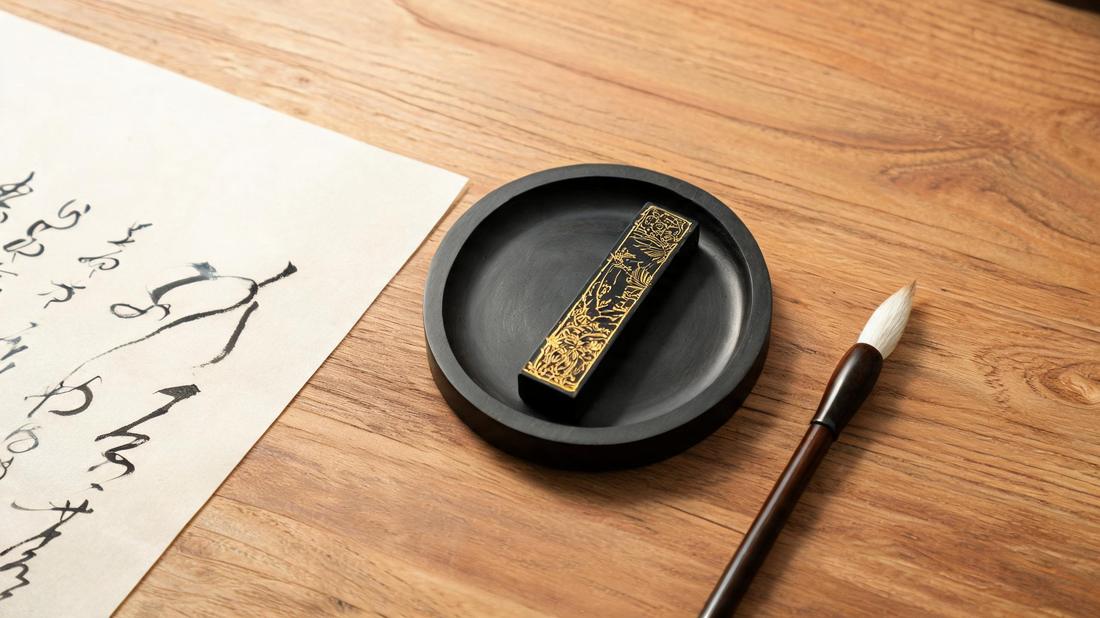
For an inkstone order, the piece a buyer approves and the piece that arrives are separated by a production run and a sea freight. The sample is the last point at which the specification can be changed without cost, so it deserves more attention than the quotation.
What a sample approval is really for
Approving an inkstone is not only a check that the supplier can produce one. It fixes the values that will be checked on every later shipment: the grinding face, the finish, the measured dimensions, the weight and the inner packing.
If those values are not written down at approval, a later shipment can differ in any of them and neither side can show what was agreed. That is the practical reason to treat a sample as a specification document rather than a preview.
The checks that decide an approval
- Working face. Look at how the grinding area is prepared, and confirm that the whole area is usable rather than only its centre.
- Measured dimensions and weight. Measure the sample and record the numbers. Catalogue sizes and delivered sizes are not automatically the same.
- Carving and edges. Check that relief carving has no chipped edges and that the outer borders are clean; these are also the first places transit damage appears.
- Stone appearance. Record veining and colour variation as characteristics of a natural material, and note any repair or filled line separately.
- Inner packing. Open the packing as a customer would, and keep it. What protects the sample is part of what is being approved.

Photographs and values to request before dispatch
Buyers who cannot attend production rely on what the supplier photographs and measures. Asking for the same views and values on every order turns that into a comparison instead of a set of impressions.
- Top view of the grinding face, in even light, without oiling or added gloss.
- Two or three angled views covering the edges and corners.
- A close view of carved decoration where the piece carries any.
- Measured length, width, thickness and weight per unit.
- A view of the packed unit, including the inner protection.
None of this is unusual to request, and it costs a supplier very little when it is agreed before the run rather than asked for afterwards.
Inclusions, repairs and how they are described
Stone is a natural material. Hairline lines, mineral inclusions and repairs occur, and the commercial question is disclosure rather than absence. A buyer should be able to state, in writing, what the supplier counts as first-quality stock and how a repaired piece is described if it is sold at all.
That answer protects the reseller twice: it prevents a customer discovering something the reseller did not know, and it gives the reseller a defensible position if a customer questions a stone that was in fact described correctly.
Keep a retained sample
The cheapest control in an inkstone programme is a retained sample from the approved order, stored with the approved measurements and photographs. When a later shipment is questioned, the comparison is made against a physical piece rather than against a memory of one.
Packing questions to settle at approval
- Is each piece individually wrapped, or separated by a divided insert?
- How is stone-to-stone contact prevented inside the carton?
- What is the packed carton weight and footprint?
- Does the unit pack need to be retail-ready for your channel, or is a transit pack enough?
For channels that sell presentation pieces, one further question matters: whether the retail box is approved at the same time as the stone. A change of box after approval changes the packed weight and therefore the freight calculation.
Frequently asked questions
Should the sample come from the production run or be made separately?
A separately made sample shows what the workshop can do; a piece drawn from the run shows what the order will be. Where both are possible, buyers usually prefer to approve against a run sample and to keep a retained piece from the same run.
How many pieces should be checked on arrival?
That depends on batch size and channel. The useful principle is to check a consistent proportion every time and to record it, so that trends across shipments become visible.
Is a heavier inkstone better?
Weight is a commercial variable that affects freight and how the piece feels in use; it is not a measure of grinding quality. Both should be specified separately.
Can liquid ink be used with a stone?
Some buyers stock both for different customers. Liquid ink is used without grinding, which changes what the range needs rather than what the stone has to do — for example Concentrated Matte Black Liquid Ink.
Next step for buyers
Fix the specification before sampling: grinding face, measured values, carving standard and inner packing. Review the Classic Duan Inkstone, the She Inkstone Premium and the Practice Inkstone, then send your channel, size tiers and annual volume for a matched quotation and a sample plan.