
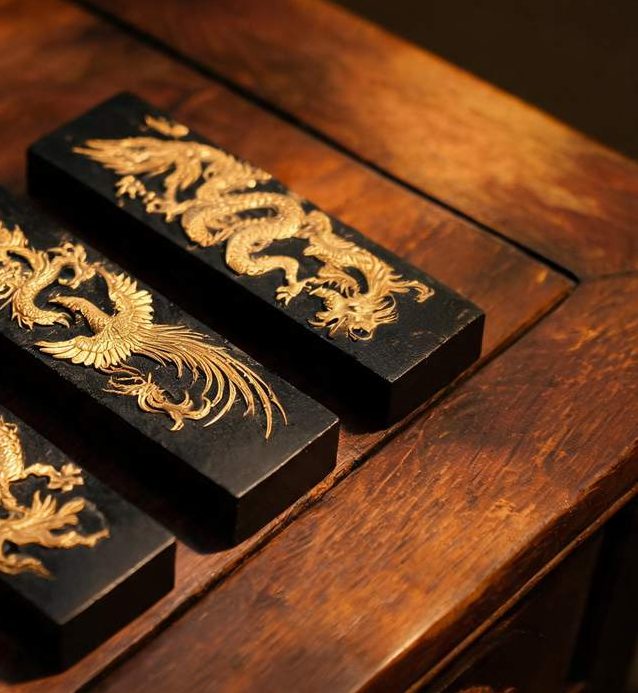
How wholesale buyers evaluate carved Hui ink sticks for gift programs — carving depth, gold tracing consistency, weight selection, edition numbering and sample-first ordering.
Why Carved Ink Sticks Anchor a Gift Assortment
Most ink stick ranges start with plain practice formats and stop there. Gift and collector channels ask for more: a stick that reads as a craft object before any ink is ground. Carved hui ink sticks answer that requirement — the body carries hand-carved decoration filled with gold, so the stick presents well in a gift box, on a museum shelf or at a ceremony table. For a wholesale buyer, though, decoration raises the verification bar. A carved stick can look right in a listing photo and still disappoint in the carton: pattern edges blur, gold filling fades, or the carving on stick number forty looks nothing like the sample. The sections below set out what to check on carved hui ink sticks before a bulk order, and which product lines support those checks with documentation.
What the Carving Should Show on a Sample
Start by separating molded decoration from genuine hand carving. Hand-carved patterns carry small variations in line weight that molded sticks repeat identically; variation is not a defect, but repeated identical flaws usually mean a mold. On the sample, read three things: edge sharpness (a crisp border between the carved recess and the black body), depth consistency across the pattern (shallow patches catch less gold filling and read as faded areas), and alignment between the pattern and the stick body. The Premium Pine Soot Hui Ink Stick line is produced with hand-carved, gold-filled calligraphy patterns over a pine soot body, and custom carving designs can be produced from a buyer's artwork file — with a custom carving sample in 10 to 15 days. That sample step is where a buyer confirms pattern depth and gold filling on a physical stick instead of trusting a catalogue image.
Gold Tracing and Edge Work: Checks That Separate Price Tiers
Gold decoration fails in a specific way: uneven application across a batch. Some sticks come out bright and crisp, others patchy, and the difference only shows when gifts are opened side by side — exactly the moment a corporate program cannot afford. When comparing carved hui ink sticks, ask how gold consistency is verified during production rather than discovered after packing. The Commemorative Gold-Edge Hui Ink Stick runs through a dedicated gold-application station with a production checkpoint system for batch consistency, and the gold edge material carries a material certificate with each shipment. At the shipment level, the gold-edge line and the pine soot carved line are both inspected under AQL standards with photo reports, so a buyer reviews actual sticks from the batch before the goods leave the factory.

Matching Stick Weight and Soot Type to the Channel
Carved decoration sits on different bodies for different channels, and mixing them up is a common ordering error. Pine soot carved sticks in the 50 g to 200 g range suit gift assortments, student display sets and trial programs; the pine soot body grinds to a deep, matte black tone suited to calligraphy and painting. Oil soot sticks in 30 g to 150 g serve studios and premium retail lines that want a rich, glossy black; the Oil Soot Hui Ink Stick Classic is refined under a standardized grinding protocol with batch-level ink density testing, and the surface is polished smooth for presentation. Commemorative formats in 100 g to 300 g are the flagship tier: the gold-edge commemorative stick pairs its decoration with edition numbering and a magnetic-closure gift box, designed to be handed over without extra packaging work. Decide the channel first, then the weight — a museum shop, a corporate ceremony and a retail shelf rarely need the same format.
Edition Numbering and the Paperwork Behind the Gift
For commemorative and collector programs, the paperwork is part of the product. The gold-edge commemorative line numbers each stick individually and can assign custom edition numbers — so a program can issue Edition 001-300 matching its own ceremony logic. Export documentation with customs valuation ships with the order, alongside the gold material certificate. On the pine soot carved line, batch QC records and material composition certificates accompany the shipment, which lets a distributor trace documentation to a production lot rather than to a product type. Buyers comparing suppliers should treat absent paperwork as a price signal: carved hui ink sticks without batch records are harder to defend to institutional customers, whatever the unit price.
An Order Flow That Starts From the Sample
Carved hui ink sticks are ordered against artwork, so the sequence matters. On the pine soot line, custom carving samples take 10 to 15 days from the artwork file, and standard lead time runs 30 to 45 days after sample approval with a 50-piece MOQ. On the commemorative line, engraving proofs arrive within 15 days and production takes 40 to 55 days after proof approval, with a deliberately low 30-piece MOQ so proof runs and test programs stay practical. Programs with a fixed ceremony date should anchor the sample stage backward from the event: the risk sits in the sample stage, where changes are cheap, not in production, where they are not.
Questions Buyers Ask Before Ordering Carved Ink Sticks
- Can the carving follow our own artwork?
- Yes. The pine soot carved line produces custom carving designs from a buyer's artwork file, with a sample for approval in 10 to 15 days. The commemorative line runs custom engraving through a proof-approval system supporting multiple languages.
- How is gold decoration quality documented?
- The commemorative line inspects gold-edge consistency through a production checkpoint system and ships a gold material certificate with each order; both lines are AQL inspected with photo reports before shipment.
- Which weight should a first order carry?
- Match the format to the channel: 50-200 g pine soot for gift assortments and retail, 30-150 g oil soot for studio and premium retail lines, 100-300 g commemorative formats for headline gifts.
- Do carved sticks need special storage?
- Pine soot sticks stored dry and cool retain quality for more than 10 years; keep sticks away from humidity in warehousing and on the shelf, as with any traditional ink product.
Build the Range From Verified Product Lines
The carved formats sit inside a wider Hui ink family: the Premium Pine Soot Hui Ink Stick carries the hand-carved, gold-filled patterns, the Commemorative Gold-Edge Hui Ink Stick serves numbered corporate editions, and the Oil Soot Hui Ink Stick Classic covers glossy-tone studio formats. Tell the team your channel, weight mix and artwork requirements, and the quotation will come back with a sample arrangement matched to the program calendar.