
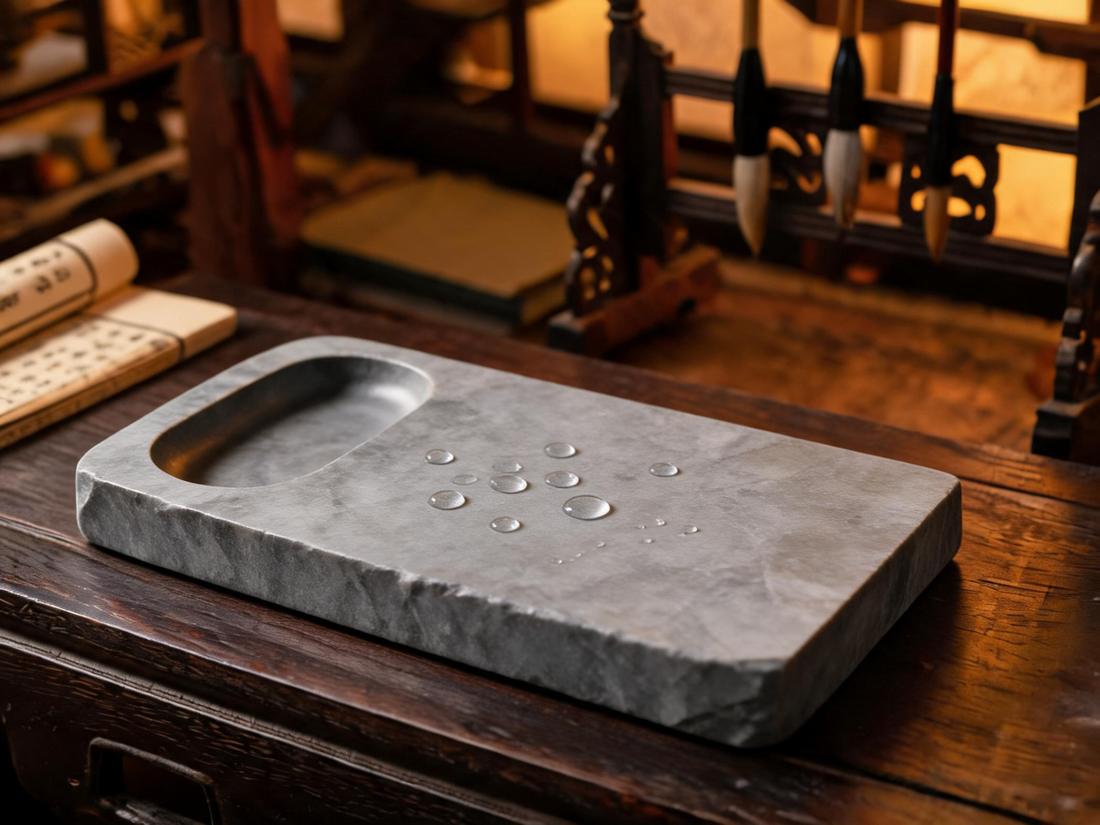
Most buying guides for inkstones are written about collector pieces. The stones that actually move in volume are the opposite: working stones bought for classrooms, studios and practice, used every day by people who are not thinking about the object at all. That changes what a buyer should specify.
The job is narrower than it looks
A functional inkstone has one task — to raise ink from a stick and water — and it has to keep doing it after months of daily use. Everything else about the stone is either a convenience or a decoration.
That narrowness is useful when comparing offers, because it converts a long list of aesthetic variables into a short list of functional ones. Does the surface raise ink at a usable rate? Does it keep doing so with use? Does the stone survive being rinsed and put away every day?
Working stone versus presentation stone
Buyers often treat these as two price points on one scale. They behave as two different products.
| Consideration | Working stone | Presentation stone |
|---|---|---|
| Primary value | Grinding behaviour and durability | Appearance, carving and box presence |
| Where the money goes | Stone suitability for the grinding face | Carving, finish and presentation packing |
| Buyer's main risk | Inconsistent behaviour across a batch | Transit damage to carved edges and corners |
| Reorder logic | Repeat the same user experience | Repeat the same look and pack |
A heavily carved stone can be a poor daily grinder if the working area has been reduced to make room for decoration. That is not a fault in the product; it is a mismatch between the product and the channel. A buyer who establishes which type they are selling avoids returns caused by the wrong expectation rather than by a defective stone.
Gumo Craftworks supplies both directions: the Practice Inkstone for classrooms and volume programmes, and carved pieces such as the Carved Decorative Inkstone for presentation channels.

Size, weight and where the stone lives
The size decision belongs to the end user's routine, not to the catalogue. A stone that sits permanently on a desk can be larger and heavier; a stone that travels in a bag has to be smaller, lighter and protected.
For distributors this becomes a stocking question. Weight per unit rises quickly with size, so a larger stone is not simply a higher-value version of a smaller one — it also carries more freight cost and needs more packing material. Buyers usually do best with two tiers: one for permanent desks and one portable format, rather than a long ladder of sizes that all need separate packing.
Artists who work away from a fixed desk often pair a portable stone with a compact format, which is the logic behind pieces such as the Compact Travel Inkstone.
The grinding face over time
This is the part of an inkstone that buyers rarely ask about, and the part that decides whether a repeat order goes smoothly.
Over extended use the working face can change. How quickly, and in what way, depends on the stone and on how the user cleans it. That makes two questions worth putting in writing before ordering in volume:
- What surface finish does the stone ship with? The buyer should be able to state what the customer will receive, because a face that is too coarse or too smooth changes the first impression.
- What cleaning routine is expected? Rinsing and drying practice affects how the face behaves over time, and a distributor fielding questions needs an answer that comes from the supplier rather than from guesswork.
Where a supplier can describe the face preparation and the expected care, the buyer has something to pass on. Where it cannot, the buyer is exposed to every cleaning question a customer asks.
Consistency matters more than the best single stone
Teaching channels buy in batches, and a class of students comparing results will notice immediately if two stones from the same shipment behave differently. For that channel the specification is not the performance of the best piece but the spread across the batch.
Buyers should ask how the supplier checks a production run for that kind of variation, and keep a retained sample from the approved order so a later shipment can be compared directly rather than described from memory.
Checks before confirming a working inkstone order
- How the grinding face is prepared, stated rather than implied.
- Intended use — regular grinding or display — confirmed in writing.
- Stone family claimed, and whether behaviour is expected to be uniform across the batch.
- Measured dimensions and weight for each size tier.
- Packing that prevents stone-to-stone contact.
- Whether a retained sample is kept for reorder comparison.
Frequently asked questions
Do I need a premium stone for daily practice?
No. Practice work is judged on grinding behaviour and durability, and a plain stone that performs consistently serves it better than a decorative piece whose working area has been cut back.
Can a stone be used for both display and practice?
Some are, but the two roles pull in opposite directions. If a customer wants both, confirm that the grinding area is intact rather than assuming it from the object's overall quality.
How should an inkstone be cleaned?
Cleaning practice affects how the working face behaves over time, so it is worth getting the routine from the supplier of the specific stone rather than applying a general rule.
Why do two stones in one shipment behave differently?
Stone is a natural material and production varies. The commercial answer is batch checking plus a retained sample, which let you compare shipments instead of arguing about them.
Next step for buyers
Buyers in the teaching and studio channels should specify grinding behaviour and batch consistency before discussing carving. Review the Practice Inkstone and the Compact Travel Inkstone, then send your channel, batch size and the size tiers you plan to stock.