
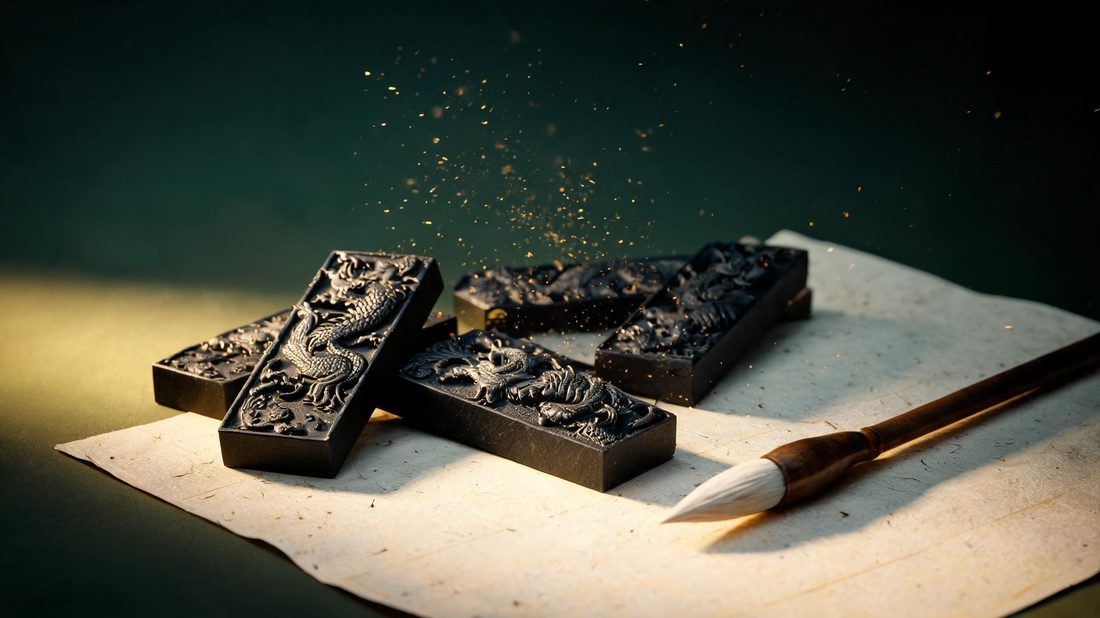
Most ink stick ranges start from a single favourite stick and grow in whatever direction the next enquiry points. The result is a catalogue that is hard to price, hard to ship and hard to explain. The variable that organises a range properly is the physical specification of the stick — length, width, thickness and mass — together with how it is packed.
What a stick specification actually contains
An ink stick is described commercially by its measured dimensions and its mass, not only by its moulded decoration. Those values drive three things at once: price per unit, packed weight per carton, and how the stick feels in the customer's hand.
Because decoration is the most visible difference, it tends to dominate how offers are compared. Two sticks can look alike in a product photograph and sit in different weight classes. Buyers setting up a programme should ask for measured values per SKU and keep them in the same sheet as the price, so the whole range can be compared on one page.
Gumo Craftworks supplies the range in tiers that support that comparison: Student Practice Hui Ink Stick for volume and classroom channels, Oil Soot Hui Ink Stick Classic and Premium Pine Soot Hui Ink Stick for retail and studio channels.
Why weight matters more in some channels than others
- Gift and collector channels. Mass is a selling point. A heavier stick feels more substantial in the box, and the box is part of the offer.
- School and practice channels. The same mass is mostly a freight and breakage variable. Densely packed lighter sticks usually serve that channel better than heavy sticks bought as a quality signal.
- Sets and bundles. Where a stick is one item among many, its mass decides how the finished set ships rather than how one stick is priced.
The practical rule is that weight should be specified per channel, not maximised across the catalogue.

Decorated and undecorated sticks are different products
Gold relief, gilt lettering and commemorative moulds add cost at the moulding and finishing stages, and they are what makes a stick presentable in a gift box. Plain or lightly decorated sticks sell into practice channels where the stick will be used up rather than kept. Both belong in a catalogue, but they should not share one price ladder.
A workable structure is three bands: a practice band, a decorated retail band, and a commemorative band for gift programmes and anniversaries. The Commemorative Gold-Edge Hui Ink Stick sits in the last of these, while packs that combine several sticks, such as the Colored Hui Ink Stick Set, suit buyers who need more than one stick in a single retail unit.
Packing decisions that decide your return rate
Ink sticks are brittle. The failure mode is rarely a collapsed carton; it is a chipped corner on one stick, which is enough for a customer to reject the pack.
- Ask how each stick is individually wrapped or sleeved, not only how the outer carton is filled.
- Ask whether sticks with relief decoration are packed so that decorated faces cannot rub against each other.
- Confirm packed carton weight and dimensions, because a heavier range changes freight cost per unit.
- Keep a retained sample from the approved order so a later shipment can be compared against it.
Storage on the customer's side
Many buyers sell through resellers who hold stock for months, so it is worth agreeing storage guidance as part of the order. Questions to settle with the supplier: whether humidity or direct light affects the finish, whether sticks are supplied boxed, and how a dealer should store part-used stock.
Checks before confirming an ink stick order
- Measured length, width, thickness and mass for each SKU.
- Which band each SKU belongs to, and how the bands differ in decoration.
- Individual stick wrapping and protection of decorated faces.
- Packed carton weight and dimensions for each tier.
- Storage guidance for the dealer.
- A retained sample kept against the approved shipment.
Frequently asked questions
Does a heavier ink stick mean better ink?
Mass and quality are separate properties. Weight is a commercial and tactile variable; what matters for the product itself is how the stick grinds and how it behaves on paper, which is a question about the material rather than the size.
Should a range include both decorated and plain sticks?
Usually yes, because the two sell in different channels. Putting them on one price ladder makes both harder to sell.
How should sticks be counted when quoting?
Quote per stick and per pack, and state the pack count. Buyers comparing offers often find the unit price is close while the pack count is not.
What else does an ink stick programme need?
Most programmes also need a stone to grind on. The Practice Inkstone covers practice channels, and liquid ink is a common alternative for customers who do not grind at all — for example the Concentrated Matte Black Liquid Ink.
Next step for buyers
Settle the three bands first, then ask for the measured specification and packed weight of each candidate stick. Review the Student Practice Hui Ink Stick and the Premium Pine Soot Hui Ink Stick, then send your channel, pack counts and annual volume for a matched quotation.