
A buyer-side explanation of the Chinese writing set: how the term differs from a calligraphy set and the Four Treasures of the Study, which components belong to which retail channel, and a three-tier stocking plan (entry, mid, collector) with MOQ, lead time and packaging notes for importers and gift distributors.
A retailer searching for a Chinese writing set is usually looking at one product photo with five or six objects in it, and wants to know what those objects are, which ones buyers actually use, and how to stock them without sitting on dead inventory. This guide answers that from the assortment side: what the term covers, where it overlaps with a calligraphy set, which components belong to which sales channel, and how to split a buying budget across three price tiers.
Key takeaways for buyers
- A writing set is an assortment decision, not a fixed product list. The same term covers a 9-piece student kit and a collector box with an inkstone.
- Not every set needs an inkstone. Retail and gift channels often sell better without one; teaching accounts usually need it.
- Set-level QC and packaging are what protect your return rate, not the brush count.
- Mid-tier sets usually drive the margin; entry-tier sets drive trial and reorder.
Writing Set, Calligraphy Set, or Four Treasures? Sorting Out the Terminology
These three phrases get used interchangeably in listings, which is exactly why buyers end up comparing products that are not really comparable. A short terminology map helps before you open a supplier's catalogue.
- Chinese writing set — the broadest term. Any packaged group of Chinese brush-writing items sold as one unit: brush, ink, paper, and often a mat, water bowl, brush rest or storage case. It can describe a beginner practice kit or a gift box, and it is the term most retail buyers use when they want a single SKU to sit on a shelf.
- Calligraphy set — usually the same physical contents, but framed around the practice of brush calligraphy rather than the culture of writing. Listings using this term tend to emphasize scripts, stroke practice and tutorial material, and they attract buyers who already know they want to learn calligraphy.
- Four Treasures of the Study (文房四宝) — a traditional term for the four core implements: brush, ink, paper and inkstone. It is a naming convention for the traditional desk, not a packaging specification. A supplier can call an eight-piece box a "Four Treasures set" and another can apply the same phrase to a four-piece one.
The practical consequence: do not select on the phrase in the title. Select on the component list and the packaging format. Two sets described as "Chinese brush writing set, traditional" can differ by an inkstick, an inkstone, a colour of box and a third of the landed cost.
What Is Actually in a Chinese Calligraphy Set?
This is the question that appears most often in search suggestions around the topic, and the honest answer is: a core four that appear in almost every set, plus a variable group that depends on the price point and the market.
Core components
- Brush (毛笔). Hair type and tip size are the main variables. Wolf hair is stiffer and holds a pointed tip; goat hair is softer and holds more ink; blended tips try to balance the two. Set listings normally specify a size range rather than one brush.
- Ink. Either a bottled liquid ink for immediate use, or a solid ink stick that is ground on an inkstone. Liquid ink is easier to ship and to use; an ink stick is the traditional object and belongs in gift and collector tiers.
- Paper. Usually Xuan paper (宣纸) or a practice paper that behaves similarly. Raw Xuan is absorbent and suits expressive brushwork; sized or coated practice paper is more forgiving for beginners and cheaper per sheet.
- Inkstone (砚台). Only needed if the set includes an ink stick. A Duan inkstone is the reference stone in traditional gifting; small student stones are common in school kits.
Add-on components that change the price point
- Felt writing mat — protects the desk and appears in almost every teaching set.
- Brush rest, water bowl, or brush hanger — small items that make a set look complete in a photo.
- Storage case or gift box — this is often the single largest cost driver after the inkstone.
- Practice sheets, copybook, or instructions — decisive in school and self-study channels.
- Seal and seal paste — a gift-channel add-on rather than a practice necessity.
When someone asks what is in a Chinese calligraphy set, the useful answer is therefore conditional: a beginner kit typically means brushes, liquid ink, practice paper and a mat; a traditional desk set means brush, ink stick, inkstone and Xuan paper; a gift set means the traditional four plus a presentation box and finishing objects. Buying against the wrong reading of the word is how retailers end up with an inkstone-heavy SKU in a market that only wanted to try brush practice.
Which Components Belong to Which Channel
The same supplier catalogue can serve a stationery chain, a museum shop and a school distributor, but not with the same configuration. Below is the split that matters most in quoting.
| Channel | Components that carry the sale | Components that can be reduced or omitted | Packaging priority |
|---|---|---|---|
| Stationery / general retail | Brushes, liquid ink, practice paper, felt mat | Inkstone, ink stick, seal | Compact box, clear front or printed contents panel |
| Gift and corporate | Brush set, ink stick, inkstone, presentation box, seal | Practice paper volume, copybook | Rigid box, magnetic closure, inner tray, sleeve |
| Teaching / school | Brushes, felt mat, water bowl, practice paper, copybook | Presentation box, seal, premium stone | Bulk-friendly carton, individual wrapping for issue |
| Collector / cultural retail | Named stone, named ink stick, designated brush hair type, raw Xuan paper | Practice consumables | Protective inner cushioning, certificate slot if supplied |
Read the table as a buying question rather than a rule. If a channel insists on an inkstone in a low-price set, you are usually paying for the stone at the expense of the brush quality, which is the part a first-time user judges the set by.
A Three-Tier Stocking Plan for Retailers
Most importers who handle this category successfully stock three price bands rather than one long list of similar sets. The tiers below correspond to real supplier lines, using the product families offered by Gu Mo Craft Technology, a manufacturer founded in 2011 with eight product lines, as the reference point for what each band looks like.
| Tier | Typical contents | Reference product families | Commercial notes |
|---|---|---|---|
| Entry — trial and volume | Brushes, liquid ink, practice paper, felt mat; student-grade accessories | Calligraphy Starter Kit Set; Student Practice series; School Calligraphy Desk Set | Aimed at first-time buyers and classroom issue; best reorder potential |
| Mid — the margin tier | Ink stick, inkstone, brush, Xuan paper in a magnetic-closure box | Complete Scholar Desk Set | MOQ 30 sets; lead time 35–50 days after sample approval; set-level QC; private-label available |
| Collector / gift — high value, low volume | Premium brush, premium ink stick, named inkstone, raw Xuan paper, gift packaging | Premium Scholar Desk Gift Set; Premium Pine Soot Hui Ink Stick; Classic Duan Inkstone; Premium Wolf Hair Calligraphy Brush; Raw Xuan Paper Professional | Stock shallow and buy against confirmed gift orders where possible |
Why the mid tier usually earns its shelf space
The entry tier sells, but its gross margin is thin because the buyer compares it to other low-priced kits. The collector tier has better margin but turns slowly and ties up cash in a gift box that only sells in season. The mid tier sits between: it contains genuine traditional objects — an ink stick, an inkstone, Xuan paper — so it reads as authentic in a product photo, while its box and MOQ still work for a normal retail reorder cycle.
For the Complete Scholar Desk Set, the relevant buying facts are a magnetic-closure box, a minimum order of 30 sets, a lead time of 35–50 days after sample approval, quality control applied at set level, and the option of private-label presentation. That set-level QC point deserves attention on any mid-tier purchase: checking individual brushes tells you less than checking that every box contains the same complete, correctly sized contents, because that is what generates customer complaints.
How to Order in Bulk Without Overcommitting
Three practical steps cover most of the risk in this category.
- Approve a physical sample before committing to the full run. Brush tip shape, paper absorbency and box tolerance are difficult to judge from photos. The 35–50 day production window quoted above begins after sample approval for that reason.
- Decide on presentation before you decide on quantity. A generic export carton and a printed gift box differ substantially in both unit cost and packing volume, which changes your freight calculation more than a small change in brush count does.
- Start narrow, then widen. A common pattern is to launch with one entry SKU and one mid SKU, read the sell-through for a season, and only then add the collector tier. Using an MOQ of 30 sets on the mid tier makes that first test order small enough to be a real trial.
If you are still mapping the relationship between channels and component mixes, the earlier piece on matching components to gift, school and retail channels goes deeper into that matching exercise. This article's tier plan is meant to sit underneath it: choose the channel, then choose the tier.
Packaging and Presentation: The Part Buyers Underestimate
In this category the box frequently appears in the customer's first impression and in the return dispute. Export packing for writing sets has to do three things at once: keep the brushes from being bent, keep the inkstone from moving inside the tray, and carry your brand and language requirements on the outer surface.
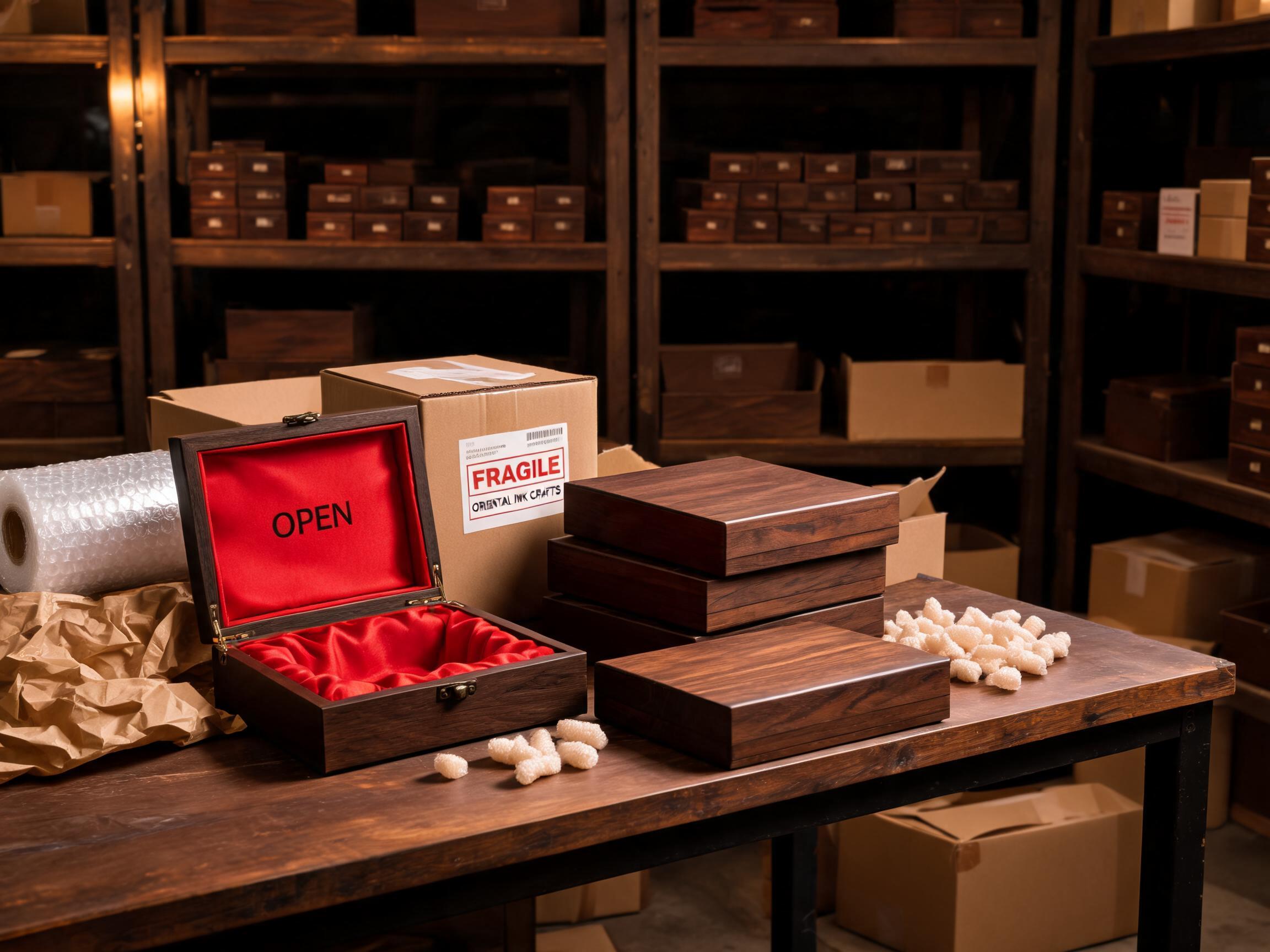
Gu Mo Craft Technology packages its export shipments with presentation boxes labelled ORIENTAL INK CRAFTS, which gives private-label buyers a starting reference for how a labelled presentation box is supplied in bulk. The presentation box labelled in this way is the version retailers can evaluate when deciding whether to keep the standard label or replace it with their own.
Practical points worth confirming with any supplier before the order is placed:
- Whether gift boxes ship flat and are assembled at packing, which reduces shipping volume but requires clean assembly.
- Whether the inner tray is cut specifically for the supplied brush and stone sizes, or is a generic insert.
- Whether brush caps or sleeves are included, since brush tips are the most common transit damage point.
- Whether the box label and any printed insert can be changed for a private-label run, and at what stage of the lead time that change must be locked.
Where to Buy Chinese Calligraphy Sets for Resale
Sourcing usually happens through one of four routes, and the right one depends on how much control you need over the component list.
- Direct from a manufacturer — best when you want private-label packaging, a defined component mix and set-level QC. Requires a sample approval step and accepts a production lead time.
- Wholesale or trading platforms — faster to start and lower commitment, but the component list is usually fixed and the packaging is generic.
- Regional importers and distributors — convenient for small top-up orders, higher unit cost, limited customisation.
- Cultural and museum wholesalers — relevant if you are assembling a curated collector range rather than a general retail line.
For buyers who want to compare real configurations before ordering, the Calligraphy Starter Kit Set is a useful reference point for the entry tier, and the Premium Scholar Desk Gift Set for the collector tier. Sampling one from each band before placing a volume order is the cheapest way to see how much of the price difference actually reaches the customer's hands.
Frequently Asked Questions
Does a Chinese writing set need an inkstone?
Only if it contains a solid ink stick that has to be ground. Sets built around bottled liquid ink do not need one, and leaving it out usually allows a better brush at the same retail price. For school and teaching accounts, small student stones are common because grinding is part of the lesson.
What is the difference between the entry and collector tiers in practice?
Mainly three things: the ink (liquid versus a solid stick), the stone (absent or student grade versus a named Duan stone), and the packaging (compact box versus a cushioned gift box). The brush is upgraded in the collector tier as well, for example to a specified wolf hair brush.
What is the minimum order and lead time for a mid-tier set?
On the Complete Scholar Desk Set, the minimum order is 30 sets and production takes 35–50 days after sample approval. For entry and collector tiers, confirm the current terms with the supplier, since these scales differ by configuration and packaging.
Can the packaging carry our own brand?
Private-label presentation is available on the mid-tier set. Confirm the label artwork deadline at the sampling stage, because a packaging change locked after production has started affects the delivery date.
Next Step
If you are building a first range, request one sample from the entry tier and one from the mid tier, compare the brush and paper against your intended retail price, and use that comparison to decide how much of the assortment should sit in each band. The mid-tier specification — MOQ 30 sets, 35–50 days after sample approval, set-level QC and private-label option — is generally small enough to test a new market before you commit to a seasonal quantity.