
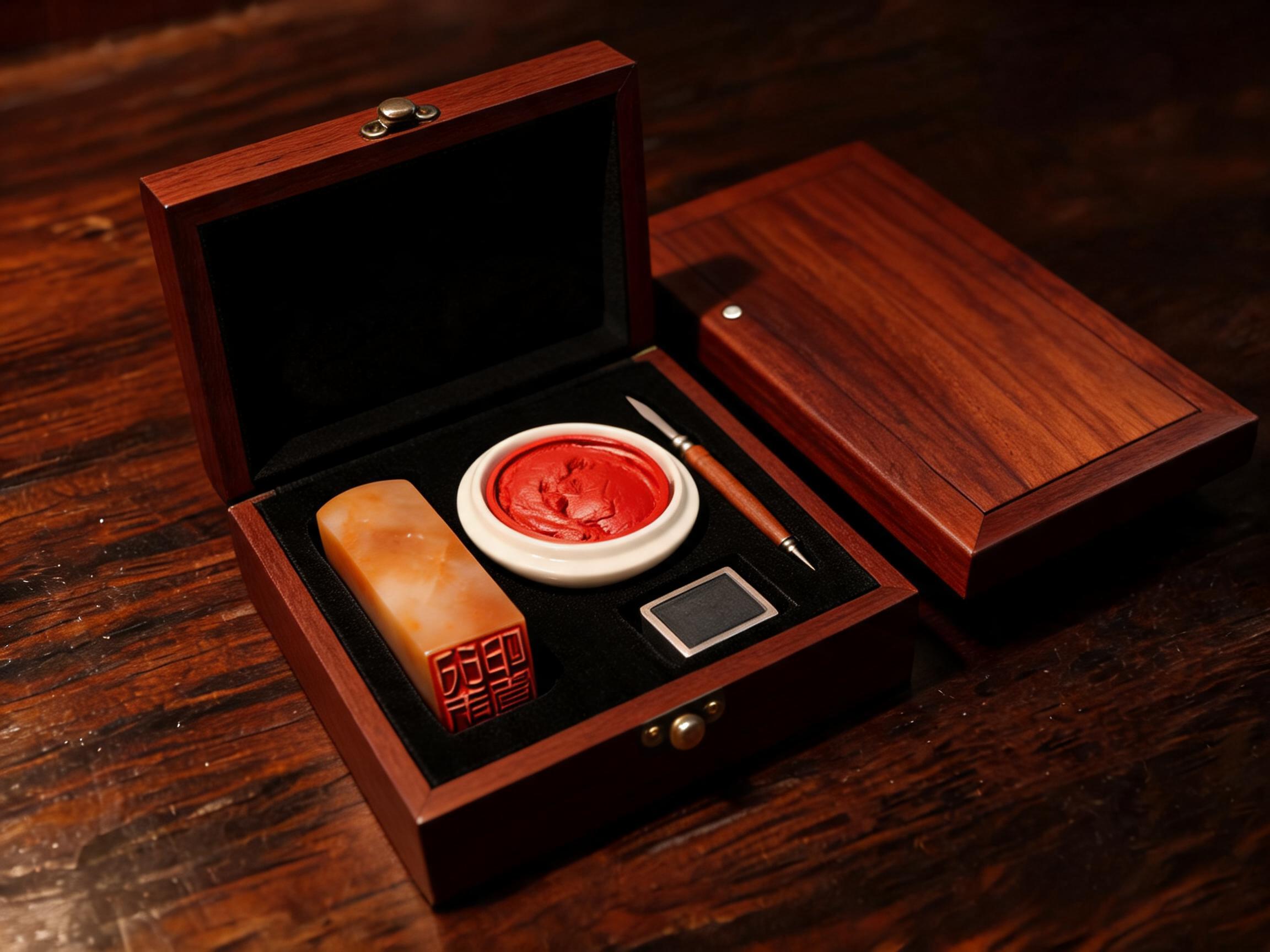
A buyer's guide to what belongs in a beginner seal carving kit, why seal stone, carving knife, ink paste, and ink pad have to be matched at set level, and how gift channels, schools, and cultural programs can source kits that arrive complete and intact.
A seal carving kit succeeds or fails at the set level, not at the level of any single part. This guide breaks down what a complete beginner set should contain, why matching the components before packing decides whether the kit works in a classroom, and what to check on a supplier's offer before you commit to a purchase order.
Key takeaways
- A complete beginner seal carving kit covers four working parts: seal stone, carving knife, vermilion ink paste, and ink pad.
- The stone should be delivered as a prepared blank, so a first-time carver can start without extra preparation steps.
- Component matching is the real quality question: parts sourced from different suppliers often do not fit or perform together.
- For gift, school, and cultural program channels, the presentation box and private-label branding are part of the product, not an afterthought.
- Ask for set-level inspection records and a component list that travels with the shipment.
What is seal carving?
Seal carving is the traditional art of engraving characters or motifs into stone seals. The engraved face is pressed into vermilion ink paste and then stamped onto paper, cloth, or a finished artwork, leaving the carved design as a mark of ownership, authorship, or identity. In many parts of East Asia the practice sits alongside calligraphy and painting; elsewhere it is taught as a craft skill and sold as a cultural gift.
Because the craft is unfamiliar to many overseas buyers, the buying decision usually starts with a simple question: what actually has to be inside the box for a beginner to complete a first seal? That question is the reason a kit exists as a product category at all, rather than a loose collection of items.
The anatomy of a complete beginner kit
A complete beginner set has four working components. If any one is missing or supplied in the wrong form, the buyer has to solve the gap locally, which is exactly what a kit purchase is meant to avoid.
| Component | What it does | What buyers should confirm |
|---|---|---|
| Seal stone | The carving blank that receives the engraved design and carries the finished seal. | Blank form and surface condition; whether it is prepared for a first-time carver. |
| Carving knife | The cutting tool used to engrave the stone face. | That the knife is supplied with the set and packed to survive transport. |
| Vermilion ink paste | The red paste that transfers the carved design onto paper when stamped. | That the paste is included and sealed in its own container. |
| Ink pad | The surface used to load the seal face evenly with paste before stamping. | That the pad is part of the set rather than a separate purchase. |
Component or accessory? Draw the line before you order
Beginners often assume the four items above are the whole story. In practice the finishing touches decide whether the first attempt feels like a craft project or a failed experiment: somewhere to work, something to clean up with, and a way to store the finished seal without damaging the carved face. These are the items buyers most often forget when they specify a kit, so it is worth writing them into the purchase specification explicitly rather than assuming a supplier will include them.
Why component matching decides kit quality
Collecting four correct-looking items from four different suppliers is easy. Delivering a kit where those four items actually work together is a different problem, and it is the reason set-level sourcing exists.
When components come from separate vendors, the buyer inherits the integration risk. The classic failure is packaging-related: pieces packed without a shared structure shift against each other and arrive chipped or scratched. Set-level matching means the components are produced in-house and matched at factory level, so the stone, knife, paste, pad, and box are fitted to each other before the kit is closed. For a buyer shipping into a school term or a gift season, that difference shows up as a lower rate of replaced or written-off units.
Matching also simplifies after-sales. Because the company produces seal carving sets since 2011 and manufactures the components itself, replacement conversation is about a kit, not about tracking down which of several suppliers provided the problem part.
What schools, gift channels, and cultural venues should look for
Different channels care about different failure modes, but all of them are buying the same underlying thing: a kit that arrives complete, intact, and ready to use.
- Schools and cultural programs need predictable quantities per class and a kit that a beginner can open and use without missing pieces. Set-level inspection and a documentation trail matter more here than packaging flourish.
- Gift channels sell the box as much as the contents. A custom magnetic-closure presentation box with private-label branding on the box and components turns a craft set into a finished gift item.
- Religious and cultural venues often buy repeatedly, so consistency between orders matters as much as the first sample. Stable component matching supports that consistency.
- Collectors and specialist retailers judge the set by how the parts fit together; a mismatched kit is noticed immediately by an experienced buyer.
A sourcing checklist for kit-level quality control
Use the following list when evaluating quotations for a beginner seal carving kit. It is written for kit-level decisions, not for judging individual parts in isolation.
- Complete component list. Confirm in writing that the offer covers seal stone, vermilion ink paste, carving knife, and ink pad, plus whatever finishing items you intend to specify.
- Set-level matching. Ask whether the components are produced in-house and matched at factory level, or assembled from third-party sources.
- Set-level inspection. Ask for set-level component matching QC and AQL inspection, rather than part-by-part checks alone.
- Component matching documentation. Request that matching documentation ships with the order, so receiving staff can verify the shipment without opening every kit.
- Branding scope. If you sell under your own brand, confirm that private-label branding covers both the box and the components.
- Commercial terms. Confirm MOQ, lead time, and Incoterms against your delivery window before approving a sample.
- Spares. For larger programs, ask about spare components so a single damaged part does not write off a whole kit.
- Export paperwork. Confirm the export documentation includes a component list for customs and receiving checks.
How the terms stack up on a real kit program
For buyers who need a reference point when comparing offers, here is how one decorative gift set is structured commercially. Its MOQ is 50 sets, lead time is 35–50 days after sample approval, and quotes can be issued on FOB, CIF, or DDP terms. Orders of 100 sets or more include 2% spare components at no cost. The export documentation includes a component list, and component matching documentation ships with the order so the receiving side has something concrete to check against.
Those numbers are useful precisely because they are checkable. A quotation that omits MOQ, lead time, or Incoterms is not ready for comparison, however attractive the unit description looks.
FAQ
What is the minimum order for a beginner seal carving kit?
For the seal carving gift set described here, MOQ is 50 sets. If your program needs fewer units, ask the supplier what options exist before you plan the launch.
How long does production take?
Lead time is 35–50 days after sample approval. The clock starts from approval, so build sample review time into your schedule before a school term or gift season.
Can the box and components carry our own brand?
Private-label branding is available on the box and on the components. Confirm the exact branding scope in the offer, since the box and the parts are printed separately.
Do you supply spare parts?
Orders of 100 sets or more include 2% spare components at no cost. This is designed to cover the occasional damaged or lost piece without holding back a whole kit from sale or classroom use.
How do we confirm the kit is complete on arrival?
Component matching documentation ships with the order, and the export documentation includes a component list. Receiving staff can check the shipment against those documents rather than opening and repacking every set.
Which Incoterms are available?
FOB, CIF, and DDP terms can be quoted. The right choice depends on how much of the freight and import process you want to manage in-house.
Send your target quantity, delivery window, branding requirements, and preferred Incoterm. We can quote the Seal Carving Gift Set against your specification and start a sample for approval.