
A practical checklist for importers and distributors in Central/Eastern Europe and Africa sourcing calligraphy sets online. Covers supplier verification, MOQ negotiation, packaging protection, and shipment documentation with real product examples.
BUYER GUIDE
You are an importer in Warsaw, Nairobi, or Bucharest. You searched for a online calligraphy set supplier, found dozens of listings, and now face the same question: which one can actually deliver a defect-free batch on time, with paperwork that clears customs?
This guide gives you a practical checklist for vetting suppliers, negotiating MOQ, and protecting your shipment. It is written for buyers in Central/Eastern Europe and Africa who source calligraphy sets online in bulk — not for end consumers.
- Verify the supplier's integrated chain and OEM capability before sending a deposit.
- Confirm MOQ, lead time after sample approval, and export documentation in writing.
- Demand export packing with carton marks and protective materials — not retail boxes.
- Request a buyer approval document set (sample photos, spec sheets, approval records) before mass production.
- Check who owns the factory. A supplier founded in 2011 with an integrated chain is a different risk profile than a trading intermediary.
Why calligraphy sets are a different sourcing challenge
A calligraphy set is not a single SKU. It is a bundle: brushes, ink sticks or bottles, paper, a brush rest, a water dropper, sometimes a seal and ink pad. Each component has its own quality tolerance and its own packaging requirement. That makes supplier vetting harder than for a single-component product.
When you buy online in bulk, you cannot touch the goods. So your entire risk management happens before you pay — in documents, samples, and agreed specifications.
Step 1: Supplier verification — what to check before you chat
Start with the company, not the product photos. A listing with beautiful images tells you nothing about production control.
Check the company's age and chain
A supplier that has been operating since 2011 and runs an integrated chain — meaning they control production steps from raw material to finished set — is structurally different from a trader who buys from multiple workshops. The integrated chain matters for two reasons: consistent quality across batch runs, and faster response when a component fails.
Ask directly: "Do you manufacture the brush and the ink yourself, or do you source them?" If the answer is mixed, ask which components are outsourced and how they inspect incoming parts.
Request evidence, not promises
Ask for:
- Business license and export registration.
- Photos or video of the production line and packing area.
- Sample of a recent export packing list and commercial invoice (redacted if needed).
- Reference buyers in your region — Central/Eastern Europe or Africa. If they have none, ask which markets they do serve.
A supplier that hesitates on these is a red flag. A supplier that sends a clear document set is already showing the discipline you need.
Step 2: MOQ negotiation — real numbers, not vague ranges
MOQ is where online listings get vague. A supplier that states a concrete MOQ is easier to plan around than one that says "negotiable" to everything.
For example, the Complete Scholar Desk Set has a stated MOQ of 30 sets. That is a workable number for a first trial order — low enough to test quality and market response, high enough to make freight cost per unit reasonable.
When negotiating MOQ, consider:
- Mixed container loads: Can you combine the School Calligraphy Desk Set and the Calligraphy Starter Kit Set in one order to reach a container threshold?
- Component swaps: If you want a different brush size or a custom box, does that change the MOQ? OEM custom work usually has a higher minimum per SKU.
- Payment terms tied to MOQ: A higher MOQ may unlock better payment terms, but only if you can actually sell the volume. Do not over-order to get a discount.
| Product | MOQ | Lead Time (after sample approval) | Export Documentation |
|---|---|---|---|
| Complete Scholar Desk Set | 30 sets | 35–50 days | Included |
| School Calligraphy Desk Set | Confirm with supplier | Confirm with supplier | Confirm with supplier |
| Calligraphy Starter Kit Set | Confirm with supplier | Confirm with supplier | Confirm with supplier |
Note: For the Complete Scholar Desk Set, the lead time is 35–50 days after sample approval. That is a critical detail — the clock starts when you approve the sample, not when you place the order. Factor that into your inventory planning.
Step 3: Packaging and shipping protection — where shipments get damaged
Calligraphy sets contain fragile and moisture-sensitive items. Brushes can bend. Ink sticks can crack. Paper can absorb humidity. Retail packaging is designed to look good on a shelf, not to survive a 20-foot container crossing the Equator.
You need export packing, which is different from retail packing. Export packing means:
- Individual units protected with foam, bubble wrap, or molded inserts.
- Cartons with clear carton marks: importer code, destination port, carton number, and handling icons (fragile, keep dry).
- Palletization with stretch wrap and corner protectors if shipping by sea.
- Desiccant packs for moisture-sensitive components, especially for sea freight to tropical destinations.
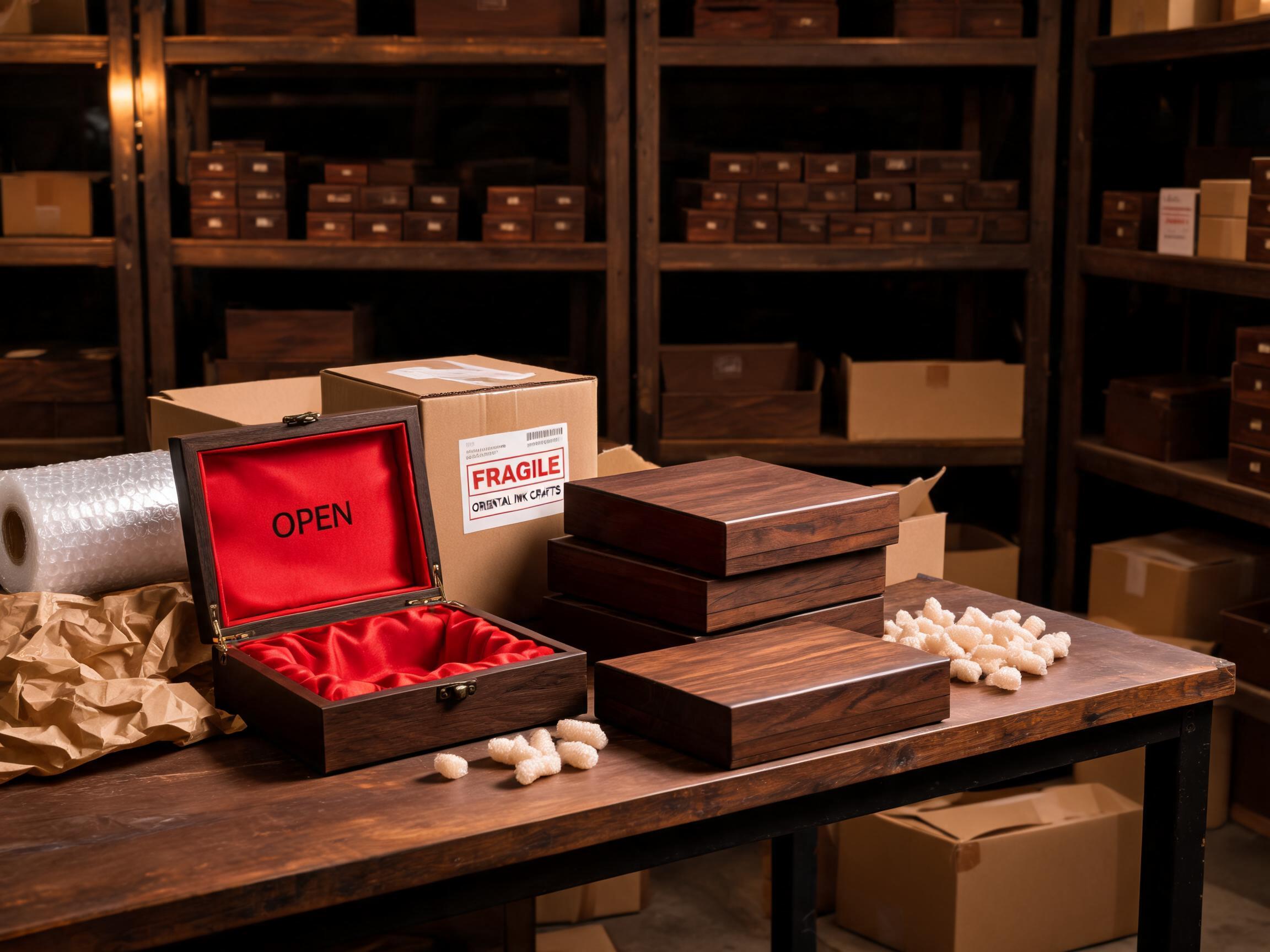
Ask your supplier to send a photo of the export packing plan before you approve mass production. If they cannot show you how they protect the goods, assume they do not protect them well.
Step 4: Documentation — the paperwork that clears your customs
Customs delays in Central/Eastern Europe and Africa are rarely about the goods. They are almost always about documentation. A supplier that includes export documentation as a standard part of the deal is saving you weeks of headache.
For the Complete Scholar Desk Set, export documentation is included. That should cover at minimum:
- Commercial invoice with correct HS code and declared value.
- Packing list with carton dimensions, weights, and carton marks.
- Bill of lading or airway bill.
- Certificate of origin (if applicable for your trade agreement).
Confirm in writing which documents are included and which cost extra. Some suppliers charge for certificate of origin or for a pre-shipment inspection report. Get this in the quote, not in a surprise invoice later.
Step 5: The buyer approval document set — your quality gate
The most underused tool in online bulk sourcing is the buyer approval document set. This is a package the supplier sends you before mass production starts, containing:
- Sample photos (not stock images, but photos of the actual pre-production sample).
- Spec sheets with dimensions, materials, and component details.
- Approval records — a formal document where you sign off on the sample.
Why this matters: once you sign the approval record, the supplier has a clear reference for the production run. If the batch arrives and the brush length is 2 cm shorter than the approved sample, you have a document to point to. Without it, it is your word against theirs.
Insist on this process even for a small first order. It sets the standard for every future order.
Step 6: Freight and Incoterms — who owns the risk at each stage
For buyers in Central/Eastern Europe and Africa, the Incoterms choice is often the difference between a smooth delivery and a costly surprise.
Consider these options:
- EXW (Ex Works): You arrange everything. Lowest price, highest risk and workload. Only choose this if you have a reliable freight forwarder who handles export customs in China.
- FOB (Free On Board): The supplier delivers to the port and loads onto your vessel. This is the most common choice for sea freight. The supplier handles export customs, you handle the rest.
- DDP (Delivered Duty Paid): The supplier handles everything up to your door, including import duties. This is convenient but often comes with a markup, and the supplier may not know your local customs rules as well as a local agent.
For a first order, FOB is usually the balanced choice. For repeat orders, compare the total landed cost of DDP versus FOB plus your own customs broker.
FAQ — questions buyers in your region ask
Can I order less than the stated MOQ for a trial?
Sometimes. Some suppliers accept a smaller trial order at a higher unit price or with a longer lead time. Ask, but do not push too hard — a supplier that bends the MOQ for a trial may also bend quality standards to protect their margin.
How do I verify quality without flying to China?
Ask for a pre-production sample shipped to you by courier. Yes, it costs money and takes a week. It is the cheapest insurance you can buy. Also ask if the supplier can arrange a third-party inspection before shipment — many will, at your cost.
What is the typical lead time for a calligraphy set order?
For the Complete Scholar Desk Set, it is 35–50 days after sample approval. That is a realistic range for a bundled product with multiple components. Budget for the full 50 days plus shipping time when planning your stock.
What if the goods arrive damaged?
Your first line of defense is the packaging specification you agreed to. Your second is the inspection before shipment. Your third is insurance. Negotiate the claims process in your purchase contract before you pay — not after damage occurs.
Final checklist before you send a deposit
- Company verified: operating since 2011, integrated chain confirmed.
- MOQ confirmed in writing: 30 sets for the Complete Scholar Desk Set.
- Lead time confirmed: 35–50 days after sample approval.
- Export packing plan reviewed: carton marks, protective materials, moisture protection.
- Export documentation confirmed: included in the price.
- Buyer approval document set agreed: sample photos, spec sheets, approval records before mass production.
- Incoterms chosen and freight cost estimated.
- Payment terms structured to protect you — typically 30% deposit, 70% against the copy of the bill of lading.
Buying calligraphy sets online in bulk is a manageable process if you treat it as a documentation exercise, not a shopping exercise. Verify the supplier, lock down the MOQ and lead time, protect the packaging, and insist on the approval document set. Do that, and the risk drops dramatically.
If you want to start with a concrete reference point, review the Complete Scholar Desk Set — its MOQ, lead time, and included export documentation give you a baseline for comparing other suppliers. Then apply this checklist to every quote you receive.