
A practical sourcing guide for distributors, wholesalers and gift buyers evaluating traditional Chinese ink blocks in bulk. Covers soot grade selection, binder ratio questions to ask suppliers, hand-carved vs molded decoration, order checks, shipping considerations, and how ink blocks compare to liquid ink for B2B programs.
Traditional Chinese ink blocks (ink sticks) are compact, shelf-stable and carry strong gift and collector value, which makes them a practical SKU for cultural product distributors, gift wholesalers and education program buyers. But bulk buying decisions hinge on a few technical points that many first-time purchasers miss: soot grade, binder (glue) ratio, decoration method, and export packaging. This guide walks through each decision point using Gu Mo Craft Technology's current ink stick lines as a concrete reference, and closes with a direct comparison against liquid ink for bulk programs.
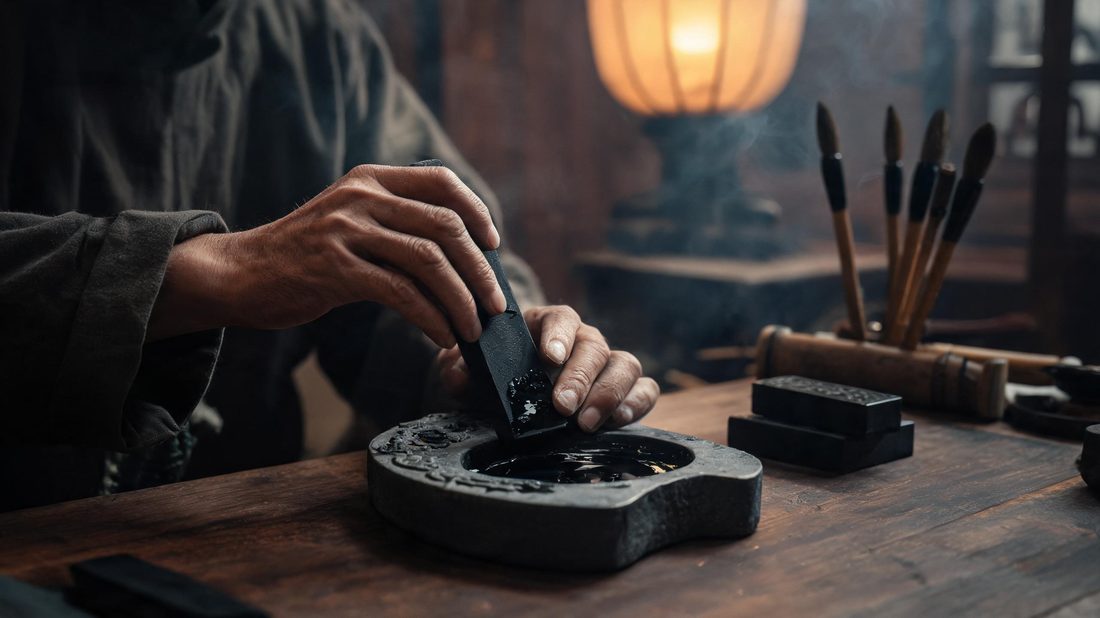
Soot Grades: Pine vs Oil, and Why Tone Matters More Than Price Tier
The first specification to lock down is the soot grade. Traditional ink sticks are made from soot bound with glue, and the two classic soot types behave differently on paper:
Pine soot produces a deep matte black. It is the traditional choice for calligraphy and brush painting, where a non-glossy, archival tone is preferred. Oil soot (refined from burning oils) produces a denser, glossy black with a slightly different flow character.
For a buyer, the important point is that soot grade changes the visual tone of the ink more than it changes the price tier. A premium-priced stick and a student stick can share the same soot grade; the price difference usually comes from decoration, weight and grading rigor. Gu Mo Craft Technology offers both grades: the Premium Pine Soot Hui Ink Stick (GMO-HIS-001) in pine soot with a deep matte black, archival-quality tone, and the Oil Soot Hui Ink Stick Classic (GMO-HIS-002) in refined oil soot with a rich glossy black tone. The Student Practice Hui Ink Stick (GMO-HIS-005) is also pine soot, with consistent matte black graded per batch.
Buyer verification method: always request physical samples and grind them on an inkstone before committing. Tone, smoothness and drying behavior on your target paper are visible within minutes and no specification sheet substitutes for that test.
The Binder (Glue) Ratio: What to Ask and How to Test It
Traditional ink sticks bind soot with animal or vegetable glue. The binder ratio is one of the most consequential — and least documented — variables in ink stick manufacturing. It affects:
- Stick hardness — a harder stick resists edge damage in shipping but grinds more slowly.
- Cracking risk — poorly balanced binder can cause sticks to crack over time or in dry climates.
- Grinding feel — how the stick feels on the inkstone, and how quickly it produces usable ink.
Gu Mo Craft Technology uses a natural vegetable binder across its pine soot and oil soot lines. Beyond that, buyers should not assume a fixed ratio: ask any supplier you evaluate to declare the binder type and its ratio range in writing, and request samples specifically to test grinding feel. If your market has very dry or very humid conditions, say so — binder performance is climate-sensitive, and a supplier who cannot discuss this is a supplier to be cautious with.
For shelf-life planning: when stored dry and cool, Gu Mo Craft Technology states its pine soot sticks retain quality for 10+ years. That stability is one of the strongest arguments for ink blocks over liquid ink in long-cycle distribution.
Decoration: Hand-Carved vs Molded, and What It Means for Gift Value
Decoration method is the main driver of presentation value and unit cost. Hand-carved decoration — for example, the hand-carved gold-filled calligraphy patterns on GMO-HIS-001 — produces crisp, raised detail that reads as a gift or collector item. Molded or machine-pressed decoration is faster and cheaper but shows less fine detail.
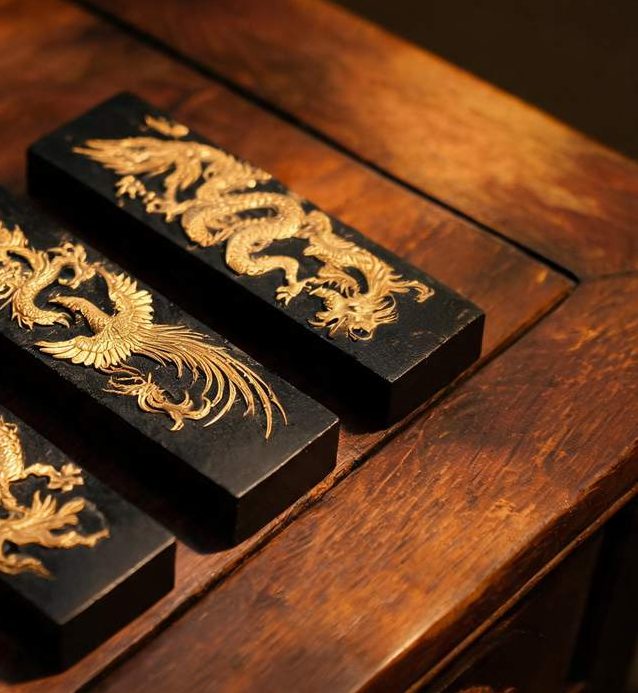
Ask every supplier explicitly which process is used, and request close-up photos of carved samples, not just catalog renders. If you plan custom artwork (corporate logos, anniversary motifs, calligraphy), ask how long a custom carving sample takes. Gu Mo Craft Technology produces a custom carving sample for GMO-HIS-001 in 10–15 days from an artwork file, and offers tone-matched samples for GMO-HIS-002 within 12–15 days from a buyer's reference. Also confirm private-label options early: both GMO-HIS-001 and GMO-HIS-002 support OEM/ODM private-label packaging, custom labels and gift box design, and GMO-HIS-005 supports custom label printing on packaging.
Order Checks, MOQs and Export Shipping
Ink sticks are heavy relative to their value and brittle at the edges, so export packaging deserves as much attention as the product itself. Before placing a bulk order, confirm:
- MOQ and weight mixing — GMO-HIS-001 and GMO-HIS-002 each carry an MOQ of 50 pieces; GMO-HIS-002 allows mixed weights combined toward the MOQ. GMO-HIS-005 carries an MOQ of 200 pieces.
- Lead times — GMO-HIS-001 and GMO-HIS-002: 30–45 days after sample approval; GMO-HIS-005: 25–35 days after sample approval, with monthly capacity up to 15,000 pieces for volume programs.
- Pre-shipment inspection — ask whether AQL inspection with a photo report is standard. GMO-HIS-001 ships with AQL photo reports; every batch of GMO-HIS-002 passes an ink density test and color consistency check before packaging; GMO-HIS-005 is graded per batch for tone and grinding performance.
- Documentation — material certificates and batch QC records ship with GMO-HIS-001 orders. Confirm what paperwork accompanies the other lines for your customs and retail requirements.
- Trade terms — FOB/CIF/DDP are available by quote; DDP is often worth comparing for first shipments into markets where you lack a customs broker.
- Free samples — GMO-HIS-005 samples are free for quality approval (buyer pays shipping); confirm sample terms for the premium lines before requesting.
Ink Block vs Liquid Ink for Bulk Programs
Liquid ink is ready to use and batch-consistent, which suits beginners and classroom settings. But in a container it is heavy, glass-bottle dependent and spill-prone. Ink blocks are compact, lighter per unit of usable ink, essentially shelf-stable, and carry far more gift and presentation value — especially with carved decoration and gift boxes. The tradeoff: grinding an ink block takes learning time, so education buyers should weigh whether their end users are beginners or committed learners.

| Spec | GMO-HIS-001 Premium Pine Soot | GMO-HIS-002 Oil Soot Classic | GMO-HIS-005 Student Practice |
|---|---|---|---|
| Soot / tone | Pine soot, deep matte black, archival | Refined oil soot, rich glossy black, archival | Pine soot, consistent matte black |
| Weight range | 50–200 g | 30–150 g | 20–50 g |
| Decoration | Hand-carved gold-filled patterns | Smooth polished surface | Plain, uncarved |
| MOQ | 50 pcs | 50 pcs (mixed weights OK) | 200 pcs |
| Lead time | 30–45 days after sample approval | 30–45 days after sample approval | 25–35 days after sample approval |
| Custom / labeling | Custom carving sample 10–15 days; OEM/ODM packaging | Tone-matched sample 12–15 days; custom label & gift box | Custom label printing; free samples (buyer pays shipping) |
| Best fit | Premium gift and collector programs | Mid-range gifting with custom branding | Education programs and high-volume retail |
FAQ
Can I mix stick weights toward the MOQ? Yes on GMO-HIS-002: mixed weights are combined toward its 50-piece MOQ. For GMO-HIS-001 and GMO-HIS-005, confirm weight-mixing terms with the supplier at quotation stage.
How should I store ink sticks in a warehouse or retail backroom? Dry and cool, away from direct heat and sunlight. Under those conditions Gu Mo Craft Technology states its pine soot sticks retain quality 10+ years, so slow-turning inventory is not a quality risk.
What paperwork should I require with a bulk order? At minimum: material certificates, batch QC records and a pre-shipment AQL photo report. GMO-HIS-001 ships with all of these; confirm equivalents for the other lines before contracting.
What do I need to provide for a custom carved design? A usable artwork file. From receipt of the file, GMO-HIS-001 custom carving samples take 10–15 days; budget additional time for sample approval and production lead time.
Are DDP terms available for first-time importers? Gu Mo Craft Technology quotes FOB, CIF and DDP. DDP can simplify first shipments; request a DDP quote alongside FOB to compare landed cost.
What capacity exists for education-scale orders? The Student Practice line (GMO-HIS-005) supports up to 15,000 pieces per month, sized for school and program procurement cycles.
Next Steps
Review the product detail pages for the Premium Pine Soot Hui Ink Stick, the Oil Soot Hui Ink Stick Classic, and the Student Practice Hui Ink Stick to match a line to your program. Gu Mo Craft Technology has manufactured traditional ink craft products since 2011, with an integrated facility covering material selection, hand-crafting, quality grading and export documentation, serving B2B buyers across Southeast Asia, Japan, Korea, the Middle East and beyond. Request samples, submit your artwork file for a carving or tone-matched sample, and ask for a quote under your preferred trade terms — the sample-and-grind test remains the fastest way to validate soot grade and binder feel before committing to volume.