
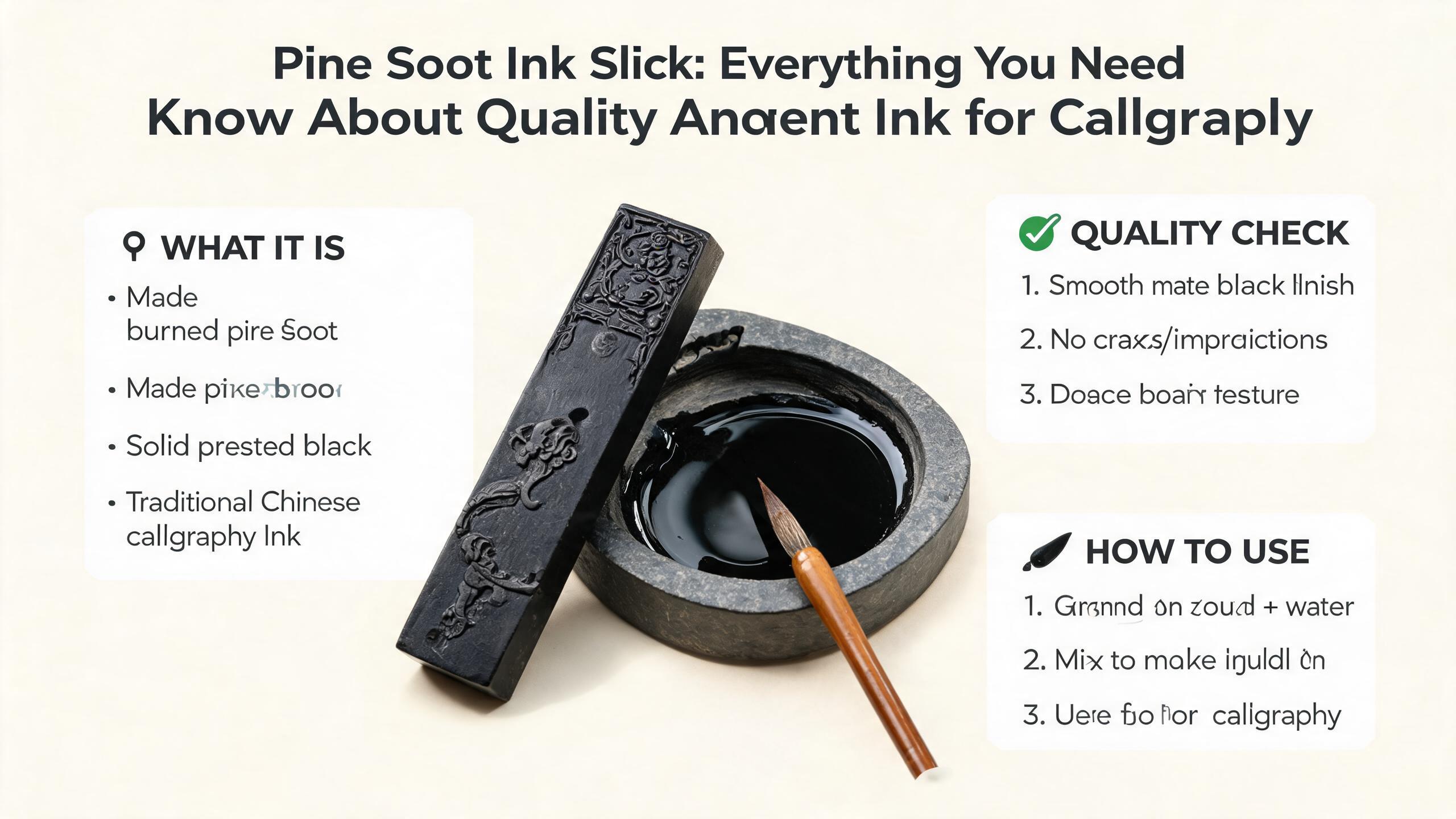
A practical guide for B2B buyers and calligraphy enthusiasts on selecting, evaluating, and sourcing pine soot ink sticks. Covers raw material differences, production process, quality indicators, storage, and common sourcing pitfalls — based on real industry knowledge.
BUYER’S GUIDE
Key Takeaways for Buyers
• Pine soot (song yan) is the traditional raw material for high-grade ink sticks — oil soot (you yan) is a separate, modern alternative.
• Quality is determined by soot particle fineness, glue type and ratio, and aging time — not just brand name.
• A genuine pine soot ink stick should produce a dense, jet-black ink with a subtle pine fragrance, not a chemical smell.
• Storage conditions (humidity, temperature) directly affect the ink stick’s lifespan and performance.
• When sourcing from a supplier, ask for particle size data, glue type, and aging period — not just “high quality.”
Why Pine Soot Ink Stick Matters for Calligraphy
For serious calligraphers, the ink stick is not a consumable — it is a partner in every stroke. The ancient ink tradition, particularly the pine soot ink stick, has been refined over centuries in East Asia. Unlike modern liquid inks, a solid ink stick gives the writer control over concentration, texture, and the subtle gradation of black that defines expressive brushwork.
But the market today is flooded with products labeled “pine soot” that are anything but. Some are made with industrial carbon black, others with cheap oil soot mixed with pine fragrance. For a B2B buyer — whether you are a stationery retailer, a calligraphy school, or a museum gift shop — knowing how to distinguish genuine quality from marketing is essential.
What Is Pine Soot Ink Stick? — Raw Material and Production
A pine soot ink stick (松烟墨, sōng yān mò) is made by burning pine wood in a controlled, oxygen-limited kiln. The soot that condenses on the kiln walls is collected, sieved, and mixed with animal glue (usually cowhide or deer-hide glue) and a small amount of preservatives like musk or borneol. The mixture is kneaded, pounded, shaped in a mold, and then dried slowly over weeks or months.
The key difference from oil soot ink sticks (油烟墨, yóu yān mò) lies in the raw material:
Property | Pine Soot Ink Stick | Oil Soot Ink Stick |
|---|---|---|
Raw material | Pine wood (specific species, aged) | Vegetable oils (tung, rapeseed, sesame) |
Black tone | Matte, cool-toned, deep black | Warm-toned, glossy, slightly brownish |
Particle size | Finer (0.1–0.5 µm typical for good quality) | Coarser (0.5–2 µm typical) |
Best for | Fine line work, calligraphy, ink wash painting | Bold strokes, rubbing, painting |
Fragrance | Subtle pine resin aroma | Mild oil scent (often masked with musk) |
From a sourcing perspective, pine soot ink stick is generally more expensive per unit because the pine wood must be carefully selected (old-growth pine yields finer soot), and the kiln process requires more skill to control temperature and airflow.
How to Judge Quality — 5 Verifiable Indicators
When evaluating a supplier’s ancient ink product, skip the “premium” label and ask for these five things:
1. Soot Particle Size
The fineness of the soot directly determines how smoothly the ink grinds and how evenly it disperses on paper. Good pine soot should have a median particle size (D50) below 0.5 µm. You can request a particle size analysis report from the supplier. If they cannot provide one, treat the product as medium quality at best.
2. Glue Ratio and Type
Animal glue content typically ranges from 10% to 25% by weight. Too much glue makes the ink sticky and slow to dry; too little makes it brittle and prone to cracking. The glue type matters too: cowhide glue is standard, but deer-hide glue (more expensive) produces a more flexible ink film. Ask the supplier for the glue type and approximate ratio.
3. Aging Time
Freshly made ink sticks are “green” — they contain residual moisture and the glue has not fully polymerized. Quality producers age their ink sticks for at least 6 months, and premium ones for 2–5 years. Aging reduces brittleness and deepens the black tone. A supplier should be able to tell you the production date, not just the batch number.
4. Grinding Test
A simple field test: grind a small amount on a clean ink stone with a few drops of water. Genuine pine soot should produce a dense, uniform black within 30 seconds of grinding. If the ink appears grayish, separates into clumps, or leaves gritty residue on the stone, the soot quality is poor or the glue is degraded.
5. Smell and Feel
Heat the ink stick slightly with your palm. A real pine soot stick releases a faint, pleasant pine resin smell — not a chemical or burnt plastic odor. The surface should feel smooth but not waxy. Waxy surface often indicates added stearin or other fillers, which reduce ink quality.
Common Sourcing Pitfalls for B2B Buyers
Here are the most frequent mistakes we see when stationery importers or art supply distributors buy pine soot ink sticks:
Assuming “pine soot” means pure pine. Many suppliers mix oil soot with pine soot to cut costs. The ink will look glossy and warm-toned — a telltale sign of oil soot content. Request a chemical composition test if you need assurance.
Ignoring the glue quality. Cheap glue (synthetic or low-grade animal glue) can cause the ink to yellow over time or become brittle in dry climates. Ask for the glue’s source and bloom strength.
Overlooking the mold impression. The design on the ink stick is not just decorative. A crisp, deep mold impression indicates the paste was properly kneaded and pounded — a sign of careful production. Blurry or shallow impressions suggest rushed manufacturing.
Buying based on age alone. An “aged” ink stick is only as good as its original materials. A 10-year-old stick made with poor soot and cheap glue will still perform poorly. Always verify the base quality first.
Storage and Shelf Life — What to Tell Your Customers
If you are reselling ancient ink, your end customers will ask how to store it. Here are the facts you can share:
Ideal humidity: 40–60% RH. Too dry causes cracking; too humid encourages mold on the glue.
Temperature: 15–25°C. Avoid direct sunlight and heat sources.
Packaging: Keep the ink stick in its original box or wrap it in acid-free paper. Do not store in plastic bags — trapped moisture can degrade the glue.
Shelf life: A well-made pine soot ink stick, stored properly, can last 20+ years. The glue may gradually lose flexibility, but the soot quality remains unchanged.
Frequently Asked Questions from Buyers
Q: Is a pine soot ink stick better than a liquid ink for calligraphy?
For serious practice and artwork, yes. The solid ink stick gives you control over concentration and texture that liquid ink cannot match. For daily practice, liquid ink is more convenient. Many calligraphers use both.
Q: What is the typical MOQ for a B2B order?
This varies by supplier. A typical MOQ for standard pine soot ink sticks (50–100 g per stick) is 500–1,000 pieces. Custom mold designs or special aging requests may require a higher MOQ. Always confirm with the supplier.
Q: How can I verify that the ink stick is truly pine soot and not a blend?
Request a material composition declaration from the supplier. For high-value orders, you can commission a third-party lab test (FTIR spectroscopy can distinguish pine soot from oil soot and carbon black). The cost is typically $100–$300 per sample.
Q: Do you offer OEM/private label for ink sticks?
Many suppliers do. You can usually customize the mold design, packaging, and sometimes the glue formula. Lead time for a custom mold is typically 4–8 weeks. Confirm the minimum order quantity for custom designs separately.
How to Start a Sourcing Inquiry
When you contact a supplier about pine soot ink sticks, include these specifics to get a meaningful quote:
Target weight per stick (common sizes: 25 g, 50 g, 100 g)
Estimated annual volume (pieces per year)
Preferred packaging (individual box, bulk, gift set)
Any certification requirements (e.g., REACH for EU, Proposition 65 for California)
Whether you need a custom mold design
A good supplier will respond with a product specification sheet, not just a price. If they cannot provide particle size data, glue type, and aging information, consider that a red flag.
For more information on our ancient ink product line, including pine soot ink sticks with verified particle size and controlled aging, contact our sales team. We can provide spec sheets, sample requests, and MOQ details.