
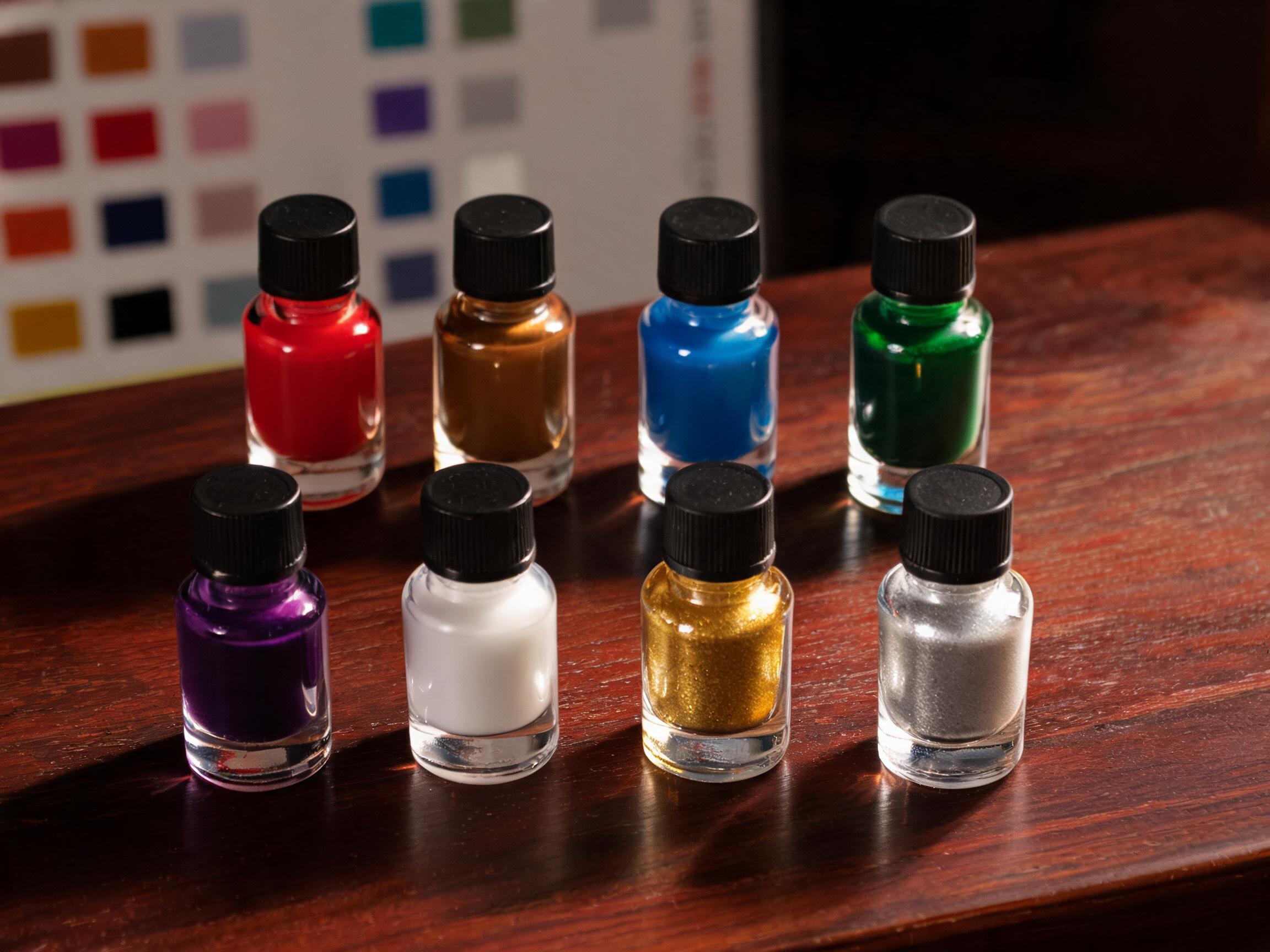
Gold ink fails in gift and stationery programs for reasons that rarely show up in a sample bottle: dye-based color that fades, batch-to-batch shade drift, and packaging that cannot carry a private label. This sourcing guide explains how mineral pigments, documented lightfastness testing, and per-shipment color references affect bulk gold calligraphy ink orders, with the specifications and verification steps buyers can work through before placing one.
Bulk Sourcing Guide
Gold ink problems in gift and stationery programs rarely show up in a sample bottle. They show up at distribution: a shade that drifts between batches, a color that dulls on a framed certificate, an insert card nobody can brand. This guide covers what separates gold ink grades in bulk, how lightfastness is documented, and what to verify before you commit to an order.
Key takeaways
- Pigment base (mineral vs dye) is the first thing to establish — it drives fade resistance and price.
- Lightfastness that is not tied to a named standard and test condition cannot be compared between suppliers.
- Per-shipment color reference charts are what keep a gift program visually consistent across reorders.
- Packaging and private-label capability decide whether the ink fits your program format at all.
- MOQ, lead time and Incoterms should be confirmed before artwork or sampling starts.
A gold ink line for gift and stationery programs usually runs parallel to black, red and other conventional colors. The reference product for this article, GMO-LIQ-005 Colored Liquid Ink Set, is a case in point: eight standard colors including gold, supplied in 30 ml bottles as a one-set unit. That structure matters commercially — buyers order the full set or a private-label program rather than a single isolated color, which changes how you check shade consistency and MOQ.
On this page
Pigment base: mineral vs dye
Gold calligraphy ink gets its color either from mineral-based pigments or from dyes. The difference is not cosmetic. Dye-based gold usually looks vivid in the bottle and in a freshly written sample, and then shifts or fades under light and over time. Mineral pigment carries the color as dispersed particles, which is why it tends to hold both shade and opacity far longer on paper.
For gift and stationery programs the consequences are practical:
- Ceremonial and award writing — certificates, guest books, presentation scrolls — are often displayed rather than stored in the dark. Dye-based color is a poor match for anything that will sit in daylight.
- Decorative borders, envelopes and program covers printed or written ahead of an event may be produced months before use. The color has to still look like gold on the day.
- Repeat orders across a program's print runs are where dye batches diverge most visibly, because small process differences affect dye shades more than pigment dispersions.
The Colored Liquid Ink Set uses mineral-based pigments with a natural binder. That is a statement about composition, and it is the first claim worth confirming in writing with any supplier, because the phrase "gold ink" alone tells you nothing about the colorant behind it. Ask directly: mineral pigment or dye, and at what pigment loading. If a supplier cannot answer the first part, the lightfastness numbers that follow are not worth reading.
Lightfastness and what counts as documentation
Lightfastness is measured on a scale where higher is better, and the number is only meaningful when it is tied to a test method. The Colored Liquid Ink Set is tested to lightfastness grade 4+ under ISO 105-B02, and its pigments meet ASTM D4236. Those two references do different jobs:
| Reference | What it establishes | What it does not establish |
|---|---|---|
| ISO 105-B02 (grade 4+) | Lightfastness of the tested material under a defined exposure method | Performance on every paper stock, or under indoor lighting conditions outside the test scope |
| ASTM D4236 | Pigment-based art material labeling standard for chronic hazard evaluation | Color permanence, coverage or drying behavior |
Two things follow for a buyer. First, grade 4+ is a reasonable working benchmark for gift and decorative writing — it indicates the color is not a short-life dye. It does not mean the ink is permanent in direct sunlight, and no supplier should imply otherwise. Second, when a supplier quotes you a lightfastness figure with no standard, no grade scale and no test report, you are comparing nothing. "Fade-resistant gold" is not a specification.
Batch color consistency and verification steps
Gift programs fail quietly on color drift. A hotel orders 500 private-label ink sets for a guest amenity line in spring, reorders in autumn, and the second batch reads slightly warmer under the lobby lighting. Nobody can prove it from memory, but the sets no longer match.
Two mechanisms reduce this risk, and both are things you can ask for rather than assume:
- A color reference chart per shipment. Each shipment carries a chart against which incoming ink can be checked. This gives your receiving team a physical standard instead of a remembered shade.
- Custom color matching. If your program needs a gold that matches an existing corporate or ceremonial palette, color matching should be done before mass production and confirmed at sample approval — not adjusted during a production run.
A workable pre-order sequence looks like this:
- Step 1 — Define the use case. Certificates and framed awards, event programs, branding wrappers, or retail stationery. Display conditions decide how much lightfastness headroom you need.
- Step 2 — Request the composition statement. Mineral or dye, binder type, and whether a test report exists for the grade you are being quoted.
- Step 3 — Ask for a color reference chart from a recent shipment, and write the approved chart reference into your order specification.
- Step 4 — Approve a physical sample. In writing, with the shade you approved retained as the reference. Verbal "looks good" approvals do not survive a reorder.
- Step 5 — Check the first incoming shipment against the chart before the rest of the run is released to your distribution channel.
For products where decoration is printed or foiled rather than written, the same discipline applies to the accompanying gift item. If your program pairs liquid gold ink with a solid ink stick edition, the Commemorative Gold-Edge Hui Ink Stick is a related premium gift format worth pricing alongside — it pairs a pine-soot body with 24K gold-edge decoration, numbered editions and a magnetic-closure gift box.
Packaging and private-label options
Packaging is where a generic ink supply either becomes a program item or stays a commodity. The Colored Liquid Ink Set is bottled at 30 ml with eight bottles per set, and a private-label gift box is available. For gift and stationery buyers, that opens three common formats:
- Corporate and hospitality gifting — the set as a boxed unit with your branding on the outer box.
- Retail stationery — sets merchandised as a color range, where the gold must sit coherently next to the other seven colors.
- Cultural venue and ceremonial supply — sets used for guest writing stations, workshops or calligraphy demonstrations, where bottle format and opening mechanism matter as much as the ink.
Whether artwork dielines, print methods or boxboard options are available for your specific design should be confirmed with the supplier during sampling, since those details vary by project. What you can fix early is the artwork deadline: private-label packaging consumes the longest part of the pre-production timeline, so approve box artwork in the same cycle as the ink sample rather than after it.
MOQ, lead time and order terms
Commercial terms for bulk gold ink sit differently from single-item products, because the color is one component of a set. For the Colored Liquid Ink Set:
| Item | Confirmed detail |
|---|---|
| SKU | GMO-LIQ-005 |
| Format | 30 ml bottles, 8 per set |
| Colors | 8 standard colors including gold |
| Pigment | Mineral-based pigments with natural binder |
| Lightfastness | Grade 4+ under ISO 105-B02 |
| Pigment standard | ASTM D4236 |
| Documentation | Color reference chart and lightfastness test report per shipment |
| Customization | Custom color matching; private-label gift box |
| MOQ | 50 sets |
| Lead time | 30–45 days after sample approval |
| Shipping terms | FOB / CIF / DDP by quote |
Two notes on planning. First, the lead time clock starts at sample approval, so every day spent on sample rounds and artwork sign-off is added to the delivery date. Second, for programs that need custom-matched gold, treat the matching and approval step as part of the critical path rather than a formality. If your quantity sits below 50 sets, ask the supplier what options exist — the MOQ is confirmed for this SKU, and it should not be assumed the same figure applies to other formats.
Product detail, including the eight standard colors and set configuration, is listed on the Colored Liquid Ink Set page.
Related premium gift format
Some institutional programs pair liquid ink for everyday writing with a presentation-grade solid ink item for ceremonial gifting. The Commemorative Gold-Edge Hui Ink Stick is built around a pine-soot body with 24K gold-edge decoration, individually numbered editions and a magnetic-closure gift box. Custom engraving is supported with proof samples within 15 days; MOQ is 30 pieces and lead time is 40–55 days after sample approval. If your program includes both writing ink and a commemorative object, quote them in the same cycle so that packaging, numbering and delivery windows can be aligned.
FAQ
Is mineral pigment always better than dye for gold ink?
For gift and stationery programs where the writing is displayed or produced well ahead of use, mineral pigment is the more suitable base because color is carried by dispersed particles rather than a dye. It is not a universal rule for every ink application, and it is not a claim that dye-based products are defective. The relevant question is whether the supplier can state the colorant and back it with a lightfastness report under a named standard.
What does lightfastness grade 4+ under ISO 105-B02 actually tell me?
It tells you the tested material reached grade 4 or higher under that exposure method. It is a comparison point between suppliers who test to the same method, and it is more useful than an unqualified "fade-resistant" claim. It does not guarantee the ink is permanent under direct sunlight or on every substrate.
Can I order gold ink on its own?
The Colored Liquid Ink Set is supplied as a set of eight 30 ml bottles with a 50-set MOQ. If your program requires gold alone or a different color combination, ask the supplier about custom color matching and set configuration when you request a quote.
How much time should I allow before a program launch?
Production lead time is 30–45 days after sample approval, so add sampling, custom color matching, packaging artwork approval and any proof rounds on top. If your program also includes an engraved ink stick edition, that runs 40–55 days after sample approval with proof samples within 15 days, so the two timelines need to be sequenced deliberately.
Before you place a bulk gold ink order, have these five answers in writing: pigment base and binder, lightfastness grade with test method, whether a color reference chart ships with each order, private-label packaging scope, and confirmed MOQ and lead time for your quantity and destination terms. Anything you cannot get in writing is a risk carried by your program, not by the supplier.
Supplier: Gu Mo Craft Technology, founded 2011, exporting across Southeast Asia, Japan/Korea, the Middle East, Central and Eastern Europe, Africa and the Americas. Send your program details — color, quantity, packaging format and destination — to request a quote and a sample plan.