
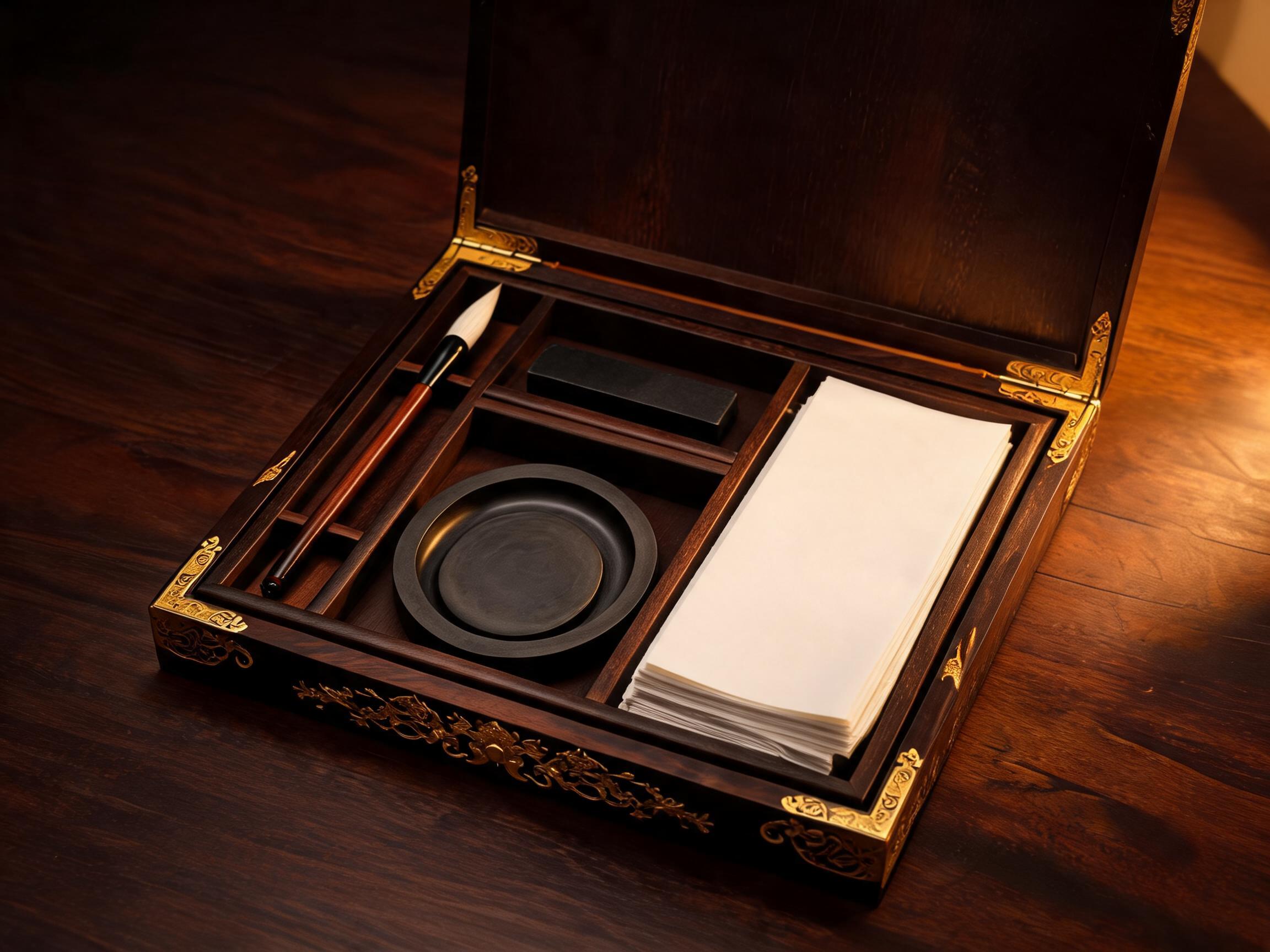
A pre-consolidation checklist for importers building mixed or consolidated orders of Chinese calligraphy supplies. It covers the four core categories, how to bundle them by destination market, when a matched set beats component sourcing, and what to verify before the container is booked.
Chinese Calligraphy Supplies Import Checklist: Bundling Brushes, Ink, Paper and Inkstones by Market
Consolidated orders of Chinese calligraphy supplies usually fail for a simple reason: the four categories are bought as four separate line items and never matched to each other or to the destination. A carton of brushes arrives without paper cut for the same use, an inkstone grade sits above or below the brush it ships with, and the buyer ends up holding stock that only sells when the customer assembles the kit themselves. The problem is not the products. It is the purchase logic.
This checklist treats brushes, ink, paper and inkstones as one buying unit and works backward from the market you are shipping to. It is written for importers planning mixed containers or consolidated orders into Japan and Korea, Southeast Asia, the Middle East and Chinese communities, and Central and Eastern Europe and Africa.
The core decision: for each market, decide whether you are buying a matched set, loose components, or a mix of both, and lock that decision before you request a quote. Component matching is the step most often skipped, and it is the step that determines whether the shipment sells as a kit or sits as disconnected stock.
The four-category checklist
Before looking at markets, confirm what each category actually delivers in your order. The list below reflects the product types available for bundling; treat it as the minimum to specify in writing.
| Category | What to specify | Bundling implication |
|---|---|---|
| Brushes | Hair type and the size range in the set or carton. Wolf hair is the standard brush hair used in the scholar desk set, for example. | Brush size must match the intended user: practice-grade for students, presentation-grade for gift sets. |
| Ink | Format: ink stick (pine soot is used in the scholar desk set), bulk liquid ink in 1L or 5L, or student-grade liquid ink. | Liquid and stick ink serve different buyers; don't assume one substitutes for the other in a set. |
| Paper | Student practice Xuan paper or professional raw Xuan paper, plus sheet count per pack. | Paper is the volume driver in education bundles and the cost driver in gift sets. |
| Inkstones | Practice-grade or premium Duan stone; confirm grade per SKU. | Inkstone grade is the clearest signal of market positioning in the whole order. |
One note on seal paste: this article does not cover paste grades or packaging. If your market expects a name-seal pairing with the set, handle paste selection through the separate grade and packaging checks you already use for that component.
Bundling by destination market
The same four categories get assembled differently depending on who opens the box. The table below is a starting position, not a rule — adjust it to what your own accounts actually stock.
| Market | Primary format | Bundling emphasis | Decision to lock |
|---|---|---|---|
| Japan / Korea | Matched set plus open-stock inkstone | Inkstone quality and shodo gift presentation | Set first, then a separate inkstone SKU for buyers who upgrade components |
| Southeast Asia | Volume school/program sets and gift sets | Paper and liquid ink volume; gift-box finish | Split the order: practice bundles vs. gift bundles |
| Middle East & Chinese communities | Gift-box sets | Presentation box and name-seal pairing | Confirm branding and packaging language before sample approval |
| CEE & Africa | Education-program bundles | Durable practice-grade components, replaceable parts | Favor student-grade ink and practice paper over premium stone |
Japan and Korea
Shodo practice and gift expectations push inkstone quality up the list. A buyer here is less likely to accept a set where the stone is clearly the weakest component. The practical move is to lead with a matched set that has a stated stone grade — the complete scholar desk set uses a Duan inkstone alongside a wolf hair brush, a pine soot ink stick and 20 sheets of Xuan paper — and then keep a separate open-stock inkstone line for buyers who want to upgrade or replace. Decide this before quoting: a set that competes with your own open-stock stone confuses the account.
Southeast Asia
School programs and gift sets pull in opposite directions on volume. School buyers want paper and ink in quantity, while gift buyers want a finished box. The clean approach is to split the purchase order into a practice bundle and a gift bundle rather than forcing one SKU to do both. Student practice Xuan paper and bulk liquid ink in 1L or 5L containers carry the practice side; the gift side carries the presentation weight.
Middle East and Chinese communities
Presentation is the deciding factor. Gift-box finish, branding and any name-seal pairing should be specified before the sample is approved, because packaging changes after approval restart the sample cycle. Custom branding, logo and packaging language are available on the scholar desk set, so the negotiation belongs in the specification stage, not after the order is placed.
Central and Eastern Europe and Africa
Education-program budgets favor durable practice-grade components over premium stone. Student-grade liquid ink, practice Xuan paper and practice-grade Duan inkstones form a coherent bundle that survives classroom use. Premium components usually become a small add-on line rather than the core of the order.
Set sourcing versus component sourcing
The tradeoff is not about price per piece. It is about who owns the matching risk.
When you buy components separately — brushes from one line, paper from another, stones from a third — you carry the job of making sure the parts fit together and that a customer who opens the box sees a coherent product. When you buy a matched set, that responsibility sits with the supplier. The scholar desk set is built on set-level component matching with AQL inspection, and component matching documentation ships with the order. That documentation is the difference between a set you can reorder confidently and a set you have to re-check every time.
For orders of 100 sets or more, 2% spare components are included at no extra cost — a practical allowance for the breakage that a set-level order tends to generate in handling and inspection. Sample approval gates the lead time: 35–50 days after approval, with an MOQ of 30 sets.
Component sourcing still makes sense where your market buys open stock — a Japan/Korea inkstone upgrade line, or loose practice paper for a school account. The mistake is mixing the two models on the same purchase order without deciding which SKU is the set and which is the spare.
Pre-consolidation verification list
Run this before the container is booked, not after the quote is accepted.
- MOQ per line. Confirm the minimum for each SKU you are combining, not just the headline set. The scholar desk set MOQ is 30 sets; component lines carry their own minimums.
- Lead time and sample gate. Set orders run 35–50 days after sample approval. Build sample approval into your schedule, not around it.
- Component matching documentation. Request it with the quote so you know what the set contains and what was checked.
- Spare components. Confirm the 2% spare allowance applies at your order volume (100+ sets) and what it covers.
- Branding and packaging language. Lock custom logo and packaging language before sample approval — changes afterward restart the cycle.
- Mixed-container split. Confirm how set cartons and loose component cartons are separated for customs and receiving.
- Seal paste. If your market needs it, route paste through its own grade and packaging check; don't fold it into the set specification.
FAQ
Can I mix sets and loose components in one consolidated order?
Yes, but decide which line is the set and which is open stock before you request pricing. The scholar desk set is available as a set-level SKU; loose practice paper and bulk liquid ink are separate lines. Keeping them distinct on the purchase order avoids the mismatch that happens when a set is treated as a paper bundle.
Is bulk liquid ink a substitute for ink sticks in a gift set?
Not for a gift-oriented market. Bulk liquid ink in 1L and 5L containers serves volume and practice use; a gift set typically specifies an ink stick. Match the ink format to the buyer, not to the carton size.
What paper should go with a school program bundle?
Student practice Xuan paper is the natural pairing for education bundles. Professional raw Xuan paper belongs with higher-grade practice or presentation lines, which usually means a different market or a different account within the same market.
How does the supplier handle component matching across the four categories?
For the scholar desk set, matching is done at set level with AQL inspection, and component matching documentation ships with the order. The production is vertically integrated across the four component categories, so the matching is controlled within one production flow rather than assembled from independent suppliers.
Where to start
The order of operations is simple: pick your primary market, decide set versus open stock for each of the four categories, and lock packaging and branding before you approve a sample. Then confirm MOQ, lead time and the documentation that ships with the order. If you are building a first consolidated order around a matched set, the scholar desk set is the reference point, with student practice Xuan paper and bulk liquid ink as the volume lines that fill out the container.