
A practical checklist for gift-channel buyers sourcing calligraphy sets for adult beginners. Covers brush count and sizes, ink format decisions, paper and inkstone choices, guide sheets, and gift-box packaging logic, with tiering guidance and ordering checks.
Adult beginners are the largest single segment of calligraphy gift buyers, and the hardest to configure for. A set pitched at children carries different assumptions about supervision and durability; a collector's box carries different assumptions about prior knowledge. The adult beginner sits in between: they need enough equipment to practice without frustration, but not so much that the box feels like a professional kit they cannot use. For gift retailers, cultural gift distributors, museum shops, and diaspora-community retailers, the sourcing question is concrete: what goes in the box, and how is it presented so the recipient can start within the first hour?
This article sets out a component checklist for adult-beginner sets, then walks through the packaging and tiering decisions that follow. It is a configuration guide, not a corporate-program tiering document or an antique-styling brief; those are separate buying conversations.
Key takeaways
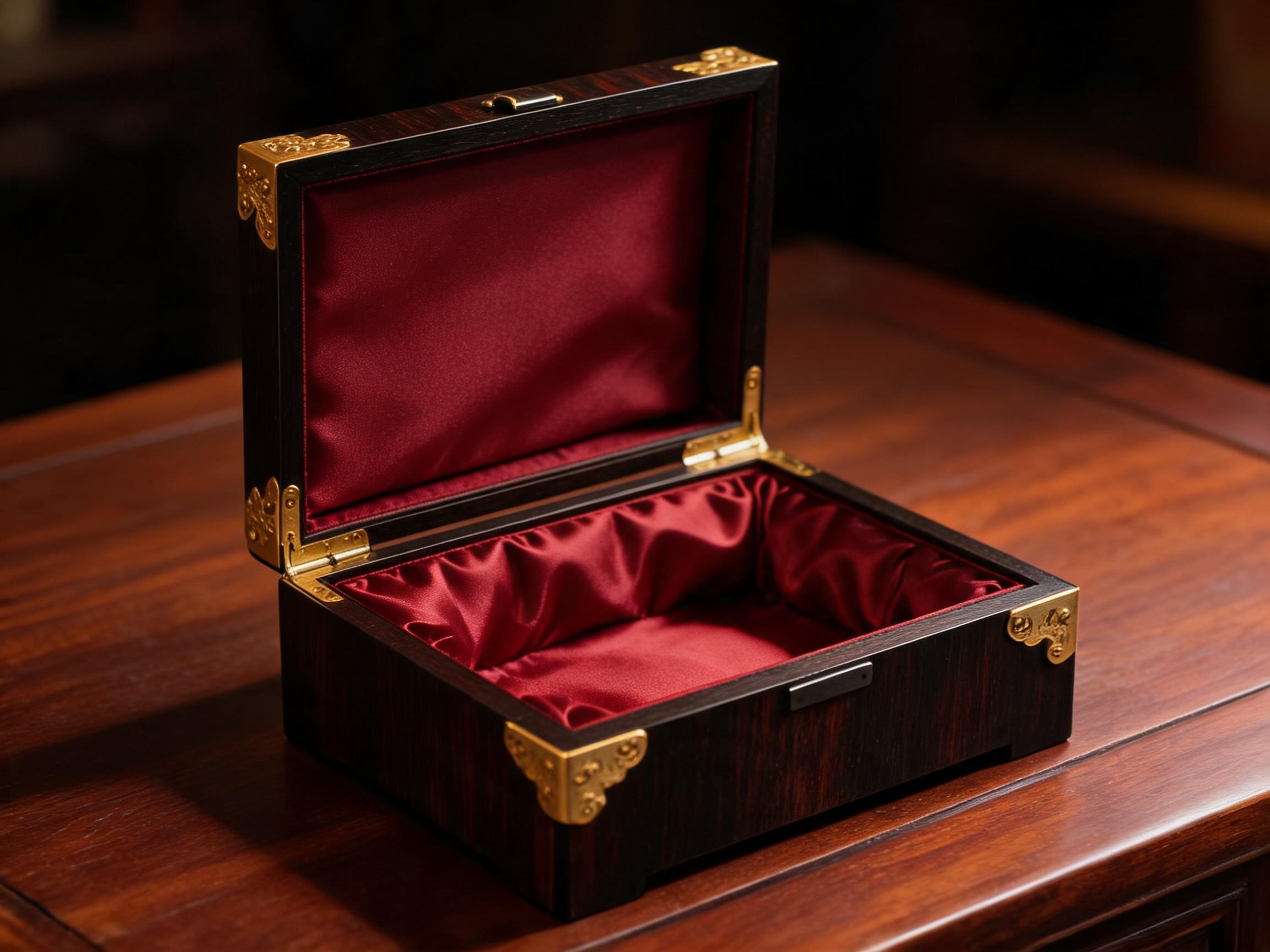
- Adult beginners need two to three brush sizes, one reliable ink format, practice paper, and printed guidance. Everything else is optional.
- The ink decision — stick plus inkstone, or liquid ink — changes cost, ritual value, and the recipient's first-session experience.
- Paper format inside the box should match the practice surface: loose sheets, a pad, or pre-printed grid sheets.
- Gift-box quality is mostly about insert fit and instruction language, not box material alone.
- Confirm set contents and MOQ with the supplier before committing to a tier structure.
What this guide covers
- Component checklist for adult beginners
- Ink format decision: stick and inkstone vs. liquid ink
- Paper format inside the box
- Box materials, interior fit, and instruction inserts
- Tiering by price point
- Ordering checks before you commit
1. Component checklist for adult beginners
A workable adult-beginner set covers four functions: making a mark, supplying ink, practicing on paper, and knowing what to practice. The checklist below reflects general craft guidance for beginners; it is not a specification for any single product.
- Brushes: two to three sizes. A medium brush handles most practice characters; a smaller brush allows detail; a larger brush introduces stroke variation. Three brushes give range without overwhelming a beginner.
- Ink: one reliable format. Either an ink stick with an inkstone, or a bottle of liquid ink. Do not include both in an entry set unless the box is explicitly positioned as a complete study kit.
- Inkstone or ink pad: required if an ink stick is included; a small dish or pad suffices if liquid ink is chosen.
- Practice paper: enough sheets for several sessions. Xuan paper is the traditional choice; many beginner sets use practice paper with printed grids.
- Guide sheets: printed stroke-order or basic-character sheets, ideally with a short bilingual explanation of posture, brush grip, and ink loading.
The line between "enough" and "too much" is usually drawn at accessories. Brush rests, water bowls, and decorative items add perceived value but are not required for a first session. Including one or two is a packaging decision, not a functional one.
2. Ink format decision: stick and inkstone vs. liquid ink
This is the single configuration choice that most affects cost, recipient experience, and box design.
| Factor | Ink stick with inkstone | Liquid ink |
|---|---|---|
| First-session experience | Requires grinding; slower start but introduces the traditional process | Immediate; recipient can write within minutes |
| Gift perception | Higher ritual and cultural value; suits display-oriented gifts | Practical; suits educational and trial-oriented gifts |
| Box requirements | Needs a stable inkstone cavity and protection for the stick | Needs leak-resistant containment and upright orientation in transit |
| Guidance needs | Instructions on grinding and water ratio are essential | Instructions on dilution and loading are helpful |
For gift-channel buyers, the practical split is by recipient and channel, not by market alone. A useful starting rule of thumb: channels where many recipients already practice calligraphy — for example Japanese and Korean stationery buyers, or Chinese diaspora communities in North and South America — tend to read an ink stick as a mark of a serious gift, while channels where calligraphy is still new to most recipients — common in parts of Southeast Asia, the Middle East, Africa, and Central/Eastern Europe — get more first-session success with liquid ink. Treat this as a channel-level observation to validate with your own customer data, not a fixed market rule: within any single market, display-oriented gift programs suit an ink stick while trial-oriented channels usually suit liquid ink.
Guangdong Gumo Crafts Technology Co., Ltd., founded in 2011, manufactures across eight product categories including the Four Treasures of the Study sets, ink, brushes, inkstones, and rice paper. Its Calligraphy Starter Kit Set is positioned as beginner-friendly with quality-graded components and an illustrated usage guide, designed for educational programs and school distribution. For gift buyers, that grading structure is the relevant detail: it indicates the supplier sorts components for a beginner audience — ask how the grading is defined and verified before you rely on it in your listing copy.
3. Paper format inside the box
Paper is where gift sets most often lose their usefulness. A stack of loose sheets is impressive in volume but awkward on a desk; a small pad is tidy but may not survive a full practice session. Three formats are common, each with trade-offs:
- Loose sheets: best volume-to-cost ratio; requires the recipient to manage sheets and may crease in transit.
- Bound pad: protects paper and sits flat; adds weight and thickness to the box.
- Pre-printed grid sheets: support structured practice; usually supplied in smaller counts because printing adds cost.
For adult beginners, a combination works well: a modest pad or folded stack for free practice, plus a small set of printed grid sheets for guided exercises. The guide sheet and the grid sheet should reference each other so the recipient knows which paper to use for which exercise.
4. Box materials, interior fit, and instruction inserts
Gift-box quality in this category is decided at two moments: unboxing and the first repack. A box that looks premium when opened but cannot hold the components securely after use tends to end up in a drawer, which shortens the product's visible life in the recipient's home.
Interior fit matters more than exterior material. Each component should have a shaped cavity or a restrained insert that prevents movement in transit. Brushes are the most fragile item in the box; a rigid sleeve or a dedicated channel protects the tips. Inkstone cavities need enough depth that the stone does not contact the lid. If liquid ink is included, confirm how the bottle is restrained and oriented — this is a question for the supplier, since packaging method varies by product.
Instruction inserts are a common weak point. Two languages are usually the minimum for gift-channel distribution; three is common in Southeast Asia and the Gulf. Beyond language, the insert should show the order of operations (prepare ink, load brush, first strokes) rather than assume prior knowledge. Suppliers with in-house design and manufacturing, such as Gumo, may be able to adapt insert content and language as part of gift set design; confirm the exact scope during quotation.
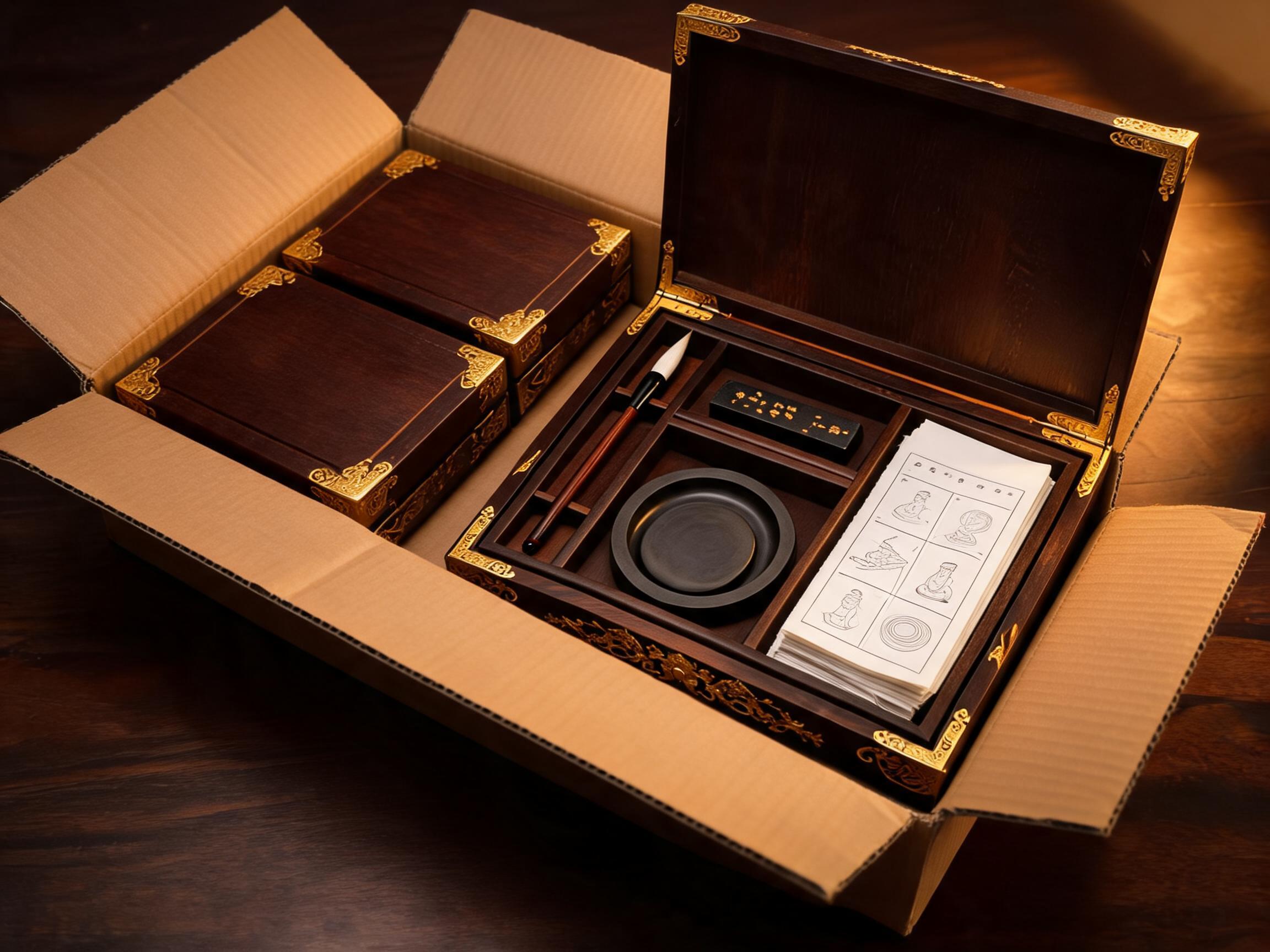
For buyers who want a step up in presentation, the Premium Craft Gift Box uses hardwood construction, a magnetic closure, and custom branding, aimed at VIP corporate gifting and cultural programs. The Complete Scholar Desk Set pairs an ink stick, inkstone, brush, and Xuan paper in a custom presentation box for cultural gifting and corporate events. For exhibition or event-specific boxes, the Custom-Themed Scholar Desk Set offers event-specific packaging and branded ink stick patterns.
5. Tiering by price point
Gift-channel buyers usually need two or three tiers rather than one box. The tiers below are framed by component and packaging decisions, not by corporate-program mechanics.
| Tier | Typical component focus | Packaging focus | Best-fit channels |
|---|---|---|---|
| Entry gift | Two brushes, liquid ink, practice pad, bilingual guide | Printed rigid box, foam or molded insert, single-language or bilingual insert | Museum shops, diaspora retail, trial gifting |
| Mid gift | Two to three brushes, ink stick and inkstone, grid sheets, guide | Wood-effect or solid board box, shaped cavities, multilingual insert | Cultural gift distributors, premium retail |
| Premium gift | Three brushes, ink stick and inkstone, Xuan paper, optional accessory | Hardwood box, magnetic closure, custom branding, presentation sleeve | VIP gifting, institutional and cultural programs |
The jump from entry to mid tier is mostly the ink format; the jump from mid to premium is mostly the box and paper quality. Buyers can therefore hold the brush count steady across tiers and vary ink and packaging, which simplifies both sourcing and shelf presentation.
6. Ordering checks before you commit
Before placing a bulk order, confirm the following with the supplier. These are questions that affect the buyer's risk, not generic diligence:
- Component grading: how brushes are sorted by size and quality, and whether the grading is consistent across production runs.
- Packaging drop-test: whether the supplier can provide a drop-test record or a pre-shipment sample for the box as packed, particularly for liquid ink configurations.
- Branding options: what can be customized — box exterior, insert, ink stick pattern, brush handle — and at what stage artwork must be approved.
- Instruction language and content: which languages are available as standard and which require new typesetting.
- Set contents and MOQ: confirm exact contents per SKU and MOQ with the supplier before finalizing the tier structure, since these vary by configuration.
Gumo provides OEM customization, gift set design, and bulk export orders, with design, manufacturing, and QC handled in-house. That structure supports the kind of configuration work described here — adjusting brush counts, swapping ink formats, and adapting inserts — but the specific scope for any given order should be confirmed during quotation.
For gift-channel buyers, the strongest adult-beginner set is not the one with the most components. It is the one where every component has a clear first-session purpose, the box protects them after opening, and the instructions assume no prior knowledge. That combination is what turns a gift into a practice.