A practical guide for B2B buyers on how to store and handle ink sticks, inkstones, and calligraphy brushes as inventory—covering climate risks, packaging integrity, repacking, and inspection on receipt.
For distributors and wholesalers of Chinese calligraphy supplies, the moment stock arrives at your warehouse is the moment quality begins to be decided—not at the factory. Ink sticks, inkstones, and brushes are natural materials. They respond to climate, light, and handling long before a retail customer ever opens the box. If you store them the same way you would store plastic or metal goods, you risk selling damaged, discolored, or cracked products that come back as returns—or worse, that damage your reputation with collectors and gift buyers.
This guide covers the specific inventory risks for these three product types, how to store them in different climates, what to inspect on receipt, and how to repack safely. It is written for B2B buyers—importers, distributors, art supply dealers, gift channel buyers, and ceremonial suppliers—who need stock to stay sellable from the moment it lands until the moment it ships out again.
In this article
Why storage matters before resale
Ink sticks, inkstones, and brushes are not inert. An ink stick contains soot and a natural binder; the binder can dry out, soften, or attract mold depending on humidity. An inkstone is a piece of natural stone with a polished surface; it can absorb odors, develop stains, or be damaged by impact. A brush has animal hair glued into a handle; the hair can lose its shape, the glue can weaken, and the handle can warp or crack.
For a distributor, these are not just aesthetic issues. A batch of ink sticks that arrives with cracked surfaces, inkstones with chipped edges, or brushes with splayed tips becomes unsellable at full price. That is lost margin, plus the cost of return shipping and customer service. Proper storage is the cheapest insurance you can buy.
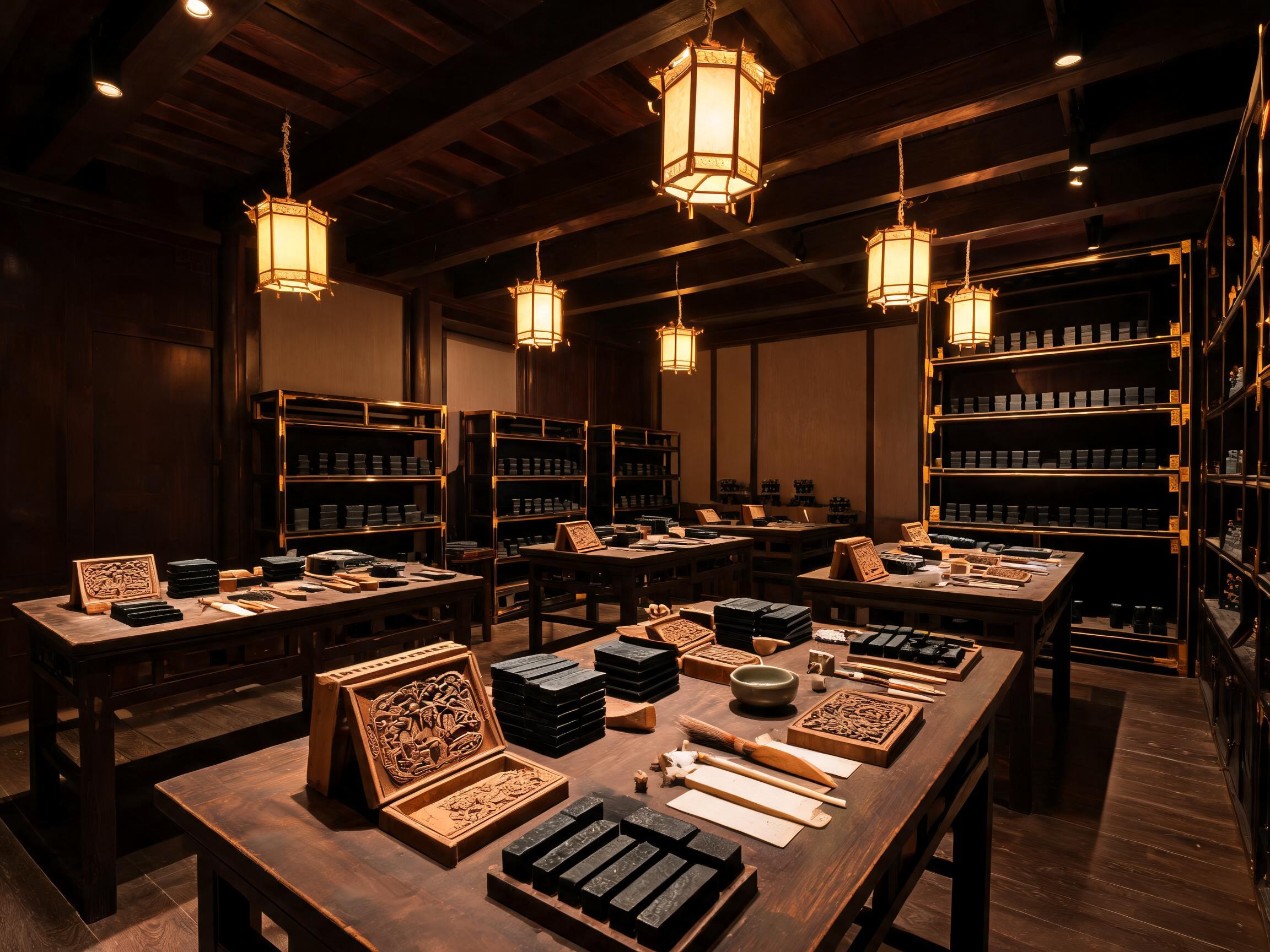
Your supplier can help, too. At Gu Mo Craft Technology (古墨工艺品), founded in 2011, every ink stick, inkstone, and brush is checked by experienced craftspeople at each stage—from soot refining and binder blending to mold pressing and shade drying. But once the goods leave the factory, the conditions they meet are in your hands. The company's export-ready packing is designed to protect items in transit, but long-term warehousing is your responsibility.
Ink sticks: protecting the binder and polish
Ink sticks are made by refining soot, mixing it with a natural binder, hammering the mixture, and pressing it into a mold. The result is a solid stick that is ground against an inkstone with water to produce ink. The surface is often polished to a smooth finish, as with the Oil Soot Hui Ink Stick Classic, which comes in weights from 30g to 150g per stick.
Key risks
- Moisture: High humidity can soften the binder, causing the stick to bend, stick to packaging, or grow mold. Low humidity can dry it out, leading to cracks.
- Light: Prolonged direct sunlight can fade the surface polish and alter the color of the ink stick.
- Odors: Ink sticks can absorb strong smells from nearby chemicals or even from certain plastics in packaging.
Storage principles
- Keep ink sticks in their original packaging until you are ready to repack for a customer. The packaging is designed to protect the surface finish.
- Store them in a cool, dry place away from direct sunlight. A cupboard or shelf in an air-conditioned room is better than a warehouse with large temperature swings.
- If you need to store them loosely, wrap each stick in acid-free tissue paper or a soft cloth. Do not use plastic bags that trap moisture.
- Keep them away from strong-smelling products like paint, solvents, or perfumes.
If you are buying in bulk, check the batch consistency. The Oil Soot Hui Ink Stick Classic is known for consistent ink density per batch, which means the sticks in one order should behave the same way. That consistency is only useful if you store them uniformly—don't put half the batch in a humid corner and half in a dry cabinet.
Inkstones: guarding the grinding surface
An inkstone is a flat stone with a smooth surface used for grinding ink sticks and mixing ink with water. The Classic Duan Inkstone is made from natural Duan stone from the Zhaoqing quarry, hand-polished to reveal its natural pattern. Sizes range from 15cm to 25cm in length.
Key risks
- Impact: Stone can chip or crack if dropped or if heavy items are stacked on top.
- Abrasion: The polished surface can be scratched by grit or by sliding other objects across it.
- Staining: Ink residue or other liquids can stain the stone if left on the surface.
Storage principles
- Store inkstones flat, never on their edge. The grinding surface should face up, but protect it from dust.
- Use the reinforced foam-insert packaging that comes with the Classic Duan Inkstone. If you repack, use a similar protective insert to keep the stone from shifting.
- Do not stack inkstones directly on top of each other unless they are in individual protective boxes. Even with boxes, avoid heavy pressure.
- Keep them in a dry area. While stone is not as sensitive to humidity as wood or bamboo, a very damp environment can promote mold on the box or on any wooden accessories.
- Clean any dust with a soft, dry cloth before storing. Do not use water or solvents.
When you receive a shipment, check for any pre-existing damage. The Classic Duan Inkstone comes with a grain grading certificate per shipment, so you can verify that the stones match the documented grade. If you offer custom engraving, ensure that engraved stones are stored separately from plain ones to avoid confusion.
Brushes: keeping the hair and handle intact
Calligraphy brushes are the most delicate of the three. The Mixed Hair Combination Brush has a 70% goat and 30% wolf hair blend, a lacquered bamboo handle, and a total length of 24cm. The hair is layered and bound for uniformity, and the handle is finished with lacquer.
Key risks
- Humidity: Moisture can cause the bamboo handle to warp or crack, and it can weaken the glue that holds the hair.
- Pests: Animal hair can attract insects, especially in warm climates. Moths or beetles can damage the hair irreparably.
- Deformation: If brushes are stored with the tip bent or under pressure, the hair will not spring back to its original shape.
Storage principles
- Store brushes upright with the tip facing up, or flat with the tip supported. Never rest the brush on its tip.
- Keep the original protective cap or tube on the tip if the brush came with one. If not, wrap the tip in tissue paper.
- Store in a dry, well-ventilated area. Avoid airtight containers that trap moisture.
- If you store brushes for a long time, check them periodically for signs of insects or mold.
- Do not store brushes near heat sources, which can dry out the bamboo and make it brittle.
The lacquered bamboo handle is durable, but lacquer can be scratched by rough handling. Keep brushes in a tray or box with dividers so they don't knock against each other during storage or transport.
Storage risks by climate
Your warehouse's climate has a direct impact on how you should store these items. The table below summarizes the main risks and the principles to apply. These are general guidelines, not precise thresholds—confirm specific conditions with your supplier if you operate in an extreme climate.
| Climate | Main risks | Storage principles |
|---|---|---|
| Humid tropical (e.g., Southeast Asia, parts of Africa, coastal China) | Mold on ink sticks and brush handles; softening of binder; warping of bamboo; insect activity | Use dehumidifiers or silica gel in storage areas; keep items in sealed packaging; avoid storing directly on concrete floors; ensure air circulation |
| Hot and dry (e.g., Middle East, Central-Eastern Europe in summer, inland Africa) | Cracking of ink sticks due to dryness; brittleness of bamboo handles; drying of glue in brushes | Maintain moderate humidity with humidifiers if needed; keep items away from direct sunlight and heat vents; consider storing in cabinets rather than open shelves |
| Temperate (e.g., Japan, Korea, parts of Europe above 30°N) | Seasonal changes can cause condensation; temperature swings can stress materials | Store in a stable environment; avoid attics or basements with large temperature swings; check stock at season changes |
| Cold (e.g., Northern Europe, Canada in winter) | Brittleness of materials if frozen; condensation when brought into warm rooms | Keep storage areas heated or insulated; allow items to warm up gradually before opening packaging |
For gift or collector-grade stock, pay extra attention to packaging. A dented box or a scratched surface can reduce the perceived value, even if the item itself is fine. For religious or ceremonial venues, where items may be used during rituals, the appearance is often as important as function—protect it accordingly.
What to inspect when stock arrives
When you receive a shipment from your supplier, a quick inspection can catch problems before they spread. Gu Mo Craft Technology provides batch-level QC photo reports for ink sticks, grain grading certificates for inkstones, and blend ratio documentation for brushes, so you have a baseline to compare against.
Ink sticks
- Check for cracks, chips, or bends in the sticks.
- Look for any signs of mold or discoloration on the surface.
- Verify the weight matches the order (e.g., 30g to 150g per stick).
- If the surface is polished, check for scratches or dull patches.
Inkstones
- Check for chips, cracks, or fractures, especially on the edges.
- Examine the grinding surface for scratches or uneven wear.
- Verify the length matches the order (15cm to 25cm).
- Confirm the grain pattern matches the grading certificate.
Brushes
- Check the tip shape—it should be pointed and even.
- Look for any loose hairs or gaps in the binding.
- Inspect the handle for warping, cracks, or lacquer damage.
- Verify the overall length (24cm for the Mixed Hair Combination Brush).
If you find damage, document it with photos and contact your supplier immediately. Most issues are caused by transit, not manufacturing, but a good supplier will work with you to resolve them.
Repacking and handling for onward shipment
When it's time to ship to your retail customers, repacking is a critical step. The way you handle items during repacking can undo all the care taken in storage.
General repacking rules
- Work on a clean, dry table. Avoid eating or drinking near the packing area.
- Use clean, dry hands or wear cotton gloves, especially for inkstones and brushes.
- Use the original packaging if possible. Gu Mo's export-ready packing includes carton marks and shipment documentation, so you can reuse it for onward shipping if it's still in good condition.
- If you create your own packaging, use materials that are acid-free and moisture-resistant. Avoid recycled paper that may contain acids that can damage the items.
- For inkstones, use foam inserts or bubble wrap to immobilize the stone. Do not let it slide around in the box.
- For brushes, wrap the tip in tissue paper and secure it with a band or string. Do not bend the handle.
- For ink sticks, wrap each stick individually to prevent them from rubbing against each other.
Handling during repacking
Lift inkstones with two hands, supporting the bottom. Never hold them by the edge. For brushes, hold them by the handle, not the tip. For ink sticks, handle them gently—they can be brittle if the climate is dry.
If you offer custom labeling or gift boxing, do this at repacking time, not at receipt. This avoids double handling and reduces the risk of damage.
FAQ
How long can I store ink sticks before they go bad?
There is no single shelf life for ink sticks—it depends on the binder, the climate, and the storage conditions. In a stable, dry environment, they can last for years. The key is to keep them away from extreme humidity and temperature swings. If you are planning to hold stock for a long time, check with your supplier for specific recommendations for the product line you purchase.
How should I hold a calligraphy brush when testing it?
When you or your retail customers test a brush, hold it gently at the middle of the handle, not too close to the tip. This gives you control without putting pressure on the delicate hair bundle. For storage, always keep the brush tip protected.
What is an inkstone used for?
An inkstone is a flat stone surface used to grind an ink stick with water to produce liquid ink. It is an essential tool in traditional Chinese calligraphy and painting. For collectors, the stone's natural pattern and quality are as important as its function.
What is an inkstone made of?
Traditional inkstones are made from natural stone, with different quarries known for different qualities. For example, the Classic Duan Inkstone is made from Duan stone from the Zhaoqing quarry. Other types include She inkstones, which are also prized. The stone is hand-polished to create a smooth grinding surface.
Can I store inkstones outdoors or in a shed?
No. Outdoors or in an uninsulated shed, the temperature and humidity fluctuate too much, which can lead to cracking or mold. Store them indoors in a stable environment.
Should I oil the inkstone before storage?
No. Do not apply oil or any treatment to the stone. The polished surface is ready to use as-is. Oil can leave a residue that affects ink grinding. Simply keep it clean and dry.
How do I know if a brush has been damaged by storage?
Look for a misshapen tip, loose hairs, or a handle that feels warped. If the tip does not come to a point when you gently wet it and let it dry, the brush may have been stored under pressure. Check the blend ratio documentation to ensure the brush is as specified.
Final checklist for distributors
Before you store or ship any of these items, run through this quick list:
- Store in a cool, dry, stable environment away from direct sunlight.
- Keep items in their original packaging until repacking.
- Protect ink sticks from moisture and odors; wrap individually if loose.
- Store inkstones flat, with the grinding surface protected.
- Store brushes with the tip protected, never resting on the tip.
- Inspect every shipment on receipt and document any damage.
- Repack carefully using clean, dry materials.
- Confirm specific storage conditions with your supplier for your climate.
By following these principles, you can keep your inventory in sellable condition, reduce returns, and build trust with your customers—whether they are individual artists, gift shops, or religious institutions. If you have specific questions about storing a particular product line, contact your supplier with the product name and your warehouse conditions. They will be able to advise you on the best approach.
For more information on the products mentioned in this guide, explore the Premium Pine Soot Hui Ink Stick, the She Inkstone Premium, or the Premium Wolf Hair Calligraphy Brush.