
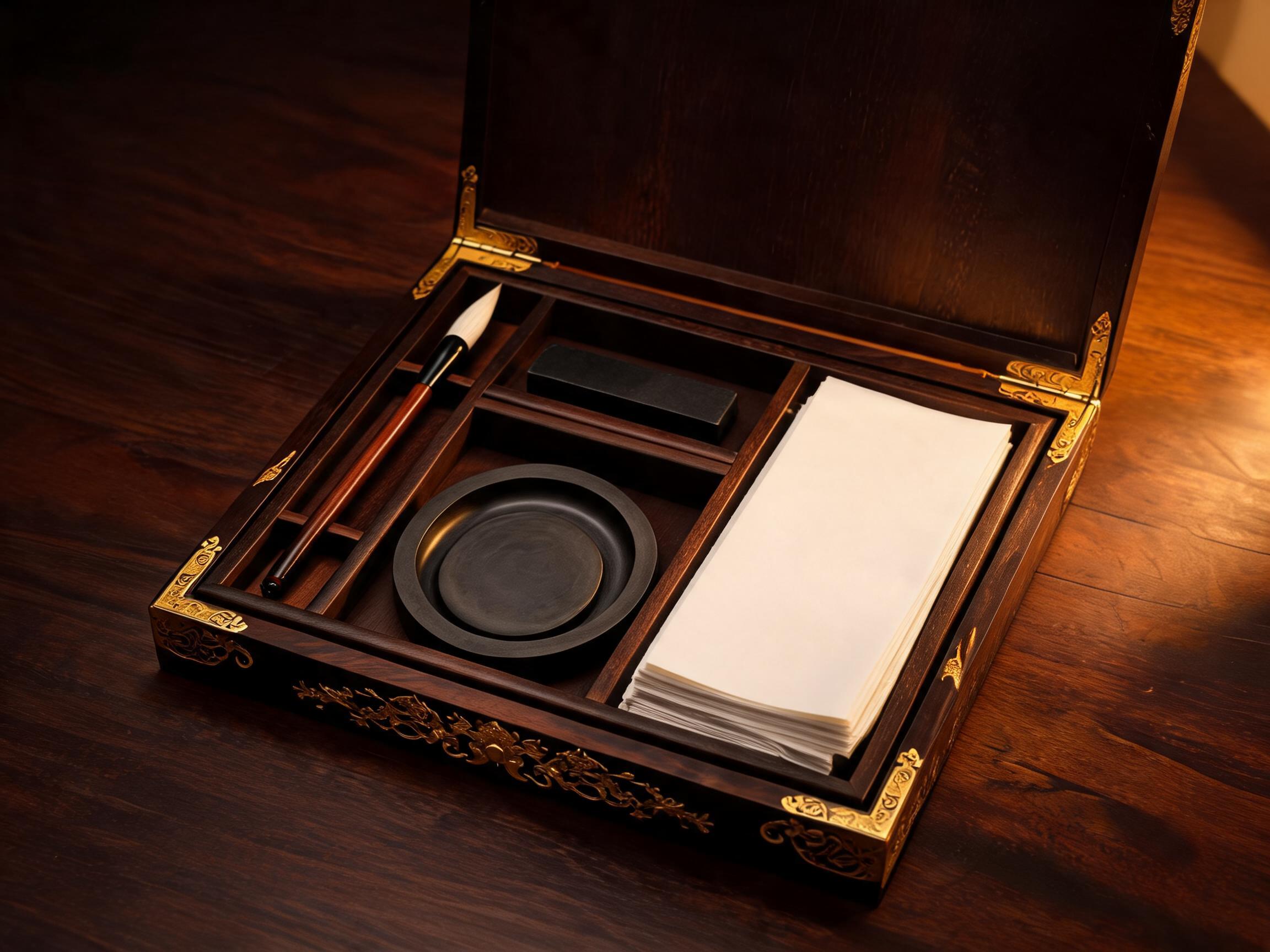
A component-by-component buying guide for importers sourcing traditional Chinese calligraphy sets. Learn what to check in the brush, ink, paper and inkstone, and which component drives perceived value in gift versus retail channels.
Searching for the "four treasures of calligraphy" almost always ends the same way: you get the names, brush–ink–paper–inkstone, and nothing you can put into a supplier brief. For an importer building a gift line or a cultural-gift retail range, the useful question is not what the four treasures are, but how to judge each one when it arrives inside a single boxed set. This guide works through the set component by component, in the order they matter to a buying decision.
Key takeaways for buyers
- A complete set is judged as a whole, but each of the four treasures is checked on its own terms.
- Gift-channel buyers should weight the inkstone and presentation box; retail buyers should weight the brush and paper.
- Customisation lives mainly in the ink stick pattern and the packaging, not in the working components.
- Ask for component-level detail before you compare set prices, or you will be comparing boxes, not goods.
- Sample a boxed set in the hand before you commit a programme to it.
Why the four treasures are bought as one set
The four treasures are brush (bi), ink (mo), paper (zhi) and inkstone (yan). They exist as a set because the practice requires all four at the same time, and because a presentation box turns four separate objects into one giftable unit. That is exactly why the phrase carries commercial weight for importers: it describes a finished, self-contained product rather than a component you have to assemble across suppliers.
For B2B sourcing, the set also creates a trap. A box can look complete and balanced while one component is doing almost all of the perceived-value work and another is effectively filler. The 4 treasures of Chinese calligraphy, evaluated properly, means evaluating the four parts separately before you accept the set as a whole.
The brush: the component buyers touch first
The brush is the most tactile item in the box and the one a buyer's customer is most likely to pick up before reading anything. For retail channels it is often the component that decides whether a set feels like a tool or a token.
What to check
- Tip shape and spring. The tip should come to a defined point and return to that point after being pressed. A tip that splays and stays splayed reads as low quality even in a photograph.
- Hair binding. The join between the hairs and the shaft should be tight and clean. Loose hairs at the collar are the most common complaint on handled samples.
- Shaft finish and balance. Check the ferrule fit and how the brush sits in the hand. Balance matters more than length for perceived quality.
- Protection in transit. A brush shipped with a cap or sleeve arrives as a gift; one shipped bare arrives as a risk.
Ask your supplier to describe the brush as a product on its own, not as "included". If a set is sold on brush quality, the brush specification should be able to carry that claim.
The ink: where customisation actually lives
In a set, ink usually takes the form of an ink stick, and the ink stick is the component most open to customisation. A branded pattern on the stick is one of the few places in a traditional set where an event logo, a theme or a programme identity can be carried without disturbing the function of the objects.
This is why ink deserves its own line in your brief rather than being treated as an accessory. It is the component that can make a set bespoke.
What to check
- Stick form. Confirm the shape, moulding and surface decoration, and whether a custom pattern can be applied to the face or the edge.
- Presentation inside the box. The stick should sit in a fitted recess, not rattle. Movement during shipping marks the stick and dulls the whole set.
- Pairing with the inkstone. The two are used together; a stick that is visibly mismatched in scale to the stone makes the set feel assembled rather than designed.
For cultural exhibitions and corporate event programmes, customisation of the ink stick pattern and the packaging is typically the practical lever. Our Custom-Themed Scholar Desk Set is built around that idea: event-specific packaging and branded ink stick patterns for exhibition and event use.
The paper: volume, protection and the gift impression
Paper is the least glamorous component and the easiest to under-specify. It is also the one a buyer's customer will use up, which changes how it should be judged in a repeat-purchase channel.
What to check
- Consistency of the sheet. Look for even texture and an absence of visible flaws across the stack, not just in the top sheet.
- Stack presentation. Loose sheets in a box shift and crease. Folded, banded or folder-held sheets survive transport and photograph better.
- Fit with the box. The paper should occupy its compartment without pressing against the inkstone or brush.
- Replenishment realism. If the set is for regular practice, paper is the component your customer will ask for again. Treat it as a consumable line, not a one-off insert.
Xuan paper is the standard reference for calligraphy sets, and it appears in complete boxed sets such as our Complete Scholar Desk Set, which brings ink stick, inkstone, brush and Xuan paper together in a custom presentation box.
The inkstone: the weight behind perceived value
Ask which component most often decides whether a gift set feels expensive, and the answer in gift channels is usually the inkstone. It has mass, it has a worked surface, and it is the component a recipient is most likely to keep on a desk after the paper is gone.
What to check
- Surface and grinding feel. The grinding face should be even and flat, with no obvious pits or tool marks that would interrupt use.
- Form and edges. Clean, deliberate edges read as craft; chipped or unfaced edges read as seconds.
- Seating in the box. A stone is heavy. Check the recess depth and any cushioning, and ask how the set is protected against the stone moving in transit.
- Visual match with the set. Tone and proportion against the brush and ink stick matter more than any single feature, because the buyer sees the box open, not the stone alone.
Because the stone carries so much of the perceived weight, it is the component where downgrading to hit a price point is most visible. If a gift programme needs to look substantial, protect this item first and adjust elsewhere.
Which component drives value by channel
The same set can be judged differently depending on where it sells. The table below is a starting position for a buying brief, not a rule.
| Component | Gift and corporate channel | Retail and cultural-gift channel | Primary buying question |
|---|---|---|---|
| Brush | Looks good in the box; tip shape photographs well | Decides whether the set is a working tool | Does the tip point and recover? |
| Ink stick | Carries the customisation and branding | Signals authenticity and era of the theme | Can a custom pattern be applied? |
| Paper | Fills the box evenly; often the least examined | Drives repeat purchase | Is the stack protected and consistent? |
| Inkstone | The weight and substance of the gift | Quality signal for serious buyers | Is the grinding face even and the seating secure? |
| Presentation box | Carries the occasion and the brand | Carries shelf presence | Does it protect all four in transit? |
A component checklist to send to suppliers
Before you compare prices, compare specifications. A short, consistent list across quotes will tell you more than any brochure.
- For each of the four treasures, a component description in its own right, not "included".
- The ink stick decoration and whether a custom pattern is possible, with what artwork you must supply.
- How the paper is presented and protected inside the box.
- Inkstone form, grinding surface description, and how the stone is held in place.
- Box construction, lining, branding area and how the closed set is protected for export transit.
- Which components can be changed independently without re-tooling the whole set.
Where a detail is not confirmed, keep it as an open question in the brief rather than assuming a default. A supplier that can answer these per component is a supplier you can brief again for the next programme.
Customisation: what to ask for and what not to assume
Custom work in this category concentrates in the packaging and the ink stick pattern. Beyond that, availability depends on the individual item and the specific request — for example, whether a particular brush or inkstone form can be adjusted for a programme. Treat those as questions to confirm per project rather than as standing options. For event-specific packaging and branded ink stick patterns, the Custom-Themed Scholar Desk Set is the relevant reference point; for a ready-made complete configuration, the Complete Scholar Desk Set shows how the four treasures are combined in a presentation box.
FAQ
Are the four treasures always sold together?
They are commonly boxed as a set for gifting and cultural retail, and the set is what most overseas buyers source. Components can also be considered individually, but the boxed configuration is what makes them a finished product.
Which component should I upgrade first?
For gift and corporate programmes the inkstone, because it carries the sense of substance. For retail channels serving practitioners, the brush and the paper, because those decide whether the set is used and reordered.
Can the ink stick be branded?
The ink stick pattern is one of the recognised customisation points, along with packaging. Confirm the artwork requirements and the pattern possibilities for your specific programme with the supplier.
What should I inspect on a physical sample?
Open the box and check each component in place: brush tip recovery, hair binding, stick seating, sheet condition and stone seating. Then close it, turn it over, and see whether anything shifts. Transit movement is the most common problem a boxed set develops.
How do I compare quotes fairly?
Ask every supplier for the same component-level breakdown and the same box description. Quotes built on different levels of component detail are not comparable, whatever the headline figure suggests.
Next step
If you are sourcing a complete set for a gift programme, an exhibition or a cultural retail range, send a component-level brief rather than a picture: what the set is for, which components you intend to customise, and how the boxed set must survive export transit. That detail is what allows a supplier to quote the set you actually want. Review the Complete Scholar Desk Set as a starting configuration, or the Custom-Themed Scholar Desk Set if your programme needs event-specific packaging and branded ink stick patterns, and raise any component questions before you place the brief.