
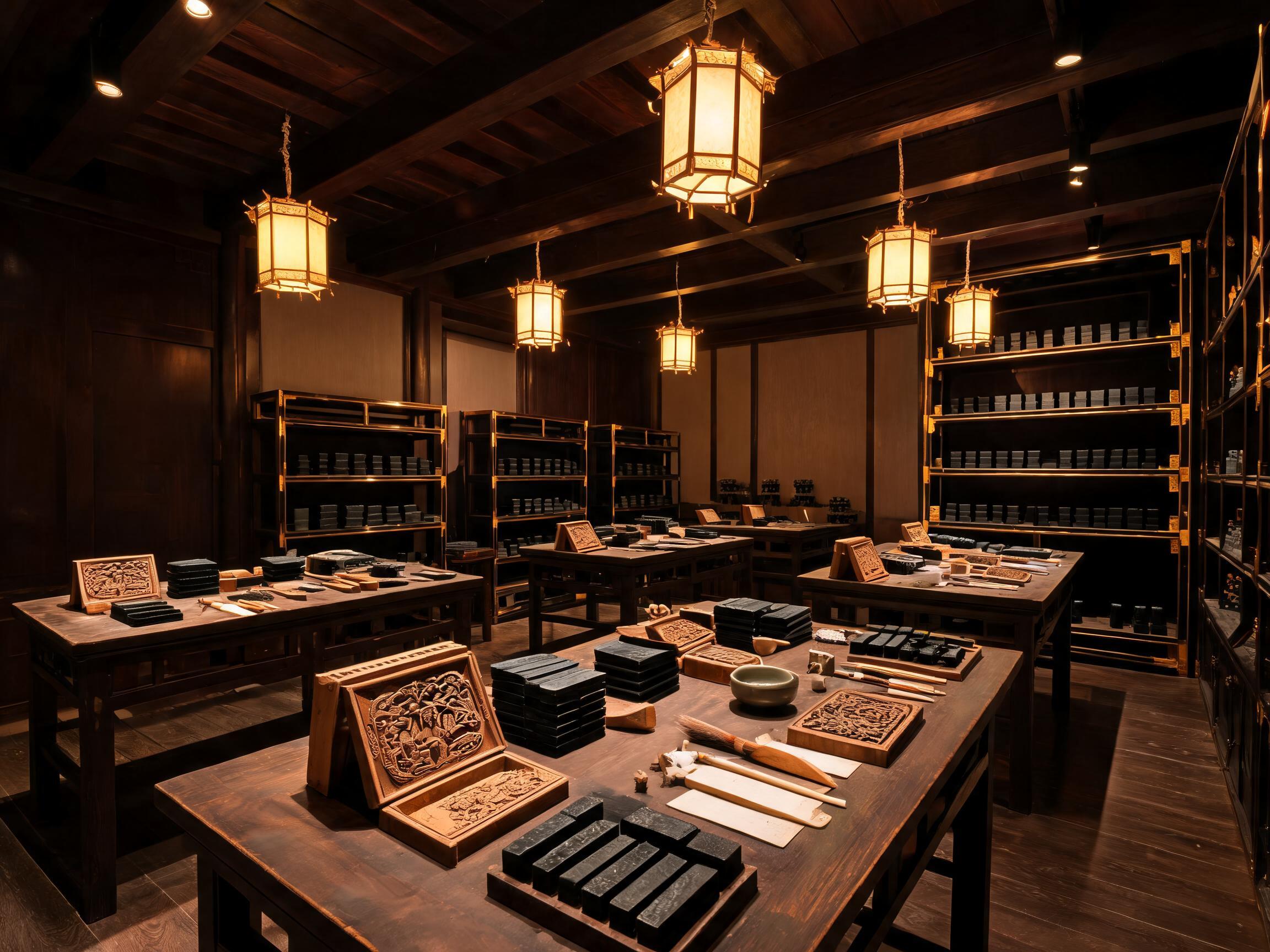
A program-level guide for B2B buyers sourcing Chinese calligraphy ink in bulk. Learn how to match liquid ink grades, bottle formats and bulk packing to three buyer programs — gift-box assortments, collector lines and temple/ceremonial supply. Includes a specification checklist to confirm with your supplier before ordering.
B2B Sourcing Guide · Chinese Calligraphy Ink
Buyers sourcing Chinese calligraphy ink in bulk usually arrive with one of three programs in mind: a gift-box assortment that has to look complete on a retail shelf, a collector line where the bottle and the ink both matter, or a recurring supply for temples and ceremonial venues that needs dependable repeat orders. Each program pulls the same product category in a different direction. The variable that decides reorder rates is seldom the ink itself — it is whether the format, grade and packing match the program you actually run.
This guide organizes liquid calligraphy ink choices by buyer program. It covers grade tiering (student, standard, premium), bottled versus bulk packing, and the specification points you should confirm with a supplier before placing a program order. It does not cover ink composition or shelf-life testing, which are treated elsewhere.
Key takeaways
- Match the ink grade to the end user, not to your own price target. Gift buyers and collectors judge the bottle and the finish; temple supply judges consistency across repeat orders.
- Bottled and bulk formats are not interchangeable. Bottled suits retail and gift programs; bulk suits refill, institutional and re-packaging programs.
- Confirm pour behavior, dry finish and packaging format per model with the supplier before you commit. These are the specifications that cause returns when they are assumed rather than verified.
- Vermilion paste belongs in ceremonial and seal-stamping programs, not in writing-ink assortments.
Three buyer programs, three different ink strategies
The same keyword search — Chinese calligraphy ink, bulk supply — hides three purchasing logics. Sorting your order by program first prevents the most common mistake in this category: buying one grade for all channels and discounting it into the wrong one.
| Buyer program | Primary decision | Typical format | Program risk if mismatched |
|---|---|---|---|
| Gift-box assortments | Presentation and completeness of the set | Bottled ink, colored sets, vermilion paste for seals | Set looks incomplete; gift buyer cannot retail it as a unit |
| Collector lines | Ink grade and bottle quality | Premium bottled ink, concentrated matte black | Ink underperforms the price point; collectors do not reorder |
| Temple / ceremonial supply | Repeat-order consistency and volume | Bulk liquid ink, with vermilion paste for ritual use | Batch variation disrupts scheduled ceremonial use |
Gift-box assortments: build the set around the presentation
Gift programs sell a finished object, not a refill. The buyer assembling a gift box is usually a retailer, a cultural-goods distributor, or an operator packaging calligraphy ink alongside brushes and paper for seasonal gifting. The ink's job is to make the set feel deliberate.
Three format decisions drive this program:
- Bottle count and visual balance. A black-only box is functional; a box with black plus colored ink reads as a set. Colored liquid ink sets are the usual way to give a gift box visible range without adding tools.
- Bottle finish. Premium bottle formats carry a gift box; student-format bottles undercut it. Premium bottled calligraphy liquid ink is the natural core of a gift assortment, with a smaller black bottle as the working unit.
- Seal component. If the set includes a seal, vermilion ink paste is a separate purchase line. Vermilion ink paste is used for seal stamping and ceremonial work — it is not a writing ink and should not be listed as one in your program.
OEM customization and gift set design are available for buyers assembling branded assortments, which matters when the box carries your own label rather than a generic one.
Collector lines: grade tiering decides repeat purchase
Collectors and advanced practitioners evaluate ink on how it behaves in use — how it flows from the brush, how it sits on paper, and how the dried stroke reads. That makes grade tiering the central specification in this program, not packaging alone.
A workable collector line typically tiers into at least two levels:
| Tier | Buyer intent | Product family | What to confirm with supplier |
|---|---|---|---|
| Student / practice | Volume practice, classroom or beginner use | Student-grade liquid ink | Pour behavior and whether the format suits high-turnover practice |
| Standard / premium writing | Regular brush work, gifted to advanced users | Premium bottled calligraphy liquid ink | Bottle format, ink finish, and how the grade compares across the line |
| Specialist finish | Calligraphy where a matte, dense dried stroke is wanted | Concentrated matte black liquid ink | Concentration handling and how it is diluted or used at the brush |
The tiering does two things for a collector program. It gives your buyers a reason to step up from one grade to the next, and it gives your own inventory a clearer logic — a premium bottle is not competing with a student bottle once the tiers are explicit.
Within a collector line, confirm per model how the ink behaves when it is diluted, and whether the bottle closure is intended for repeated opening or single-use pouring. These are format questions, and they are answered by the supplier's model-level specification rather than by the category as a whole.
Temple and ceremonial supply: consistency across repeat orders
Temples and ceremonial venues buy differently from retailers. Their usage is scheduled, often tied to festivals or regular ritual practice, and the people using the ink are not choosing between grades — they need the same result each time. This makes repeat-order consistency the program's core requirement, ahead of presentation.
Two product lines carry most of this demand:
- Bulk calligraphy liquid ink — the working supply for venues that use ink in volume. Bulk calligraphy liquid ink is the format to discuss when the buying unit is a recurring institutional order rather than a retail pack.
- Vermilion ink paste — used for seal stamping and ceremonial applications. It is a distinct line from writing ink and should be ordered and stocked as such.
For a temple program, the practical questions are about continuity: can the supplier hold the same model across repeat orders, and what does the buyer need to specify so that a reorder matches the first delivery? Ask the supplier to state the model reference you should quote on reorders, and keep that reference on your own purchase records. This is a process point, not a product claim — it is the buyer's own protection against drift between shipments.
Bottled versus bulk packing: choosing by program, not by price
Bottled and bulk formats solve different problems, and the choice follows your sales channel more than your margin target.
- Bottled suits retail, gift boxes and collector lines, where the bottle is part of what the end buyer sees.
- Bulk suits institutional and ceremonial programs, refill operations, and buyers who repackage under their own label.
A frequent sourcing error is ordering bulk to service a retail program and then repacking without a consistent bottle. The ink survives; the shelf presentation does not. Decide the packing format by how the ink leaves your warehouse, not by how it arrives at it.
If your program needs a specific bottle, closure or pack count, OEM customization and bulk export service are the conversation to have with the supplier at the quotation stage — not after the order is placed.
Specification checklist: what to confirm before ordering
The specifications below are the ones that most often sit unresolved until a problem appears. None of them should be assumed from the category; each should be confirmed per model with the supplier.
- Grade and intended user. Student, standard or premium — and which tier your buyer program actually serves.
- Format. Bottled or bulk; if bottled, the bottle format and closure type.
- Finish and behavior. How the ink pours, and how the dried stroke reads, for the specific model you are quoting.
- Colored range. If your program includes color, confirm the colors included in the set rather than assuming a standard palette.
- Seal and ceremonial lines. Confirm vermilion paste separately from writing ink, including its intended use in your program.
- Packing and labeling. Pack count, label language, and whether branding is applied by the supplier.
- Reorder reference. The model identifier to quote on repeat orders so a later shipment matches the first.
Matching programs to the ink line
| Your program | Core ink | Supporting lines |
|---|---|---|
| Gift-box assortment | Premium bottled black | Colored liquid ink set; vermilion paste if a seal is included |
| Collector line | Premium bottled; concentrated matte black | Student-grade as an entry tier |
| Temple / ceremonial supply | Bulk liquid ink | Vermilion ink paste for seal and ceremonial use |
The pattern is simple: presentation programs buy bottles, performance programs buy grades, and institutional programs buy consistency. An ink line that serves all three does so by having distinct products for each, not by stretching one product across every channel.
Frequently asked questions
Can one ink grade serve both gift and temple programs?
It can, but the program outcome differs. A gift box needs a bottle the end buyer sees; a temple program needs a format suited to repeated institutional use. Confirm the format against the program before deciding whether one grade is enough.
Is vermilion ink paste the same as red writing ink?
No. Vermilion ink paste is intended for seal stamping and ceremonial use. Keep it as a separate line in your catalog and in your stocking plan.
What should I ask for before confirming a bulk order?
Ask for the model-level specification covering grade, format, finish and packing, plus the model reference to quote on reorders. Reviewing these before the order is placed is the cheapest quality step available to a buyer.
Can the ink be supplied under our own brand?
OEM customization and gift set design are offered, including bulk export service. Discuss label, pack and bottle requirements at the quotation stage so they are built into the order rather than added afterward.
Next step
If you are building or restocking a calligraphy ink program, start by naming the program — gift, collector or temple — and the format that fits it. Then request the model-level specification for the grades you are considering and compare them against the checklist above. Gu Mo Craft Technology produces the liquid ink lines referenced here, including bulk, premium bottled, student-grade, colored set and concentrated matte black, alongside vermilion ink paste, and supports OEM customization and bulk export for program buyers.